
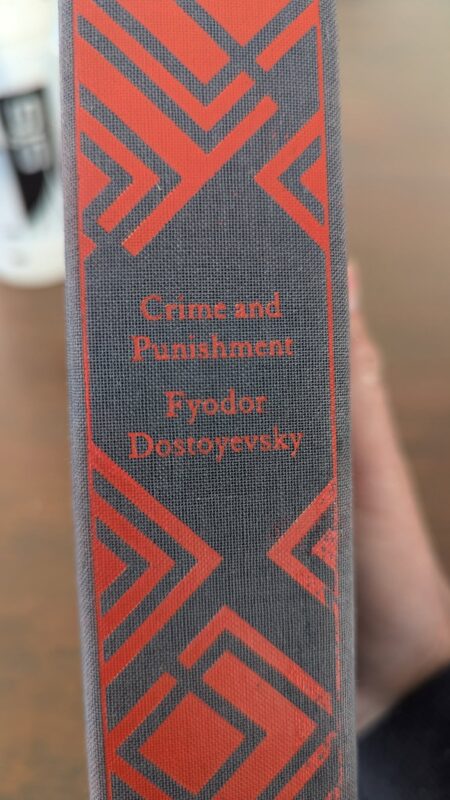


Title: Crime and Punishment
Author: Fyodor Dostoyevsky
Written: 1866
Translator: David Mcduff (1991)
Pages: 671 Pages
Structure: 6 “Parts” and an “Epilogue”, each consisting of up to eight chapters
The Details
I feel dwarfed by this great work.
“Crime and Punishment” by Fyodor Dostoyevsky is full of powerful ideas, and I feel like I have merely scratched the surface, and that I have missed much.
I encountered the word “casuistry” for the first time which means to deceive oneself by clever but flawed moral reasoning.
The protagonist, Raskolnokov uses this self deception to murder a woman who has been exploiting the poor via her pawnbroking business.
He sees himself above the law because he is acting for “the greater good”.
Another character, Marmeladov, remarks “science of our day has actually declared compassion a social evil, and this notion is already being put into practice in England, where they have political economy”
These ideas are alive today.
In my youth, I callously turned my back on those I loved so I could “serve God”. I rationalised heartlessness because it was for a higher cause.
Political animals today decry compassion and “woke-ness” as a weakness, because the strong should not be burdened by the weak.
The author describes Raskolnokov’s descent into moral darkness, and insanity, and his slow transformation back to humanity and compassion through the love of a selfless and caring prostitute, Sonya.
“What should you do?” she cried, jumping up, and her eyes that had been full of tears suddenly began to shine. “Stand up!” (She seized him by the shoulder, he got up, looking at her almost bewildered.) “Go at once, this minute, stand at the crossroads, bow down, first kiss the earth which you have defiled and then bow down to all the world and say to all men aloud, ‘I am a murderer!’ Then God will send you life again. Will you go, will you go?” she asked him, trembling all over, snatching his two hands, squeezing them tight in hers and gazing at him with eyes full of fire.
He was amazed at her sudden ecstasy.
“You mean Siberia, Sonia? I must give myself up?” he asked gloomily.
“Suffer and atone for your sin by it, that’s what you must do.”
It is a long agonising road, but Raskolnokov slowly realises his error, owns up, and faces the consequences.
This is a great work of literature. I found it hard to read. In places it had me sobbing at the horrible pain in the story. I had to read it slowly. I will probably have to read it again.
But it does reinforce one thing I still firmly believe. To be human is to have compassion.