


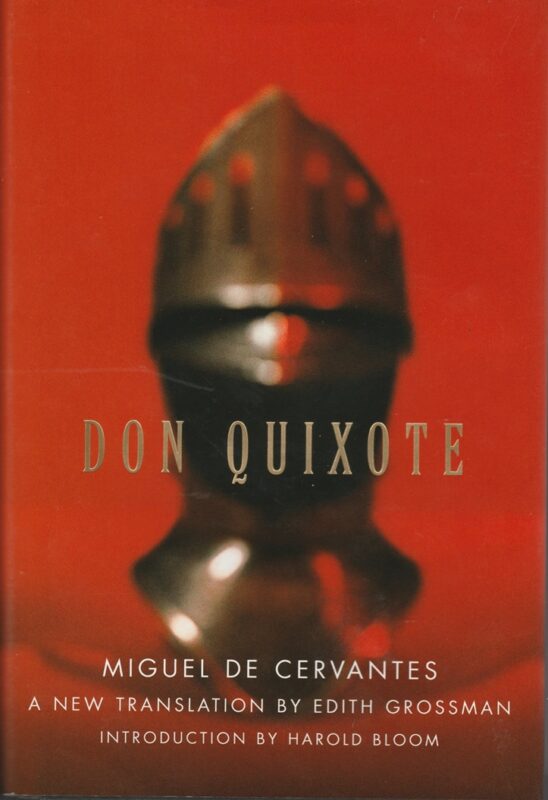
Title: The Ingenious Gentleman Don Quixote of La Mancha
Author: Miguel De Cervantes
Written: 1605, 1615
Translator: Edith Grossman
Pages: 940 Pages
Structure: Two “Parts”. Part 1 (1605): 87 Chapters. Part 2 (1615): 74 Chapters
I was shell-shocked after reading this book. How can something which, on the face of it, is a farcical comedy about the exploits of a mad man have such a huge impact? I sat there for ages afterwards trying to soak in this amazing story and realizing that in the folly of the protagonist I saw myself many times over.
Cervantes tells this story in an ingenious way. Rather than present the story as a narrative about a hero and his deeds, he pretends to have heard about Don Quixote by reading a fictitious book called History of Don Quixote of La Mancha by Cide Hamete Benegeli. Cervantes tells us the story was written in Arabic, and that he needed to pay a Morisco (Moorish convert to Christianity) to translate it for him.
Part of this process involves stories within stories, so we have whole chapters within the book which are novellas and short stories about adventures by other people.
This provides an excellent opportunity for Cervantes to share some of his own personal experiences about serving in the navy, being captured by pirates, being imprisoned on the Barbary Coast, and eventually being ransomed. Cervantes, the narrator, becomes one of the characters in the novel. You can hear his voice, and sense his attitudes, just as clearly as those of Don Quixote and Sancho Panza.
Have you ever believed in something so strongly that it affected the way you saw the world, the way you interpreted events, the way you related to people? Have you ever wanted to re-invent yourself? Have you ever wanted to be a better person?
Once a mediocre middle-aged man named Alonso Quijada read about gallant acts of chivalry in his vast library of books, and decided he wanted to emulate that heroism. But because he read so many books and filled his mind with so many stories, he became mad:
“The truth is that when his mind was completely gone, he had the strangest thought any lunatic in the world ever had, which was that it seemed reasonable and necessary to him, both for the sake of his honor and as a service to the nation, to become a knight errant and travel the world with his armor and his horse to seek adventures and engage in everything he had read that knights errant engaged in, righting all manner of wrongs and, by seizing the opportunity and placing himself in danger and ending those wrongs, winning eternal renown and everlasting fame.”
He re-branded himself “Don Quixote”, dusted off some rusty armour, fitted out his old horse, and set off on an adventure. And on those adventures, the world appeared differently to him. What was an Inn appeared to him as a castle. What were windmills appeared to him as giants. What were flocks of sheep appeared to him as armies.
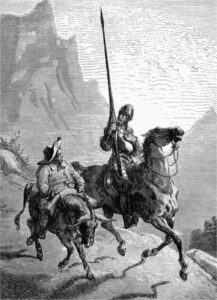
By Gustave Doré
Public Domain.
When confronted by his faithful friend and squire, Sancho, about his view of reality, Don Quixote shows us how and why he could re-cast the world in the way he saw it. Evil magicians were changing the appearance of the world:
“Everything is artifice and mere appearance, devised by the evil magicians who pursue me”
At first I thought “this man is a lunatic”, but then I realised I’ve often done the same thing when I re-interpreted the world around me based on my own interests. Roads and land parcels became for me historic trails and bush tracks where I could ride my bike; news stories became battles between good and evil for the future of humanity; watching an international sports match against another country became a war-like struggle for national pride.
Cervantes shows us that we all have our madnesses. We all see the world, not as it is, but how we are.
“in his imagination he saw what he did not see and what was not there”
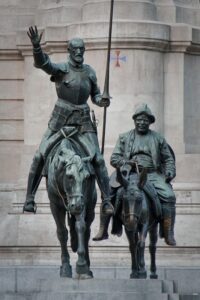
By Random , CC BY-SA 3.0
Despite his unorthodox view of the world, his friend Sancho loves him. People who recognize his insanity humour him and show him respect. They see the goodness in Don Quixote, “The Knight of the Sorrowful Face”.
“there’s nothing of the scoundrel in him; (he’s) as innocent as a baby; he doesn’t know how to harm anybody, he can only do good to everybody, and there’s no malice in him: a child could convince him it’s night in the middle of the day, and because he’s simple I love him with all my heart and couldn’t leave him no matter how many crazy things he does.”
In fact, Don Quixote is aware of the way people see him, but he doesn’t care. The most important thing for him is to do good.
“I always direct my intentions to virtuous ends, which are to do good to all and evil to none; if the man who understands this, and acts on this, and desires this, deserves to be called a fool, then your highnesses, most excellent Duke and Duchess, should say so.”
But not everyone loves Don Quixote, or is gracious about his idiosyncrasies. His niece conspires with some family acquaintances to burn some of the Knight’s books and to deceive him into abandoning his life of chivalry to return to the mundane life of Alonso Quijada.
Sadly, this strategy eventually works, and Don Quixote, due to his own integrity and sense of honor, abandons the chivalric life, suffering from a broken heart, which eventually kills him.
Cervantes allows Don Quixote to die for two reasons. The first was that he loved the character he created, and did not want other writers to hijack the story and use him for their own gain:
“For me alone was Don Quixote born and I for him; he knew how to act, and I to write; the two of us are one.”
The second reason is that Cervantes wanted to show us that we all need a dream-like re-interpretation of the world in order to live. We all yearn for meaning in a meaningless world. We want to do good, and right wrongs. And when we lose that vision, we die.
Don Quixote is one of the greatest books of all time. I love this book. I hope you read it.
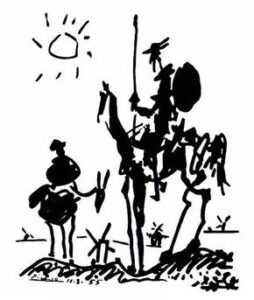
Pablo Picasso
pablopicasso.org
Fair use (Old-50),