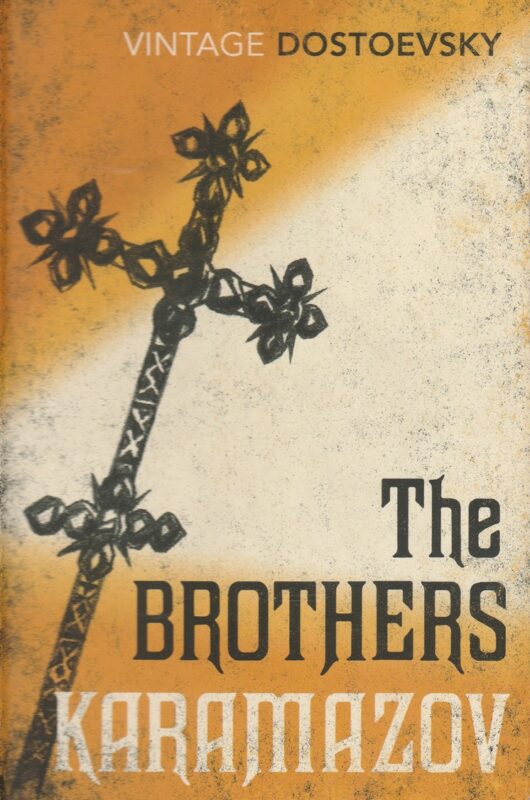


Title: The Brothers Karamazov
Author: Fyodor Dostoyevsky
Written: 1880
Translator: Richard Pevear and Larissa Volokhonsky (1988)
Pages: 796 Pages
Structure: 12 “Books” and an “Epilogue”, each consisting of up to fourteen chapters
After reading this book I feel like I have experienced a moral and spiritual tempest that has left destruction in its wake, and I am forced to ask how we are supposed to live when horrible things happen, innocent people suffer, and there are no clear resolutions to the conflicts that surround us.
At its heart, the book asks “although I may not be to blame for injustice, am I still responsible for it?”
It offers no clear-cut answers, but through different people demonstrates different responses to this question.
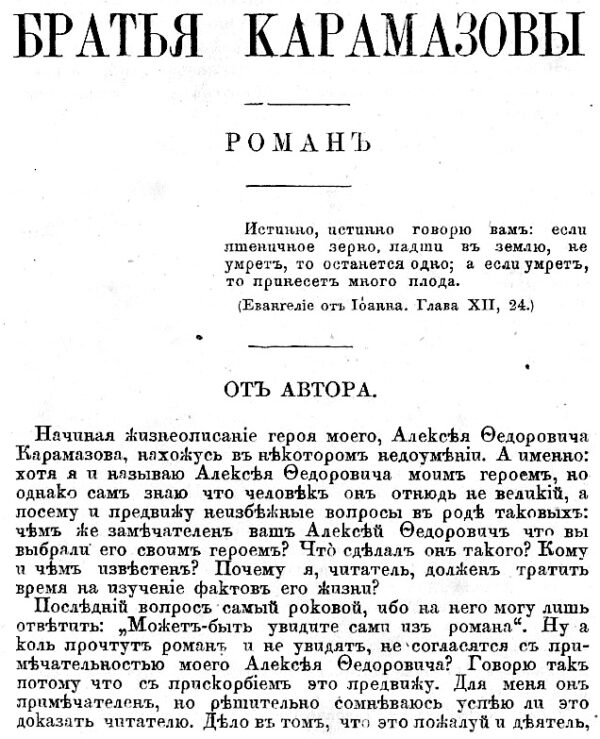
The Brothers Karamzov” is about a father (Fyordor Pavlovich) and his three sons: Dmitri (“Mitya”), Ivan (“Vanya”), and Alexei (“Alyosha”). The father is a contemptible amoral monster who neglects his sons during their childhood, and abuses / manipulates them as young adults.
The three sons develop uniquely. Dmitri is chaotic, sensual and passionate. He eventually goes on trial for a murder he did not commit. Ivan is intellectual and rejects religion. Alyosha is spiritual and compassionate.
Ivan yearns for justice and is outraged at the suffering in the world. How can a just “God” allow it?
“What comfort is it to me that there are none guilty and that cause follows effect simply and directly, and that I know it? – I must have justice, or I will destroy myself. And not justice in some remote infinite time and space, but here on earth, and that I could see myself. I have believed in it. I want to see it, and if I am dead by then, let me rise again, for if it all happens without me, it will be too unfair.”
It is for this reason that Ivan refuses to believe in God. In a long and intense discussion with his monastic brother Alyosha, he uses the example of an innocent child that was recently murdered and whether there could eventually be forgiveness for the murderer.
“Is there in the whole world a being who could and would have the right to forgive? I don’t want harmony, for love of mankind I don’t want it. I want to remain with unrequited suffering I’d rather remain with my unrequited suffering and my unquenched indignation, even if I am wrong. Besides, they have put too high a price on harmony, we can’t afford to pay so much for admission. And therefore I hasten to return my ticket. And it is my duty, if only as an honest man, to return it as far ahead of time as possible. Which is what I am doing. It’s not that I don’t accept God, Alyosha, I just most respectfully return him the ticket”
The “ticket” that Ivan is metaphorically returning is admission to a universe whose final harmony, redemption, and meaning are promised by God. Even if that harmony exists, even if all suffering is eventually justified or redeemed, Ivan refuses to take part in it. While not rejecting God’s existence, he rejects God’s terms. He refuses a world in which innocent suffering is the price of cosmic order. He refuses to participate in that universe, choosing protest over reconciliation. It is Ivan’s way of preserving his conscience, but it also places him outside the shared human task of bearing and responding to suffering.
Alyosha is the opposite. He has spent several years in a monastery under the spiritual guidance of an old priest, Zosima. One of Zosima’s teachings was that “each of us is guilty in everything before everyone.”
“There is only one salvation for you: take yourself up, and make yourself responsible for all the sins of men. For indeed it is so, my friend, and the moment you make yourself sincerely responsible for everything and everyone, you will see at once that it is really so…”
Alyosha’s response to the suffering in the world is to assume responsibility for it and participate. He may not be legally to blame for something, but he is responsible for doing something about it. We see this in his actions towards his brothers, but also in his wider life.
Alyosha intervenes in a conflict between a group of bullying schoolboys and a boy (Ilyusha) whose father was assaulted and humiliated by Alyosha’s brother Dmitri. Over time, and with patience, the group is reconciled because of Alyosha’s actions.
Between these two brothers is Dmitri, a violent and passionate man who breaks off his engagement to Katya so he can be with the woman he loves, Grushenka. Unfortunately Dmitri’s father Fyodor is also smitten with Grushenka, so father and son are rivals for her affections.
Dmitri is penniless because of his own prodigality, and the miserliness of his father. This makes him desperate for money, and over the course of the story we see him descend into madness as he searches for funds that he can use to start a life with Grushenka.
“The vile bog he had gotten stuck in of his own will burdened him too much, and, like a great many men in such cases, he believed most of all in a change of place: if only it weren’t for these people, if only it weren’t for these circumstances, if only one could fly away from this cursed place then everything would be reborn! That was what he believed in and what he longed for.”
We see Dmitri as a lost soul, with no concept of personal responsibility. He sees his circumstances as something foist upon him by others, and that his life will improve only if the circumstances somehow changed. This is a stark contrast with the idea of radical responsibility adopted by his younger brother.
This is a long and difficult book to read, but (like all worthwhile things) it is worth the effort. As we progress through its pages, it feels as though a violent storm is slowly building. There are conflicts which seem unsolvable. There are injustices that can’t be “fixed”.
There is a murder, but we don’t know who committed it.
There is a trial, but we know that even though the evidence is stacked against him, the defendant is innocent.
Ivan, who has chosen to distance himself from the injustices of the world, discovers that his actions and attitudes made it possible for the murder to be committed. He realizes too late that he shares in the responsibility for that act despite not having committed it. This drives him insane.
Dmitri, who is adamant that he did not commit the murder, nevertheless admits his own moral failures, and accepts responsibility for the things he has done.
Alyosha enters this storm with a simple, almost sheltered faith, and emerges changed. The collapse of Elder Zosima’s public sanctity strips away any reliance on signs, authority, or certainty. What remains is Alyosha’s choice to stay engaged with the world as it is. He does not withdraw like Ivan or burn himself out like Dmitri. Instead, he acts responsibly within the imperfections, offering compassion without claiming answers. By the end of the novel, Alyosha represents a fragile hope: not a solution to injustice, but a way of living that refuses to let injustice sever human bonds.
I have previously admitted that I am clueless when it comes to literature. This is nowhere more evident than with “The Brothers Karamazov” – one of the greatest works of literature. There’s no way I can possibly describe it in the way it deserves. It’s beyond me. But I am glad to have read it.
One thing Dostoyevsky says to me is that it’s not enough to feel outraged about injustice. We must be compassionate – and that compassion must reveal itself in actions. Whether we have answers to difficult questions is irrelevant. What matters most is what we do.
“Love in action is a harsh and dreadful thing compared to love in dreams.”