
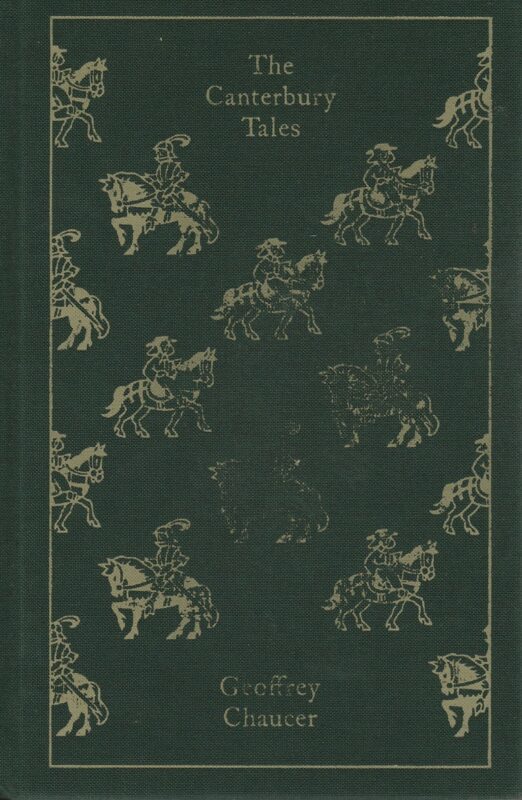


Title: The Canterbury Tales
Author: Geoffrey Chaucer
Written: circa 1380 CE
Translator: Neville Coghill (1951)
Pages: 504 Pages
Structure: A series of 24 “tales”, each with its own prologue
The Details
Chaucer’s “Canterbury Tales” is a delightful book.
Because it was originally written in Middle English, I decided to read a modern translation.
Fourteenth century English is difficult to read unless you have experience with it. Here’s a side-by-side comparison of the opening lines of the book to demonstrate this:
| Whan that Aprill with his shoures soote The droghte of March hath perced to the roote, And bathed every veyne in swich licour Of which vertu engendred is the flour; Whan Zephirus eek with his sweete breeth Inspired hath in every holt and heeth The tendre croppes, and the yonge sonne Hath in the Ram his half cours yronne, And smale foweles maken melodye, That slepen al the nyght with open ye (So priketh hem Nature in hir corages), Thanne longen folk to goon on pilgrimages, |
When in April the sweet showers fall And pierce the drought of March to the root, and all The veins are bathed in liquor of such power As brings about the engendering of the flower, When also Zephyrus with his sweet breath Exhales an air in every grove and heath Upon the tender shoots, and the young sun His half-course in the sign of the Ram has run, And the small fowl are making melody That sleep away the night with open eye (So nature pricks them and their heart engages) Then people long to go on pilgrimages |
I reached the halfway point, and figured I was enjoying it so much I didn’t want it to end, so I started from the beginning again and read it at a slower pace. I didn’t want this book to end.
Things to look out for.
Almost all of the tales are written in Iambic Pentameter. Each line has five “feet” each usually with a stressed and unstressed syllable. Interestingly, the only time Chaucer deviates from this is when he tells his own tale and deliberately makes it look and sound terrible with lines that don’t scan. (You’ve got to admire a writer who mocks himself rather than others).
The thing that makes this book delightful is the way Chaucer tells his tales through the different voices of each character.
The noble Knight tells the tale of Greek heroes Theseus, Arcite and Palamon, and uses grand language to tell a compelling tale of honor, love and fate:
'Alas why is it people so dispraise
God's providence or Fortune and her ways,
That oft and variously in their scheme
Includes far better things than they could dream?
The worldly Miller uses the same form of rhyming couplets to describe something way more bawdy:
She was a fair young wife, her body as slender
As any weasel's, and as soft and tender;
She used to wear a girdle of striped silk;
Her apron was as white as morning milk
Over her loins, all gusseted and pleated.
The Man of Law tells an epic tale, but this type uses a form called “Rhyme Royal” with a rhyming pattern of ABABBCC to spin a story of tragedy and perseverance that leaves the reader stunned:
In that large book that overhangs the earth
 - And people call the heavens, it well may be
That it was written in his stars at birth
Love was to be his death; for certainly
The death of every man is there to see
Patterned in stars clearer than in a glass,
Could one but read how all will come to pass.
This form is used several times throughout the book, but always for sweeping epics of majestic tragedy; never for comedic purposes.
The Wife of Bath was my favourite. This earthy woman tells a tale, but the delight is in her prologue where she tells about the different husbands she has had, and the life she enjoyed with them:
He was, I think, some twenty winters old,
And I was forty then, to tell the truth.
But still, I always had a coltish tooth.
Yes, I'm gap-toothed; it suits me well
I feel, It is the print of Venus and her seal.
So help me God I was a lusty one,
Fair, young and well-to-do, and full of fun!
And truly, as my husbands said to me
I had the finest quoniam that might be.
Imagine a fourteenth century writer giving such unbridled energy, joy of life, and agency!
Her tale is fun as well, recounting how a lecherous knight was rehabilitated by a wise old woman.
Conclusion
Canterbury Tales was written almost 700 years ago, but the people in the stories are like us, warts and all. Lovable, despicable, pitiable… you will definitely read about yourself or someone you know.
There is bawdiness, adventure, heartache, redemption, rivalry, even alchemy.
This is the genius of Chaucer. In his tales he holds a mirror up to the every-day people of the England of his time. And as we read those tales, we realize that people are the same, centuries later.
I love this book, thoroughly recommend it, and will almost certainly read it again.