
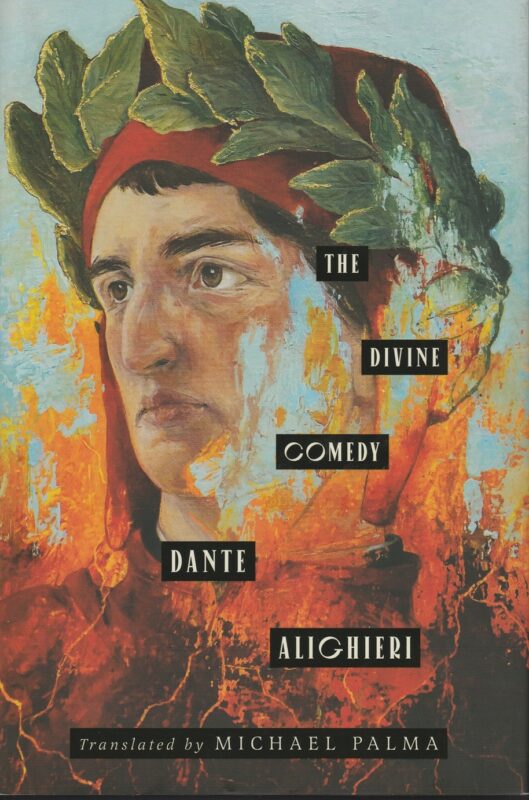


Title: The Divine Comedy
Author: Dante Alighieri
Written: 1308-1321
Translator: Michael Palma (2025)
Pages: 585
Structure: 3 “books”, each consisting of 33 or 34 “cantos”, each about 160 lines long
The Details
Dante’s “Divine Comedy” was one of the most difficult books I have read, but worth the effort.
It’s a 14th century account of one man’s descent to the depths of Hell, and his upward rise to the heights of heaven.
I am not a man of faith, but I enjoyed his story, and admired Dante’s integrity and piety.
It was nice to catch up with Virgil, but quite upsetting to see such legendary characters as Dido, Helen, Ulysses and Jason suffering in Inferno. Something I still think was quite unjust.
Structure
Divine Comedy was originally written in the language of Tuscany, Italy. Because of its popularity, the book shaped the language of the country, and its Tuscan vernacular used by the author ended up becoming the language of Italy, or what we now recognize as Italian.
The original poetry was written in lines of eleven syllables, grouped into stanzas of three lines, where the first and third lines rhymed, and the second line rhymed with the first and third lines of the following stanze. Tecnhnically this is called “Hendecasyllabic Terza Rima”.
The translator used Iambic Penatameter, which is more common with readers of english poetry (e.g. Shakespeare and Chaucer).
The rhyming structure is ABA BCB etc.
“Divine Comedy” is split into three books: Inferno (Hell), Purgatorio (Purgatory), and Paradiso (Heaven).
For example the opening lines of the book:
Midway through our life's journey, I once found
myself in a dark wood, for I had strayed
from the straight pathway to this tangled ground.

How hard it is to tell of, overlaid
with hard and savage growth, so wild and raw
the thought of it still makes me feel afraid.
Each of those books is split into a series of “cantos” or songs. Inferno contains 34 cantos, Purgatorio and Paradiso contain 33 cantos.
Each canto is a poem of about 155 lines.
Thoughts
Many readers unused to epic poetry might ask: What’s it like reading a five-hundred page poem?
I found it unusual to start with, but after a few pages I started not to notice the poetic structure, and read it like I would any other novel.
The language is vivid and stirring. The fact that this is a translation makes this doubly impressive. Not only did Dante craft spectacular imagery, but Palma, the translator has used his bardic skills to translate faithfully while maintaining the poetic beauty. Not only this, he has done it in a way that makes the story reasonably easy to understand for the modern reader.
For example, have a look at this powerful passage spoken by Ulysses, in Inferno, Canto XXVI:
...Think of your birthright. Living like a brute
is not the destiny of men like you,
but knowledge and virtue ever our pursuit.'

With these few words of mine, my shipmates grew
so eager to go on that even I
could not have stopped them had I wanted to.

Setting our stern against the morning sky,
we turned our oars to wings in our mad flight,
gaining always on the left as days flew by.
My favourite quote is from the proud warrior Capaneus in the third circle of Hell. He says “That which I was in life, I am in death”. While the author intended this to demonstrate “just desserts”, it shows me that who we become is its own reward or punishment.
Some parts are particularly difficult, especially when Dante places some of his contemporaries in Hell – people with whom fourteenth century readers would have been familiar, but names unknown to you and me. Thankfully, Palma provides over eighty pages of notes in an appendix, explaining the significance of unfamiliar names and terms.
If you intend to read it, I think it might help to first consume a bit of ancient mythology first (Homer, Virgil, etc). A bit of christian mythology helps to understand it too.
Fun fact: the “Inferno” section was the most satisfying to read. “Paradiso” was heavy going with a lot of pious philosophy, and very little plot.