


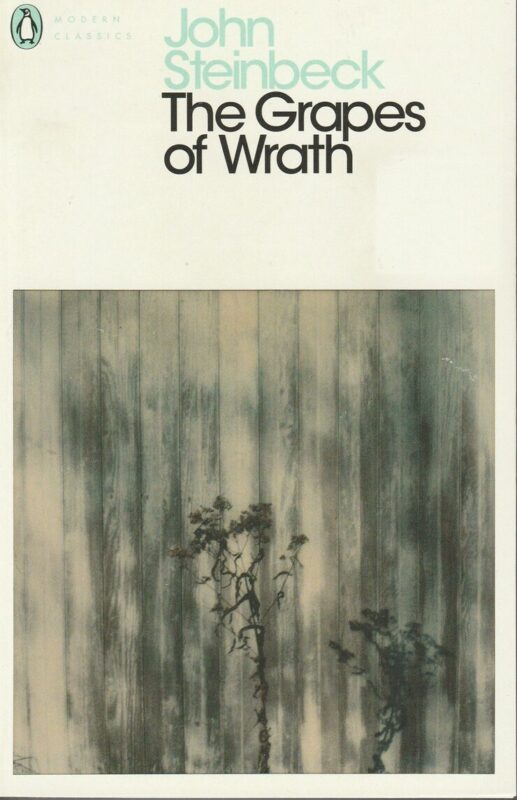
Title: The Grapes of Wrath
Author: John Steinbeck
Written: 1939
Pages: 476 Pages
Structure: 30 Chapters
This is one of the greatest books I have ever read. It’s a powerful masterpiece that made me rethink the meaning of words we use every day such as “justice”, “community” and “compassion”.
The Grapes of Wrath was written by John Steinbeck and published in 1939.
The book’s title comes from “The Battle Hymn of the Republic” – an old American song by Julia Ward Howe about liberation, divine justice, and the fight against slavery, written during the Civil War.
It is set during the Great Depression and follows the Joad family, share croppers, who are evicted by the Bank from their Oklahoma Farm and decide to travel 2,000 miles to California in search of work and a better life.
Thousands of similar families make the long trek west – the large influx of migrants causing fear and then outright hostility among the locals:
They were migrants. And the hostility changed them, welded them, united them-hostility that made the little towns group and arm as though to repel an invader, squads with pick handles, clerks and storekeepers with shotguns, guarding the world against their own people.
In the West there was panic when the migrants multiplied on the highways. Men of property were terrified for their property. Men who had never been hungry saw the eyes of the hungry. Men who had never wanted anything very much saw the flare of want in the eyes of the migrants. And the men of the towns and of the soft suburban country gathered to defend themselves; and they reassured themselves that they were good and the invaders bad, as a man must do before he fights.
The westward exodus is fueled, in part, by unscrupulous employers who advertise for workers, and then use the over-supply of labor to drive down wages:
When there was work for a man, ten men fought for it-fought with a low wage. If that fella’ll work for thirty cents, I’ll work for twenty-five.
If he’ll take twenty-five, I’ll do it for twenty.
No, me, I’m hungry. I’ll work for fifteen. I’ll work for food. The kids. You ought to see them. Little boils, like, comin’ out, an’ they can’t run aroun”. Give ’em some windfall fruit, an’ they bloated up. Me. I’ll work for a little piece of meat.
And this was good, for wages went down and prices stayed up. The great owners were glad and they sent out more handbills to bring more people in. And wages went down and prices stayed up. And pretty soon now we’ll have serfs again.
Against this backdrop of hatred, the Joad family show great kindness to those in need – even when they have nothing themselves.
At the start of their trek, with their truck loaded high with all their worldly possessions, three people up front and eight people sitting in the truck tray atop the mattresses, back-slidden preacher, Jim Casey, asks if he can come along on the trip. Despite there being no room, not much food, and little money, the family kindly agree to let Casey join them.
Later, they encounter the Wilson family in their broken down car, camping by the side of the road, with no food. Tom and Al Joad fix the car, and the Joads invite the Wilsons to join them on the westward journey and share their food.
When cooking a stew in a pot at another camp, Ma Joad notices the crowd of hungry children from other families, gathering around, drawn by the smell of the cooking food. She feeds her family, but leaves enough food in the pot for the hungry children to help themselves.
The irony is that the people with nothing are generous to the point of hurting themselves, while the people with everything are terrified of losing a small part of their immense wealth. Ma Joad puts it clearly when a camp store keeper lends her ten cents for a bag of sugar:
“If you’re in trouble, or hurt, or need — go to poor people. They’re the only ones that’ll help — the only ones.”
It’s impossible to read this book and not feel deeply for the characters. The Joads are decent hardworking people who have suffered greatly through no fault of their own, and who maintain their dignity despite facing immense hostility.
The last scene of the book had me speechless. I won’t spoil it here for those who haven’t read the book, but we witness a overwhelming act of kindness from a young woman who has just faced the unbearable tragedy of the death of her child. How can someone with absolutely nothing show such compassion? Where does that compassion come from?
For me, this story reinforces an important truth. To be truly human is to have compassion.
It is as relevant today as it was when it was written almost ninety years ago.
If you haven’t read a “great” book before, please read “The Grapes of Wrath”. It was worth every second that I spent reading it.