


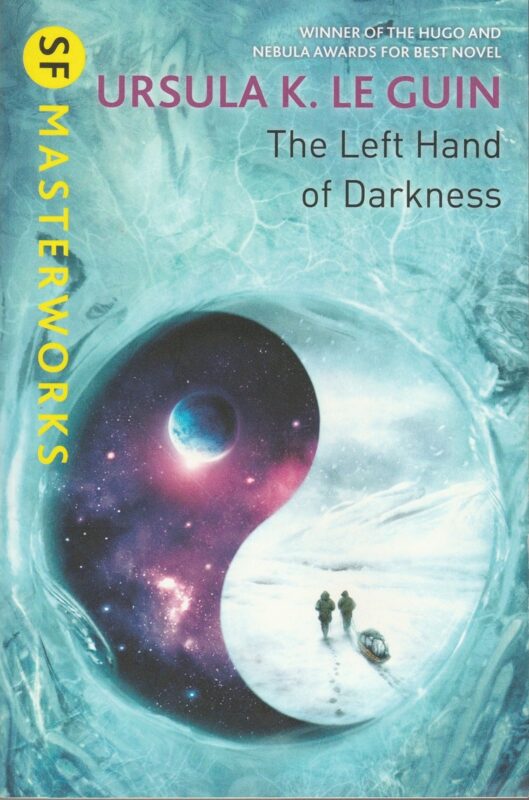
Title: The Left Hand of Darkness
Author: Ursula K. Le Guin
Pages: 304 Pages
Published: 1969
Structure: 20 Chapters and an appendix
“The Left Hand of Darkness” is more than a science fiction novel, it’s a visit to a strange world named Gethen, as seen through the eyes of several different people, and includes excerpts from the mythology and sacred texts of this imaginary planet.
The multiple narrative voices of the book create a fascinating experience. Part of the time we’re seeing Gethen through the eyes of an off-planet visitor, Genly Ai. At other times we experience the story from the perspective of former prime-minister and political fugitive, Therem Estraven. Still again we read extracts from historical field notes, sacred texts, traditional stories, etc. Using such a rich palette of voices, Le Guin achieves an unusual depth of detail in her world building. She doesn’t tell us what it’s like, she reveals it from the perspective of numerous points of view.
The title of the book comes is a quote from “Tormer’s Lay”, a fictional philosophical poem from the sacred texts of the Handdara: “a religion without institution, without priests, without hierarchy, without vows, without creed”.
“Light is the left hand of darkness
and darkness the right hand of light.
Two are one, life and death, lying
together like lovers in kemmer,
like hands joined together,
like the end and the way.”
Le Guin went to a lot of effort to create this mythical world for us to enjoy. She created religions, sacred texts, poetry, history and unusual but strangely familiar political systems. But perhaps this most surprising aspect to the story is the portrayal of gender in the novel.
The inhabitants of Gethen live most of their lives without gender. There are no male / female differences during this time when they’re not interested, indeed not capable of sexual intercourse. The only exception is for four days each month when they randomly assume either male or female characteristics, a time known as “Kemmer”. They have no control over this process. One month they might be male, the next month female. If any of them become pregnant they remain female until the child is born.
This has profound implications on how the Gethenians structure their society. They have a holiday once per month during their Kemmer, and provide special accommodation for people to enjoy that time. But for the rest of their time both gender and sexual attraction are irrelevant. Anyone can become pregnant, so everyone assumes the same level of responsibility about it – not just one gender. Since there’s no physiological difference for most of the time, there is no division into different strong/weak, protective/protected halves. They do not see each other as either men or women. There is no war.
This unusual aspect of the story forces us to think about how fundamental gender and sexuality are in our society, and how much it affects everything we do.
The Gethenian leaders must address a important question. Should life continue as normal, or should they join the wider interplanetary community (Ekumen) offered by off-worlder Genly Ai. Prime Minister Estraven asks Ai, “do you know what patriotism is?”
He replies with something about “love of country” to which Estraven replies:
“No, I don’t mean love, when I say patriotism. I mean fear. The fear of the other. And its expressions are political, not poetical: hate, rivalry, aggression. It grows in us, that fear. It grows in us year by year.”
This attitude towards fear is repeated later by King Argaven XV who says to Ai:
“But I do fear you, Envoy. I fear those who sent you. I fear liars, and I fear tricksters, and worst I fear the bitter truth. And so I rule my country well. Because only fear rules men. Nothing else works. Nothing else lasts long enough.”
This fear eventually turns Ai and Prime Minister Estraven into fugitives, fleeing the fearful but vindictive king, searching for a way to a neighboring country to see if they can convince them to join the Ekumen.
The result is a tale of friendship and difficulty as the two fugitives embark on a dangerous journey through difficult terrain and over large tracts of glacial ice to reach safety. During this time they learn to trust each other, and see the world from the other persons perspective. During this time, Estraven goes through a time of Kemmer, and Ai needs to relate to Estraven not as an asexual man, but (this time) as a woman.
As you can guess, the story isn’t really about politics and strange aliens. It’s about friendship in times of difficulty. Whatever the genre, these stories are wonderful to read, and when endowed with Le Guin’s vivid world-building this becomes a masterpiece.
I deliberately read this book after Lord of the Rings because I want to experience outstanding world-building. When we read a story like this, we’re aware that our experience is of an iceberg, with much of it obscured from immediate view but nonetheless essential to the story.
“The Left Hand of Darkness” was definitely worth my time. I am glad I read it.