


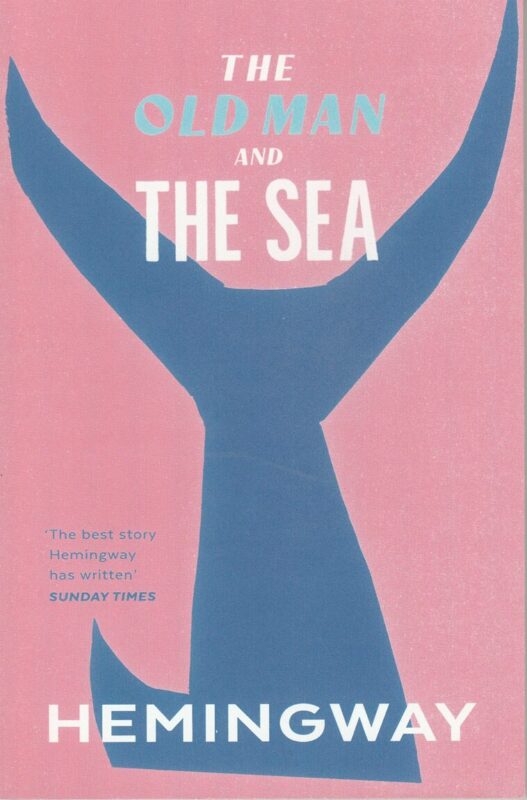
Title: The Old Man and the Sea
Author: Ernest Hemmingway
Written: 1952
Pages: 99 Pages
Structure: No Chapters
How can such a short and simple story about an old man going fishing have so large an impact? Hemmingway’s “Old Man and the Sea” is one of the great stories of the twentieth century, earning the author the Nobel Prize for Literature shortly after it was published.
The protagonist, an old fisherman named Santiago hasn’t caught a fish in over eighty days. The sail on his boat has been patched with flour sacks, and is described as resembling “a flag of permanent defeat”. He is so unlucky, that the parents of his young assistant, Manolin, disallow him from fishing with Santiago because he is “salao” – the worst kind of unlucky.
And so Santiago sets out before sunrise in his little skiff, sailing far offshore, to eventually catch the largest fish of his life, an eighteen foot fifteen hundred pound marlin. Hemmingway’s description of the fish is stunning – and appears in the mind almost in slow motion:
The line rose slowly and steadily and then the surface of the ocean bulged ahead of the boat and the fish came out. He came out unendingly and water pored from his sides. He was bright in the sun and his head and back were dark purple and in the sun the stripes on his sides showed wide and a light lavender. His sword was as long as a baseball bat and tapered like a rapier and he rose his full length from the water and then re-entered it, smoothly, like a diver and the old man saw the great scythe-blade of his tail go under and the line commenced to race out.
The book examines the problem we all face – how do we deal with continuous setbacks? What do we do when our best efforts fail? What remains when success doesn’t come? Why should we persevere?
Santiago fights the giant marlin for over two days. The fishing line cuts his fingers. He runs out of food and water. His boat is towed out of sight of land into the gulf stream by a gigantic fish that is fighting for its life.
And the man does not give up. This is a fight that only one of them can win:
You are killing me, fish, the old man thought. But you have a right to. Never have I seen a greater, or more beautiful, or a calmer or more noble thing than you, brother. Come on and kill me. I do not care who kills who.
At the end of two days, starved and exhausted, the man reels the fish in and delivers the final blow:
He took all his pain and what was left of his strength and his long-gone pride and he put it against the fish’s agony … lifted the harpoon as high as he could and drove it down with all his strength, and more strength he had just summoned, into the fishes side…”
Santiago struggles to secure the fish to the side of his small boat, because it’s too long to fit inside – it’s larger than the boat. He manages this after some difficulty, hoists his sail, and heads towards home. But he is thwarted, because the blood from the kill attracts sharks.
He fights the shark off with his harpoon but not before it takes a bite out of the magnificent fish.
The blood draws in another shark, which Santiago kills, but loses his harpoon in the process.
“But a man is not made for defeat”, he said, “A man can be destroyed but not defeated.”
Santiago is not defeated. Yet more sharks come. The man is forced to make a spear out of a knife tied to the end of an oar, but the knife breaks.
In the end he is reduced to clubbing the sharks as they approach his fish, but the sharks consume his catch, and he’s left with the fish’s head and skeleton
The Old Man is on the Sea alone. There is no one to witness his perseverance, triumph and setbacks. There is no one to talk to. He talks to himself. The ongoing self-dialogue shows us what’s going on in his head. He talks to a bird that alights on the bow of his boat, to the fish he is hunting, to the sharks who eventually devour his catch.
It is in this dialogue that we discover what drives him. He thinks about the great base-baller Joe DiMaggio, about the lions that he saw on a beach when he sailed off the coast of Africa, about luck, about what he should have brought, and about whether God is punishing him for going out so far and hunting such a large fish.
Earlier in the book he tells the boy “I may not be as strong as I think, but I know many tricks and I have resolution.”
I think that’s why Santiago is able to persevere. He is driven by dreams of powerful sportsmen and great hunting beasts. He has a resolve deep down that lets him push on despite the outrageous insults that fortune slings at him, despite his age, despite his poverty.
The book ends with the Old Man sleeping, dreaming about lions, with the boy sitting alongside. He has his dreams and his friendship intact.
He doesn’t get the fish. From many perspectives, he wasn’t successful. But he is unbowed, and that’s what matters.
This book is well worth the read. You can consume the whole thing in just over two hours – and retain all the ideas and images. It shows us what it means to struggle in seemingly impossible situations. I am glad I read it.