


Title: The Plague
Author: Albert Camus
Written: 1947
Translator: Robin Buss, 2001
Pages: 238
Structure: 5 “parts”.
“The Plague” is a beautifully written book which describes an outbreak of Bubonic Plague in the Algerian town of Oran in the 1940’s. But, as with most great books, it’s about much more than that.
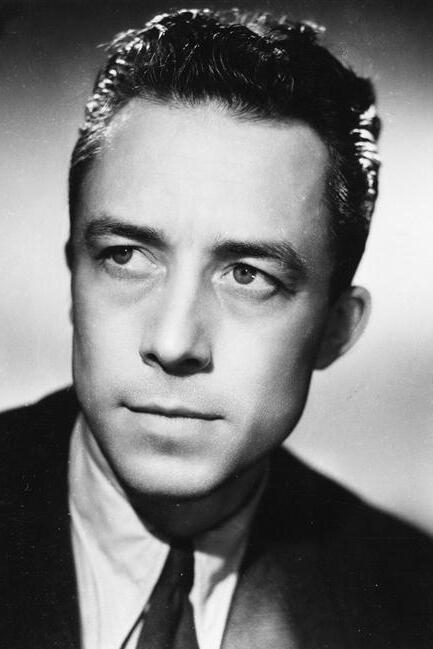
Albert Camus was a French author, philosopher and political activist who joined the French Resistance in the fight against the Nazis in Word War II. He won the Nobel Prize for Literature in 1957 – the second youngest recipient in history. “The Plague” is considered by many to be his greatest work.
While ostensibly about an outbreak of disease and how a town responds, the story is really about us as humans – how precarious our lives are, how powerless we are to defend ourselves against disasters, and how important it is to act with kindness and goodness.
All I say is that on this earth there are pestilences and there are victims – and as far as possible one must refuse to be on the side of the pestilence.
The story describes life in this bland (almost “average”) Algerian coastal town as it faces an epidemic and is placed under quarantine for about a year, while thousands of people die from the disease. The people are unremarkable, and respond as any average town would: first with disbelief and denial, then with grief, and finally with resignation.
The local authorities don’t want to panic the population: “let’s act quickly if you like, but keep quiet about it.” They worry about whether this disease is the plague or not, and how they should refer to it.
But Doctor Bernard Rieux pinpoints the issue precisely: “It doesn’t matter whether you call it plague or growing pains. All that matters is that you stop it killing half the town.”
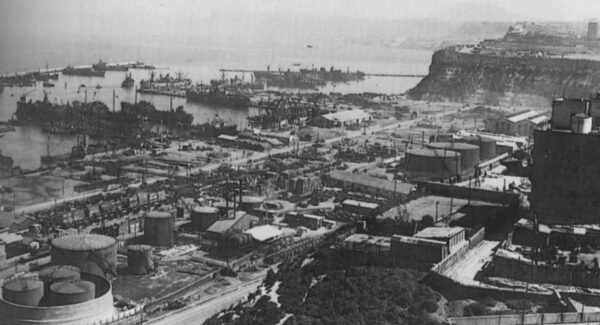
The government places the town under quarantine, and make the disease notifiable. Anyone who has symptoms needs to let the authorities know, and those with the disease must be isolated.
In scenes eerily reminiscent of the COVID-19 outbreak, people are upset about being isolated from the rest of the country, and about the closure of all avenues of transport out of the town. Armed guards patrol all exits.
From that point on, it could be said that the plague became the affair of us all…once the gates were closed, they all noticed that they were in the same boat, including the narrator himself, and that they had to adjust to the fact.
Some people try to rationalize that this disease doesn’t affect them, and that they should be allowed to leave.
In the first hours of the day when the decree took effect, the Prefecture was besieged by a crowd of applicants who, on the phone or face-to-face with the town officials, were all equally interesting and at the same time equally impossible to consider. In truth, it was several days before we realized that we were in an extreme situation and that the words ‘compromise’, ‘favour’ and ‘exception’ no longer had any meaning.
Eventually the people of the town accept the cold fact that the plague is with them, and are resigned to their fate. But this is where something wonderful happens. Instead of withdrawing, some people volunteer to help with the health of the town – at great personal risk to themselves because it increases the chance that they will succumb to the infection.
Camus says something quite counter-intuitive. He says that it’s not his intention to give too much significance to the “heroic” actions of these people because this is from the misplaced assumption that goodness is rarer than it really is, and malice is more common it really is. He makes the point that people are often more good than bad, and that “goodness” or “badness” is not the question.
What mattered more was being informed rather than being ignorant, because it was ignorance that did the most damage, and clear-sightedness that enabled us to do the most good:
But they are more or less ignorant and this is what one calls vice or virtue, the most appalling vice being the ignorance that thinks it knows everything and which consequently authorizes itself to kill. The murderer’s soul is blind, and there is no true goodness or fine love without the greatest possible degree of clear-sightedness.
This is profound, and is echoed in Hannah Arrendt’s observation about the banality of evil – unspeakable crimes can be committed by unremarkable men with clear consciences. Dogma, cowardice and conformity, when combined with ignorance can make good people people do horrendous things. Conversely, the act of being informed, when combined with courage can guide people to do great deeds.
The truth, combined with a courageous heart, changes people. Rambert, an out-of-town journalist, initially tried to circumvent the quarantine. He didn’t live here. This was none of his concern. He just wanted to leave town, and was prepared to break the law to do it. But at the last moment he has a change of heart and decides to volunteer with the health teams:
“I always thought that I was a stranger in this town and had nothing to do with you. But now that I have seen what I have seen, I know that I come from here, whether I like it or not. This business concerns all of us.”
This is where it became clear to me that Camus wasn’t just talking about an epidemic, but about all the uninvited sorrows that visit us as humans. We are powerless to stop things like war, plague, oppression, and famine. They visit us all from time to time whether we like it or not. As individuals we can’t prevent them. But we all “come from here”. This business concerns all of us.
Towards the end of the story, the plague begins to die out and life returns to normal. People are celebrating that the long periods of suffering are over. But then disaster strikes. Dr Rieux’s friend Tarrou falls ill with the plague and dies. Camus is telling us that issues like the plague never really leave us. We’re never fully free of them. “The plague bacillus never dies”, he says, “it can remain dormant for dozens of years in furniture or clothing… it waits patiently in bedrooms, cellars, trunks, handkerchiefs and old papers.”
But the main point isn’t the inevitability of disasters like the Plague. The point is our response:
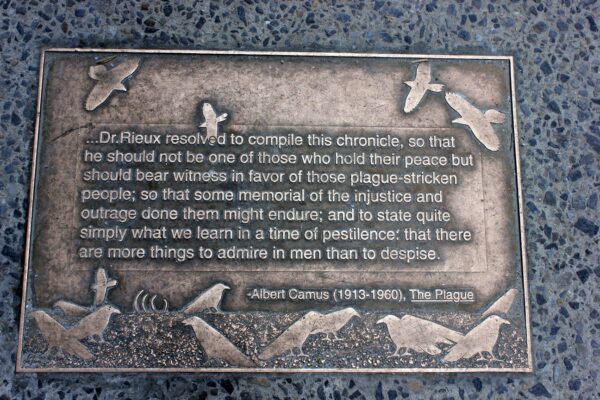
“Dr Rieux decided to write the account that ends here, so as not to be one of those who keep silent, to bear witness on behalf of the victims, to leave at least a memory of the violence and injustice that was done to them, and to say simply what it is that one learns in the midst of such tribulations, namely that there is more in men to admire than to despise.”
This is a beautifully written book. It’s both challenging and optimistic in that we’re faced with inevitable catastrophes but also with the goodness that can be found in the human heart.