
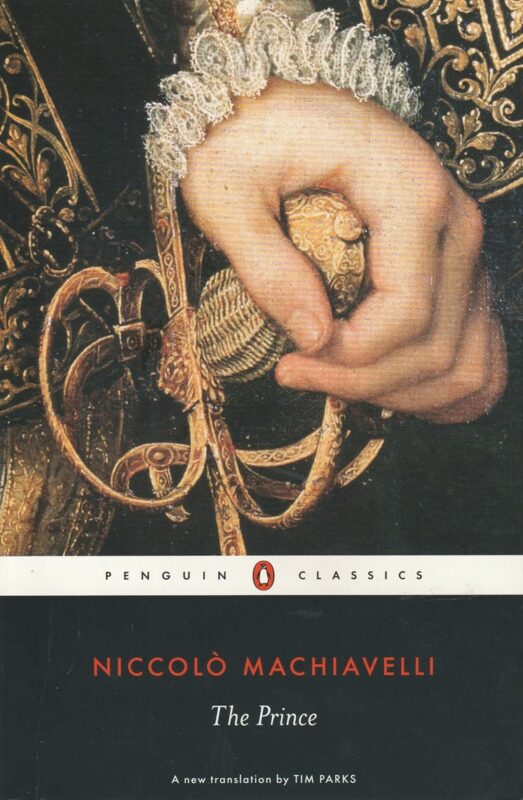


Title: The Prince (Il Principe)
Author: Niccolò Machiavelli
Written: 1513
Translator: Tim Parks, 2009
Pages: 124
Structure: 26 chapters.
Fifteenth Century Italy was a turbulent place. After a life of exemplary diplomatic service, Niccolò Machiavelli found himself imprisoned, tortured, and on the verge of ruin following a change of political leadership in his country.
This book is an instruction manual that Machiavelli sent to the new leader, explaining how to gain political power, what was necessary to hang on to it, and how not to be a victim of circumstance. In a way, Machiavelli was saying “I have experience, I can be useful. Here is proof. Spare a kind thought for me.”
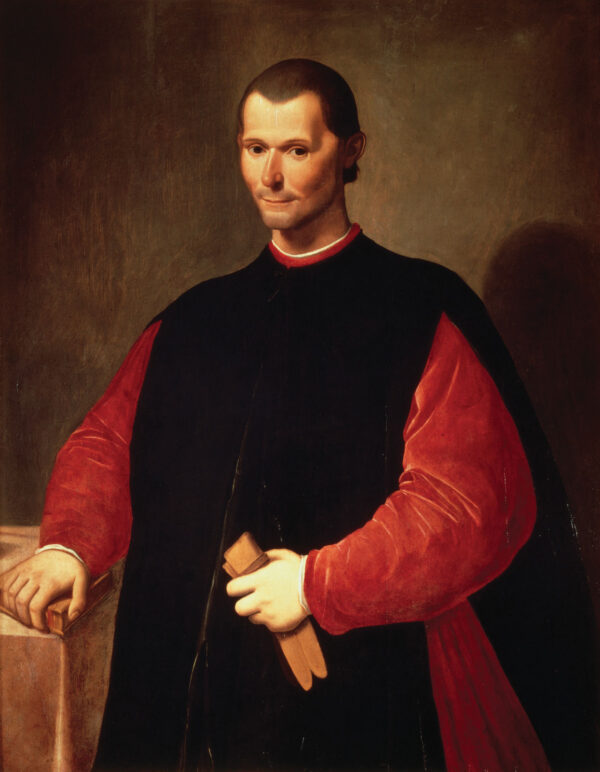
“Eager myself to bring Your Highness some token of my loyalty, I realized there was nothing more precious or important to me than my knowledge of great men and their doings, a knowledge gained through long experience of contemporary affairs and a constant study of ancient history. Having thought over all I’ve learned, and analysed it with the utmost care, I’ve written everything down in a short book that I am now sending to Your Highness.”
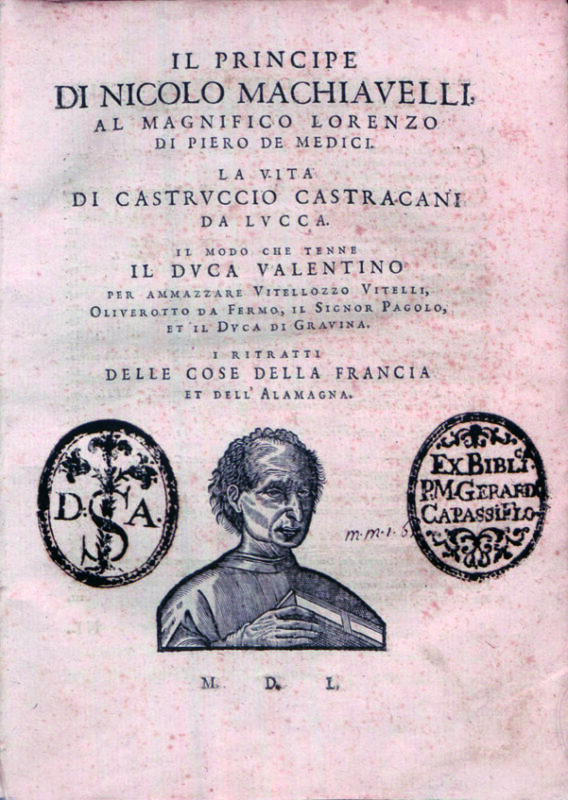
The book was sent to the powerful Lorenzo de’Medici, Duke of Urbino in 1513. Like Dante’s Divine Comedy, it was written in vernacular Italian, rather than Latin. The intention was for it to be understood, rather than treated as a sacred text. But it was controversial, and the book was not made available publicly until five years after Machiavelli’s death.
From the author’s perspective, it had limited success. Machiavelli never received the preferment he sought. Instead, in 1520 he received a humble commission from Cardinal Giulio de’Medici to write a history of Florence, which he completed in 1525, two years before his death.
The book is in three parts which describe: the various ways that states are governed, and their weaknesses; the Military; the qualities of a leader.
Types of Government
His description of the way that states are governed, and how to overcome them, is surprisingly candid.
“…hereditary monarchies where people have long been used to the ruler’s family are far easier to hold than new ones; all a monarch need to do is avoid upsetting the order established by his predecessors…
If he doesn’t go out of his way to get himself hated, it’s reasonable to suppose his people will wish him well.”
In other words, “don’t rock the boat, and try not to get yourself hated by the people.”
Machiavelli goes on to say that when you take over a new territory, provided the culture is not too different, all you need to do is “eliminate” the previous ruling family, but leave all laws and taxes as they were. People will quickly forget the previous ruler, but they don’t like changes that inconvenience them.
Where there is resistance due to large cultural differences, he’s more brutal.
“…it’s worth noting that in general you must either pamper people or destroy them; harm them just a little and they’ll hit back; harm them seriously and they won’t be able to. So if you’re going to do people harm, make sure you needn’t worry about their reaction.”
His reason for advising this is to forestall future problems. It’s difficult to detect future problems, in the same way it is difficult to detect some diseases in their early stages, but this is the easiest time to counter them. When the problem is obvious, when the disease is rampant, it’s often too late to rectify.
Machiavelli is particularly cautious about trying to conquer people “living in freedom under their own laws”. He says that if you try to conquer people who are accustomed to freedom, they will always “rally to the cry of freedom” and overturn the invader.
“If the population hasn’t been routed and dispersed so that its freedoms and traditions are quite forgotten, they will rise up to fight for those principals at the first opportunity.”
The Military
I was surprised at how blatant Machiavelli is about military power. He sees it as the main priority of a ruler.
“A ruler, then, must have no other aim or consideration, nor seek to develop any other vocation outside war, the organization of the army and military discipline. This is the only proper vocation of the man in command. And it’s such a potent one that it not only keeps those born to rule on their thrones but often raises private citizens to political power. Vice versa, when rulers think more about frills than fighting they lose their thrones. In fact, the thing most likely to bring about a ruler’s downfall is his neglect of the art of war; the thing most likely to win him power is becoming an expert in it.”
He’s scathing about Mercenaries (Soldiers for hire) and Auxiliaries (soldiers from a foreign power), and insists that the only reliable army is one built from your own people.
“A republic with a citizen army is less likely to fall victim to a coup”. Mercenaries will happily take your money when there is no danger, but will flee when their lives are at stake. Auxiliaries will help you win, but may keep going and conquer you once the battle is over.
Machiavelli advises leaders to “never stop thinking about war”, to “read history”, and to “never relax in peacetime”.
Machiavelli doesn’t pull any punches. He’s merely describing the world as he sees it. It is horrifying to read. I am sure there are many modern leaders who subscribe to this way of thinking.
The Qualities of a Leader
The author is pragmatic about morality, suggesting that ethics can be a hindrance to a leader. He explains that there is a “gap between how people actually live and how they ought to live.”
“…if you always want to play the good man in a world where most people are not good, you’ll end up badly. Hence if a ruler wants to survive, he’ll have to learn to stop being good, at least when the occasion demands.”
For Machiavelli, the most disgraceful thing is a failing that could lose a leader their position. If a moral failing doesn’t lead to a loss of power, avoid it if you can, but don’t worry too much if you can’t. Don’t be concerned about the bad reputation that comes with those “negative qualities” that are essential to holding on to power. (Who’d have thought that a quality could be negative?).
He then goes on to discuss qualities such as generosity, meanness, compassion, cruelty, and honesty.
He sees generosity as a dangerous thing. If a ruler spends his own money to keep people happy, he’ll run out of money. If he then raises taxes to get more money, he’ll upset the population.
It is better to be mean:
“…when people see that his penny-pinching means he doesn’t have to raise taxes and can defend the country against attack and embark on campaigns without putting a burden on his people, he’ll increasingly be seen as generous – generous to those he takes nothing from, which is to say almost everybody, and mean to those who get nothing from him, which is to say very few.”
He then cynically suggests that if the ruler is spending someone else’s money – for example the booty of war, then he should be as lavish as he can. The main thing is not to impoverish yourself by spending more of your own money than is necessary.
Machiavelli then delves into the age-old question of whether it is better for a ruler to be feared or loved. He concludes that it would be nice to be both feared and loved, but of the two, it’s safer to be feared. Loving a leader is the choice of the people, often arising from gratitude. But, he says, “men are a sad lot, gratitude is forgotten the moment it’s inconvenient”. But fear is something people never forget, and is something that can be controlled. Therefore it’s safer to base power on fear rather than love.
With regards to honesty and keeping promises, Machiavelli claims that it’s foolish for a leader to allow himself to be bound to promises, especially when circumstances change, and the fulfillment of the promise might be more costly than anticipated.
He says it’s more important to seem to be virtuous than to actually be virtuous. This leads to what I think is the most cynical line in the book:
“There is nothing more important than appearing to be religious. In general people judge more by appearances than first-hand experience, because everyone gets to see you but hardly anyone deals with you directly. Everyone sees what you seem to be, few have experience of who you really are…”
Appearance is everything. People look at the end result. The crowd is won over by appearances. All the world is a crowd.
It’s disheartening to read such things. We hope for a world where people act in good faith, but Machiavelli is telling us that a successful leader only pretends to be virtuous. Morals are optional and can be jettisoned when inconvenient.
Conclusion
This book is sobering to read. I think it’s essential reading for anyone who has an interest in politics. Perhaps not such much as an instruction manual on how to gain power, but as a revelation of how those in power really think.
It forces me to ask – “when a politician makes a promise, or does a seemingly good thing, how sincere are they, and how much of this is purely to manipulate opinion?”