


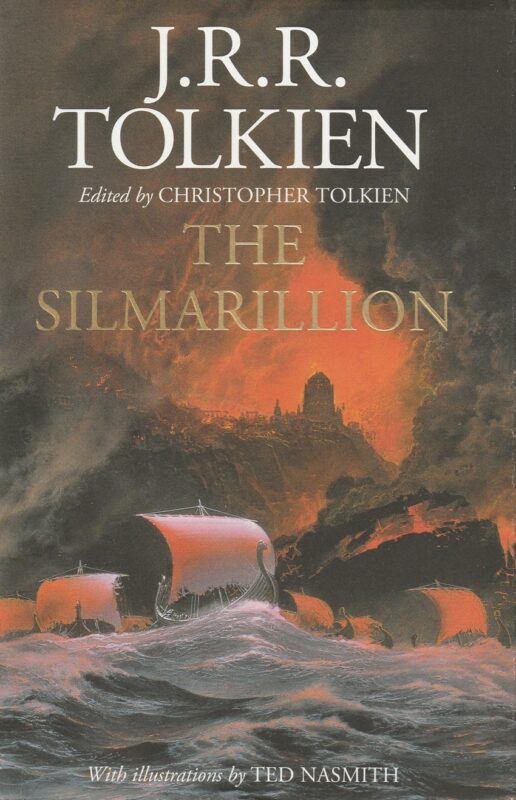
Title: The Silmarillion
Author: J.R.R.Tolkien
Published: 1977
Pages: 358 Pages
Structure: 4 major sections, plus a series of tables, genealogies, index, and appendix
This is a difficult to read book which is also delightful. It is well worth the effort for anyone who is a lover of Tokien’s world of “Middle Earth”. The Lord of the Rings and the Hobbit were such successful books because they’re built on a massive mythic foundation. They’re like the top 10% of the proverbial iceberg. The other 90% is represented by the depth of epic detail in the Silmarillion.
This book covers the history of Tolkien’s fictional universe from creation of the world (Arda) until after the events described in The Lord of the Rings – a period which spans approximately 60,000 years.
Themes
A recurring theme in the story is the persistent malevolence of Melkor / Morgoth and his servant Sauron, the damage it causes, and how the inhabitants of the world endure it, and (at times) overcome it.
“From splendour he fell through arrogance to contempt for all things save himself, a spirit wasteful and pitiless. Understanding he turned to subtlety in perverting to his own will all that he would use, until he became a liar without shame.”
Throughout the book we see numerous works of splendour and beauty: the magnificent lamps Illuin and Ormal; the light giving trees Telperion and Laurelin, the scintillating gems (the Silmarils) forged by Fëanor; the beautiful Ships of the Teleri that were drawn by swans; the mighty city, Gondolin, hidden in the mountains; the majestic island kingdom of Númenor, … the list feels like it is endless.
Although these works fill the reader with awe, they are all either destroyed or perverted by the lies of Melkor and Sauron.
“From him came many lies, which he spread abroad among the Elves, and he filled their hearts with doubts, and fear of the Valar, and bitterness one against another.”
At numerous times in the book, I thought “does this creature never give up?”
And this made me think about all of the amazing books I have read this year. Why is there so much conflict and pain? Why is this always the kernel at the centre of almost all great stories?
The simple answer is that we humans all face conflict. We love stories where we can vicariously experience the lives of the protagonists as they deal with heartache.
A classic example is the heroic tale of Beren and Lúthien in the Silmarillion.
Beren and Lúthien
A mortal man, Beren, falls in love with an immortal, Lúthien. Her father, Thingol, is opposed to the relationship and sets Beren an impossible task. He may only marry Lúthien if he goes to the very heart of Morgoth’s stronghold, steals a gem from his crown, and brings it back.
Beren promises to return with the gem, a Silmaril, in his hand. It is a perilous task but, with Lúthien’s help and the assistance of Huan, a talking dog, Beren is successful.
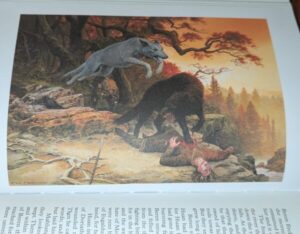
Unfortunately, on the way back, Beren fights with a werewolf, sword in one hand while holding the gem in the other. The wolf bites off Beren’s hand. All that remains is the stump of his wrist. He returns to Thingol:
“But Beren knelt before him, and said: ‘I return according to my word. I am come now to claim my own.’
And Thingol answered: ‘What of your quest, and of your vow?’
But Beren said: ‘It is fulfilled. Even now a Silmaril is in my hand.’
Then Thingol said: ‘Show it to me!’
And Beren put forth his left hand, slowly opening its fingers; but it was empty. Then he held up his right arm; and from that hour he named himself Camlost, the Empty-handed.”
The twist is that the gem is indeed in Beren’s hand. But that hand is in the belly of the wolf.
Túrin Turambar
Yet another example of this heroism is Túrin, the son of Húrin.
He grows up under the shadow of Morgoth’s curse. His father defies Morgoth and is captured, and Túrin’s life is marked from the beginning by loss and misfortune. Though generous and fiercely protective of others, Túrin is proud and quick to anger. His attempts to escape his fate by taking new names and forging new lives only draw him deeper into tragedy.
Túrin continually shows courage and leadership. He defends the weak, becomes a great captain of men, and wins renown in battle. His greatest deed is the slaying of the dragon Glaurung, yet even this victory brings ruin rather than peace. Through the dragon’s malice, Túrin unwittingly marries his sister Niënor, who has been driven into madness and forgetfulness. When the truth is revealed, Niënor casts herself into the river, and Túrin is left utterly broken.
At the end, Túrin speaks to his sword before falling upon it:
“Hail Gurthang! No lord or loyalty dost thou know, save the hand that wields thee.”
Túrin’s greatness lies in his resistance. His final triumph over the dragon is secondary to that. He never serves Morgoth and never ceases striving to do what he believes is right, even as the world twists his efforts into sorrow. His story shows a noble spirit battered but not defeated by malevolence. He is a hero whose dignity endures even in utter defeat.
We read tragedies to be inspired by heroism such as this.
Pity / Humility
Apart from heroic deeds, and bravery, the other qualities that ultimately defeat evil in Middle Earth are compassion and respect for those that seem insignificant. Compassion is so foreign to Morgoth that he doesn’t anticipate that the Lords of the West will show pity for the inhabitants of the land.
“For to him that is pitiless the deeds of pity are ever strange and beyond reckoning.”
The result is a titanic battle which sees Morgoth cast into the void until the end of time, and most of his forces utterly destroyed.
Similarly, in the next age, when the One Ring needs to be destroyed and Sauron needs to be defeated, the task seems impossible.
There at the last they looked upon death and defeat, and all their valour was in vain; for Sauron was too strong. Yet in that hour was put to the proof that which Mithrandir had spoken, and help came from the hands of the weak when the Wise faltered. For, as many songs have since sung, it was the Periannath, the Little People, dwellers in hillsides and meadows, that brought them deliverance.
In our society we tend to measure political and military success by capacity and control. Power is measured in resources and the ability to project power. History tends to laud those who seem to wield these tools most effectively. Tolkien subverts this. At the crucial moment in his story the great and wise fail, and Sauron cannot be undone by a superior plan or an overwhelming show of strength. Deliverance does not arrive through dominance at all. It comes instead through the “little people” who normally sit outside the halls of power and who barely register in thoughts of the powerful.
This is not a simple “underdog” tale where the small turn out to be secretly formidable. The Periannath (Hobbits) have no hidden edge. Their courage is modest and their small lives are unremarkable. Nothing about them fits our modern sense of political power. The world is not saved by a new weapon or a decisive act of leadership. When it comes to the crunch, what matters is endurance, attachment to home, and a refusal to let go of what is simple but cherished. What matters most in the end are the things that cannot be manufactured or forced from above.
That redefines our idea of “success”. We are saved by the fidelity of those we barely notice. Insignificant people turn out to be the hinge on which everything turns.
Conclusion
This is a brilliant book. One man seems to have created in his lifetime something that normally takes a human culture centuries. It’s so believable and rich.
The text is densely packed, so it’s worth reading slowly.
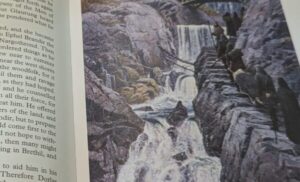
The artwork by Ted Nasmith is sublime.
I am glad I read this book.