
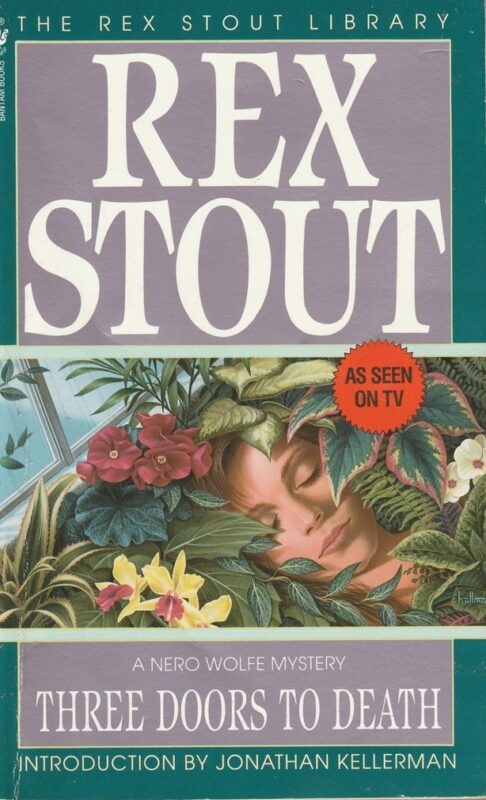


Title: Three Doors to Death
Author: Rex Stout
Published: 1950
Pages: 219 Pages
Structure: 3 Novellas
I’ve never read a Murder Mystery before, but I’m glad I started with Rex Stout. This collection of three novellas was a fun introduction to the genre, and an entertaining holiday read.
Nero Wolfe is a private detective who lives opulently in a luxurious brownstone house on West 35th Street in New York. He has a live-in staff of three, including his assistant Archie Goodwin, his cook Fritz Brenner, and his gardener Theodore Horstmann. He loves good food, rare orchids and good wine. He’s overweight, and hates leaving his house. But he’s a genius, and is sought out by the rich and famous to solve crimes.

The stories are written from a first-person perspective, but the twist is, they’re not from Wolfe’s perspective. The narrative is from the point of view of Archie Goodwin, Nero’s assistant. Archie is a single young man, unlucky in love, but very competent as a detective. This is a brilliant approach – we get to view Wolfe’s idiosyncrasies through the eyes of someone who lives with him. And since Wolfe is such an enigmatic character, it’s much more enjoyable to watch him through Archie’s eyes.
The style is wonderfully dry.
“Cramer returned to the red leather chair, sat, and said to someone, “You snippy little bastard.” I ignored it, knowing it couldn’t be for me, since I am just under six feet and weigh a hundred and eighty and therefore could not be called little.”
Though this was my first experience of a Rex Stout story, they felt strangely familiar I think this is because Rex Stout has created an original style which has been imitated countless times in movies and novels dealing with sleuths and private detectives. Perry Mason, Ellery Queen, Colombo, and even Dixon Hill from Star Trek Next Generation come to mind. The dark, dry murder mystery has become a familiar pattern in our collective perception. As we read the stories, we can almost see the damp New York sidewalks, hear the hum of traffic and the harmon-muted trumpet playing the background music.
I won’t go into too much detail about each of the novellas. Each of them can be read in one sitting. Each of them are equally entertaining, and (as you’d expect with murder mysteries) each of them has a delicious twist at the end.
In the first novella, “Man Alive”, a model / high-fashion designer engages Wolfe to find her uncle who was thought to have commited suicide, but is actually alive.
Archie’s thoughts on the matter are hilarious.
” It had seemed that we were about to be tagged for the chore of ripping the false face off of a murder disguised as a suicide, and at the smell of murder I always go tight all over. In the detective business that’s the center ring in the big tent. The headline MAN DEAD gets the eye good, but Cynthia Nieder had scrapped that and changed it to MAN ALIVE, which was quite a comedown.”
Archie is infatuated with the beautiful model. He is forced to sit through a fashion show and ends up being equally infatuated with each of the other models, deciding that he’d like to marry any of them.
The second novella, “Omit Flowers”, Wolfe’s oldest friend Marko asks for his help to solve a murder in which his old associate, a chef named Virgil Pompa, has been falsely implicated. Pompa is a chef for a successful chain of restaurants, and Archie has to deal with the wealthy family owners.

What ensues is a battle of wits between Archie and a group of privileged high-society people who try to protect each other from suspicion with cunning alibis. But as you’d expect, Archie uses some unconventional methods to get to the truth.
The third novella “Door to Death” is fascinating in that the normally reclusive Wolfe is forced to venture outdoors (something he rarely does) because he needs to recruit a new gardener.
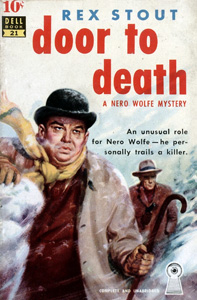
What starts as a polite visit admiring another mans orchid garden turns into a crime scene when a corpse is found in the greenhouse, and (once again) the wrong man ends up in the frame for the murder.
Nero Wolfe took a long stretching step to clear a puddle of water at the edge of the graveled driveway, barely reached the grass of the lawn with his left foot, slipped, teetered, pawed wildly at the air, and got his sixth of a ton of flesh and bone balanced again without having actually sprawled.
“Just like Ray Bolger,” I said admiringly.
He scowled at me savagely, which made me feel at home though we were far from home.
Once again, the pair of detectives are confronted with a wealthy family who are determined not to co-operate with the investigation, and are quite content for an innocent man to take the wrap for a crime he did not commit.
Wolfe and Goodwin resort to some unconventional methods to extract the truth from the situation and solve the crime.
I enjoyed the book. It’s light-hearted reading that you could finish in a day or two. It’s funny, and at the same time you’re forced to pay attention to the facts if you want to work out “whodunnit” before the reveal at the end.