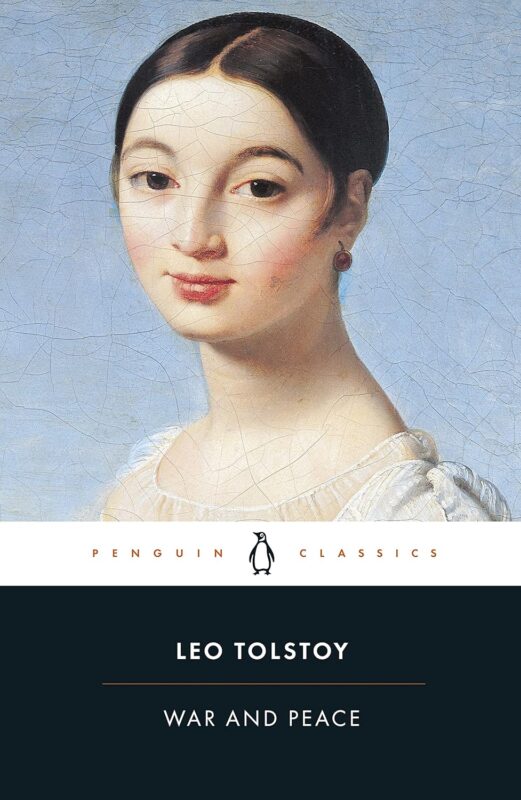


Title: War and Peace
Author: Leo Tolstoy
Published: 1869
Pages: 1,440 Pages
Translator: Anthony Briggs (2005)
Structure: 4 “volumes”, each split into up to 5 “parts”, each split into up to 30 chapters.
“War and Peace” is a rich and vast work of literature set during the Napoleonic Wars that gives an intimate insight into the upheaval caused by military conflict. For me it was a vivid multi-level experience that explored nations, families and individuals as they struggle for survival and search for meaning. Tolstoy refused to call it a novel, or a poem, or even a chronicle of history.
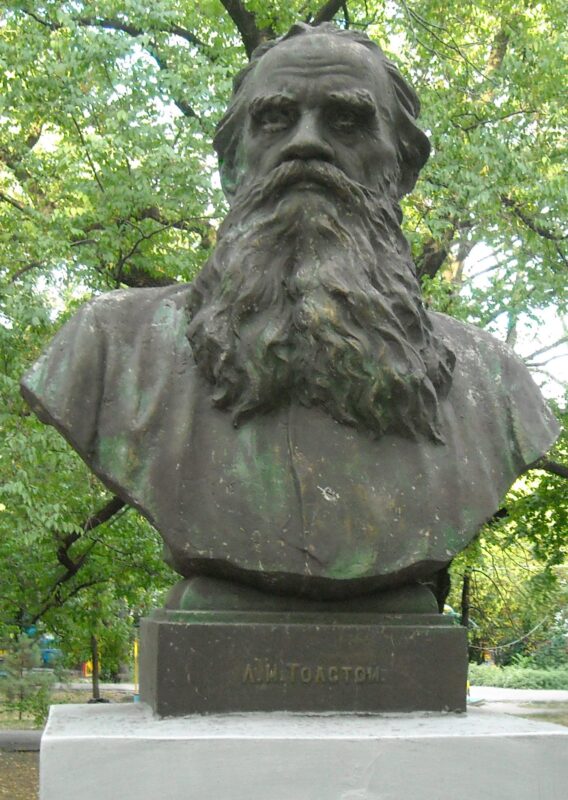
Leo Tolstoy (1828 – 1910) was born more than twenty years after most of the events described in the book, but he would have grown up around people who had fresh memories of the war. He started writing War and Peace in 1863, releasing it in installments in 1867, then publishing the complete work in 1869. To put things in perspective, this time-difference would be like someone today publishing a book about the Vietnam war.
This is a surprisingly easy book to read. Although it is long, the language is straightforward. It’s not dense, and flows naturally. It seemed intimidating at first: so many Russian names, different levels of nobility, various military ranks. But as I immersed myself in it, the strangeness became familiar; I grew to understand the characters, and began to appreciate the beauty of early nineteenth century Russia under Tsar Alexander I.
The perspective shifts continually throughout the story. It moves back and forth between the personal level, political maneuvering of influential families and ambitious generals, and to a bird’s eye view of the movement of nations through time. Tolstoy continually asks the question “What does it all mean? What makes it worthwhile? What is the force that moves nations?”
These are huge questions. But Tolstoy takes the radical step of trying to answer them. And he succeeds.
We begin focused on a man, Pierre Bezukhov, the illegitimate son of a dying count. Despite the machinations of ambitious relatives, the count dies and bequeaths all of his estate and his title to Pierre, who finds himself changed from a fringe-dwelling child of illegitimacy to one of the wealthiest men in Moscow. Pierre is naive, idealistic, passionate, but most of all he is good. He wants to do the right thing, but has no idea how to do it.
‘If we were fighting for freedom, I’d understand it, I’d be the first to enlist, but helping England and Austria against the greatest man in the world – that’s not right.’
Prince Andrey gave a shrug; it was all he could do in the face of such childish words from Pierre. His manner suggested there was no answer to such absurdities. And indeed it would have been hard to find any answer to this naive question other than the one he gave now.
‘If everybody fought for nothing but his own convictions, there wouldn’t be any wars,’ he said.
‘And a good thing too,’ said Pierre.
Prince Andrey grinned at him. ‘Yes it probably would be a good thing, but it won’t ever happen
‘Well, why are you going to war?’ asked Pierre.
‘Why? I don’t know. Because I have to. I’m just going.’ He paused. ‘I’m going because the life I’m leading here, this life is not to my taste!’
These characters are believable. I found it easy to put myself in their shoes. I imagined what it would be like to be Pierre, a fish out of water, feeling clueless about what was going on around me, and wanting to make sense of it all. This is wonderful, but it becomes difficult to read when the characters suffer because we identify with them.
Tolstoy is cruel to his characters. They suffer greatly. We get to see how they respond. We observe their growth, and marvel at their strength.
Pierre is manipulated into a sham-marriage in which he is betrayed by his wife. He ends up being taken prisoner when the French invade Moscow and is forced to mach long distances. Through it all he grows stronger despite the atrocious things he has to deal with.
After his time as a prisoner of war we hear him say:
‘Everybody says that adversity means suffering,’ said Pierre. ‘But if you asked me now, at this moment, whether I wanted to stay as I was before I was taken prisoner, or go through it all again, my God, I’d sooner be a prisoner and eat horse-meat again. We all think we only have to be knocked a little bit off course and we’ve lost everything, but it’s only the start of something new and good. Where there is life, there is happiness. There is a huge amount yet to come. ‘
This is such a profound change in a character.
Prince Andrey goes to war and almost dies in the confusion of the battle of Austerlitz. He meets Napoleon. He comes home to a heavily pregnant wife who dies in childbirth shortly after his arrival. He’s forced to reconsider everything he had previously taken for granted.
As he is lying on the battlefield, wounded and confused, we get a vivid description of his experience and feelings. I felt like I understood what it must feel like to be close to death and have a sudden change in perspective:
‘What’s happening?… I think I’m falling… My legs are going,’ he thought, collapsing on his back. He opened his eyes, hoping to see how the fight between the French soldiers and our gunner ended. Was the gunner killed or not? Did they get the cannons or were they saved? But he saw none of that. Above him was nothing, nothing but the sky – the lofty sky, not a clear sky, but still infinitely lofty, with grey clouds creeping gently across. ‘It’s so quiet, peaceful and solemn, not like me rushing about,’ thought Prince Andrey, ‘not like us, all that yelling and scrapping, not like that Frenchman and our gunner pulling on that cleaning-rod, with their scared and bitter faces, those clouds are different, creeping across that lofty, infinite sky. How can it be that I’ve never seen that lofty sky before? Oh, how happy I am to have found it at last. Yes! It’s all vanity, it’s all an illusion, everything except that infinite sky. There is nothing, nothing – that’s all there is. But there isn’t even that. There’s nothing but stillness and peace. Thank God for that!’
With a wider view, we see armies arrayed on the hills and in the misty gullies at Austerlitz.
Several generals are gathered around a map of the battlefield, and one opinionated general speaks louder than the others and suggests a bold offensive. One of the older generals, Kutusov, is reluctant, and doesn’t venture an opinion. We hear him say later to his adjutant “I think we shall lose”.
He stands atop a strategically safe hill with his battalion on the morning of the battle. He knows that to descend into the fog will be catastrophic, and so deliberately holds back. Soldiers from other battalions have already descended into the mist and confusion ensues.
Just at that moment the young proud and inexperienced Tsar rides onto the field. and orders Kutusov into a dangerous attack. Since the Tsar is commander-in-chief, the general has no option but to obey orders, and leads his men down the hill and to a huge defeat.
Tolstoy doesn’t romanticize war. He presents it as confusing and terrifying. Generals claim to know what they’re doing and things are going to plan when they’re not. Soldiers in the midst of battle receive orders that are hours out of date. Most people are unaware of what is supposed to be happening.
In the midst of this we see canon balls ripping into the earth several paces in front of soldiers, bullets whizzing past, grapeshot mowing down rows of men. Death, carnage, gunsmoke, blood and confusion everywhere. The war scenes are so vivid and terrifying.
And then we zoom out, and look at the big picture:
On the 12th of June the forces of Western Europe crossed the Russian frontier, and war began. In other words, an event took place which defied human reason and all human nature. Millions of men set out to inflict on one another untold evils – deception, treachery, robbery, forgery, counterfeiting, theft, arson and murder – on a scale unheard of in the annals of law-courts down the centuries and all over the world, though at the time the men responsible did not think of these deeds as crimes.
What led to this extraordinary occurrence? What causes lay behind it?
The author spends entire chapters exploring these questions, and concludes that traditional explanations are inadequate for such a dreadfully simple and incomprehensible thing. It was more than the fact that Napoleon was a megalomaniac or Alexander was obstinate. “The actions of Napoleon and Alexander,” he explains, “whose word seems to have dictated whether anything should or should not happen, are no more self-determined than the actions of any common soldier.”
Tolstoy presents this as a dichotomy. Individuals use their freedom to make every effort to do what they think they should. But the “swarm of humanity” is an elemental life where people inevitably follow natural laws that been laid down beforehand.
At the end of the book he spends twelve chapters exploring this concept in minute detail.
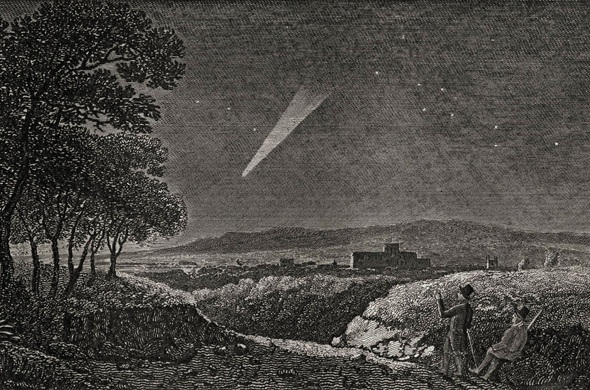
The imagery in the book is delightful.
We see the great comet of 1811 hovering in the sky while Moscow burns.
We see Tolstoy use a long and detailed simile of a dead bee hive to describe Moscow after it had been abandoned ahead of the advancing French army.
Early in the story we experience a hunt where a pack of hounds and hunters on horses pursue a wolf through the snow. We see the chase from the perspectives of several hunters, from the perspective of wolf itself, and even from one of the dogs.
(The dog) Rugay …trotted along behind ‘Uncle’s’ horse with mud all over his hunched up back…with the serene air of a conqueror. ‘Look, I’m just like any other dog till it comes to a chase, then then – watch out!’ was what the dog’s demeanour conveyed…
At the end of the hunt they spend the evening in a primitive hut in the woods, eating traditional Russian food, singing folk songs, and dancing. This is an image that a couple of the protagonists recall with fondness when trying to deal with the horrors of the war.
Finally, towards the end of the book, we eavesdrop on an intimate family gathering at Christmas seven years after the war. There’s a sense of peace and resolution in the joys of family life, but at the same time a restlessness at the state of things. Some of the people men taking some political action by creating a secret society to influence the direction of the government.
Having just come through an enormous conflict, they’re now discussing more potential conflict. It appears that the “swarm of humanity” is once more about to “inevitably follow natural laws”.
I find it impossible to adequately review this wonderful book.
To read this book is like experiencing virtual reality. A few weeks of reading time expands into fifteen years of Russian life, heartache, devastation and hope. If you allow it, War and Peace becomes a rich experience.
It is a great book, and is worth the large amount of time required to read it.