


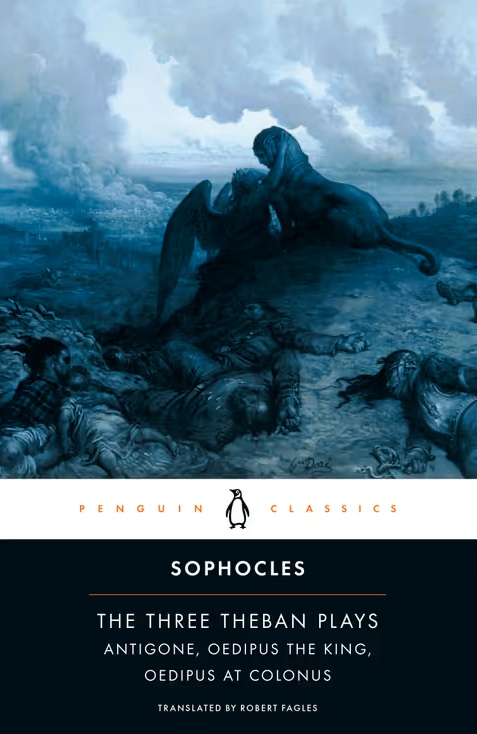
Title: Antigone
Author: Sophocles (circa 440 BCE)
Translator: Robert Fagles (1982)
Structure: A play consisting of 1,470 lines
Antigone is a powerful Greek tragedy about civil disobedience, and the abuse of political power. Although it is set during a civil war that occurred almost two and a half thousand years ago, it is as relevant today as it was then.
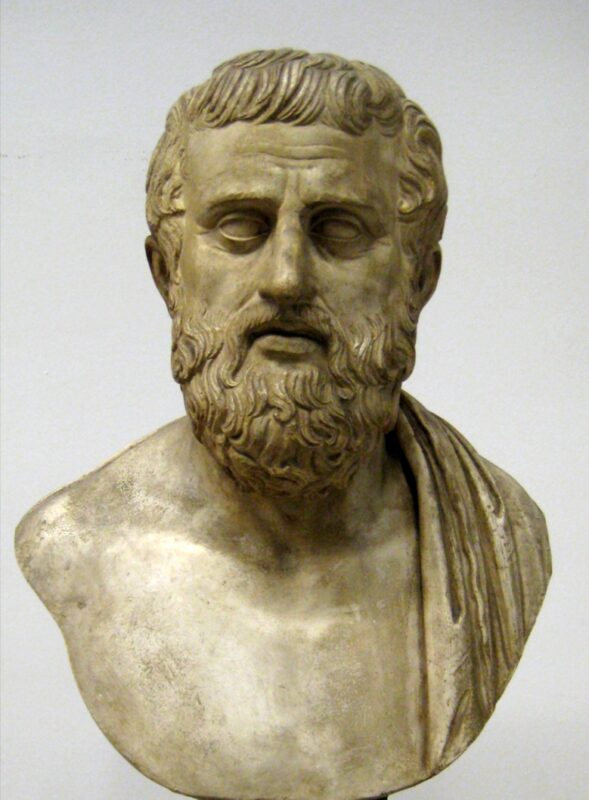
Sophocles was a Greek playwright who lived in the 5th century BCE and wrote over 120 plays. Along with his “Oedipus” plays, Antigone is one of his most famous works.
It explores an insecure King who chooses political security over ethics, a niece who defies him, and the tragic consequences of these actions. This play is timeless. It could have been set in the twenty-first century and would have been just as relevant.
Antigone is the daughter of King Oedipus, who is in self-imposed exile. Oedipus’ brother Creon (Antigone’s uncle) has assumed control of Thebes during a civil war. Oedipus’ two sons, Eteocles and Polynices fought on opposing sides during a battle, and both were killed.
In an attempt to secure the legitimacy of his leadership, Creon orders that Eteocles should be honored with a hero’s burial, while Polynices should be shamed: his body left un-buried on the field of battle, an action contrary to ancient Greek religious customs. If a dead body was not buried its spirit could not enjoy the afterlife in Hades.
Polynices’ sister, Antigone, decides to disobey the royal decree and attempts to bury her brother. She chooses to obey the higher requirements of her religion.
The play explores the conflict between Antigone and her uncle, as well as the attitudes of others, political leaders, the population at large, her family and her lover.
We see Creon at the start of the conflict: authoritarian and self-important:
“There are my principles. Never at my hands
will the traitor be honored above the patriot.
But whoever proves his loyalty to the state –
I’ll prize that man in death as well as life.”
And, in her own way, Antigone is also inflexible. She sees an important principle, and refuses to violate it, even if it means death:
“I will bury him myself.
And even if I die in the act, that death will be a glory.
I will lie with the one I love and loved by him –
an outrage sacred to the gods!”
Thus Sophocles sets up an inevitable clash. Two unyielding people refuse to bend on an issue that is important to them both. But who is right? Who is wrong?
A sentry discovers an attempt by someone to bury Polynices’s corpse. Fearfully, he approaches the king to tell him the news. The king is furious and takes the burial personally, interpreting it as a conspiracy to overthrow him: “…there were certain citizens who could hardly stand the spirit of my regime, grumbling against me in the dark…”. Creon rants at the sentry, accusing him of taking bribes in exchange for allowing the burial.
The sentry makes an astute observation:
Oh it’s terrible when the one who does the judging
judges things all wrong.
Antigone is eventually caught in the act when she tries again to bury her brother and we see the clash between the two main forces in the play. Creon asks, “Did you have the gall to break this law?” and Antigone answers “of course I did… nor did I think your edict had such force that you, a mere mortal, could override the gods…”
The argument continues with Antigone claiming that the citizens would side with her “if their lips weren’t locked in fear.”
Creon is unmoved and sentences Antigone and her sister (as an accomplice) to death by being buried alive.
Sophocles then turns up the heat on Creon. His son, Haemon, is betrothed to Antigone. Haemon confronts Creon who refuses to listen to his son, accusing him and Antigone of anarchy:
“Anarchy –
show me a greater crime in all the earth!
She destroys cities, rips up houses,
breaks the ranks of spearmen headlong into rout.
But the ones who last it out, the great mass of them
owe their lives to discipline.
Haemon makes an insightful warning about leadership to his father:
“You’ve seen trees by a raging winter torrent,
how many sway with the flood and salvage every twig,
but not the stubborn – they’re ripped out, roots and all.
Bend or break.
In typical Greek tragic style, Sophocles pushes Creon even further. The prophet Tiresias confronts him. This is the same Tiresias whom Odysseus sought out in the underworld in Homer’s Odyssey – a man famed for fearlessly telling the truth and observing things that others struggle to see.
The prophet is clear. This conflict is Creon’s fault. He must change his attitude: “..it is you – your high resolve that sets this plague on Thebes… Take these things to heart, my son, I warn you. All men make mistakes, it is only human. But once a wrong is done, a man can turn his back on folly… Stubbornness brands you for stupidity – pride is a crime.”
Creon refuses to listen, and takes offense. “Are you aware that you’re speaking to the king?”
Tiresias then offers a blood-curdling prophecy. He tells Creon that the gods will avenge his stubbornness. His family will suffer death. His subjects hate him. The tragedy is unavoidable.
While maintaining his dignity in front of the prophet, Creon is shaken by the exchange, and later discusses the situation with one of his leaders. The leader advises Creon to stop the execution as soon as possible.
Even at this point, Creon makes the conflict about his own pride, asking the leader “You think I should give in?”
But Creon is too late. Antigone is dead. Her betrothed, Haemon, is also dead, having killed himself from grief at his lover’s death. His wife Euridice is dead, having committed suicide after learning of the death of her son, Haemon.
In short, Creon loses everything, and everyone dear to him.
At the end, Creon is broken.
“Whatever I touch goes wrong – once more
a crushing fate’s come down upon my head!”
I think it’s clear why this play has endured for two and a half millennia. We understand the importance of law and order, but we also value higher values: goodness, justice, compassion. It’s not enough for a leader to rule with a rod of iron, they need flexibility. They need to see themselves as servants of the state, not the other way round.
Despite the tragedy, if we’re honest with ourselves, I think there is a deep satisfaction when we see a power-hungry leader crushed by fate. We despise such leaders. They’re with us today as much as they were in ancient Greece. And (we hope) they will eventually face the consequences of their actions.