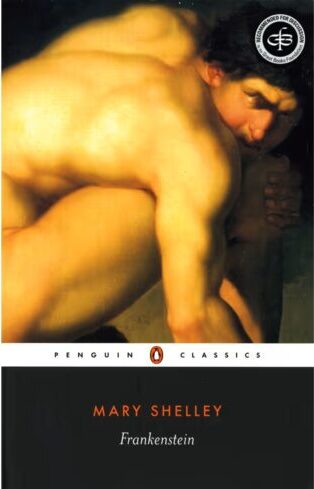
Title: Frankenstein, or, The Modern Prometheus
Author: Mary Shelley (1797 – 1851)
Pages: 352
Structure: 24 Chapters
Frankenstein is where it all started. The mad scientist, the evil laugh on a stormy night, the experiment that went wrong, the man who dared to discover forbidden knowledge: these are all tropes that were born of the ingenious imagination of Mary Wollstonecraft Shelley.
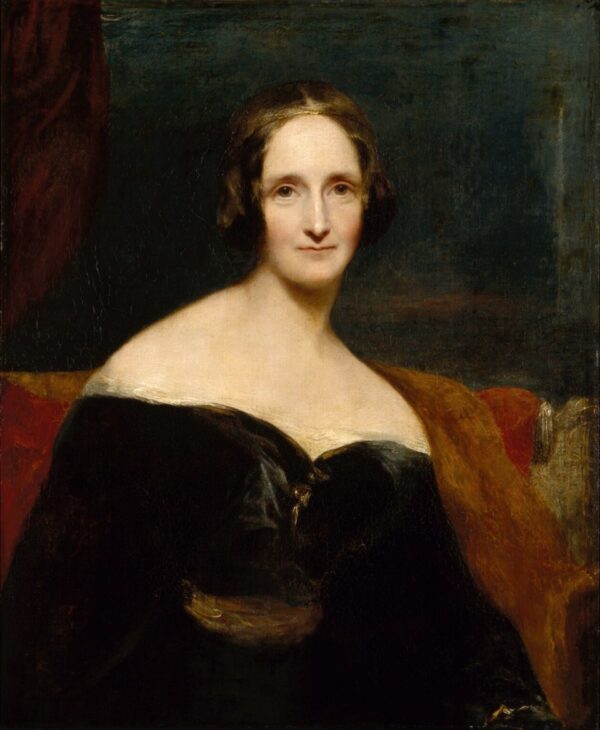
Shelley conceived this story on a stormy night in 1816 as part of a challenge among friends to see who could tell the best ghost story. She was eighteen years old, recently married to Percy Bysshe Shelley, and was staying with Lord Byron and John Polidori in Geneva.
“We will each write a ghost story,” said Lord Byron, and his proposition was acceded to.
In her introduction to the novel, Shelley writes how she was overwhelmed with the images that swamped her imagination as she constructed her story in her mind.
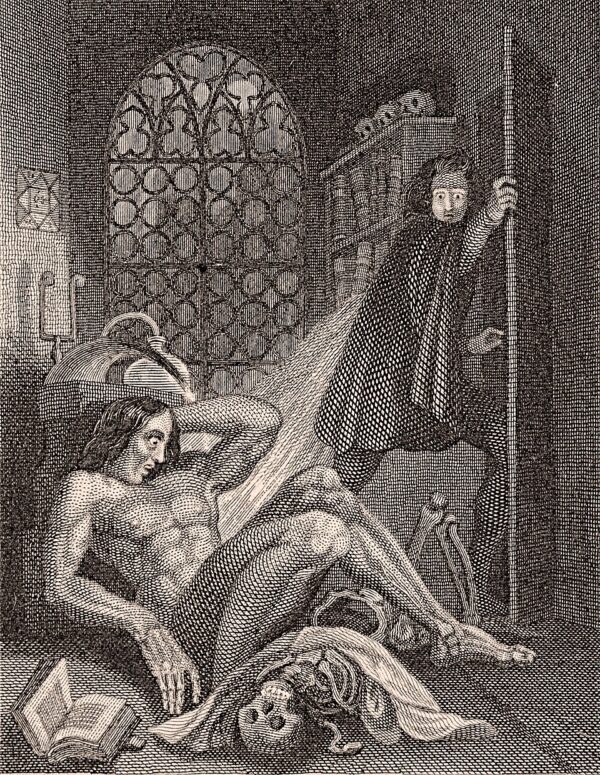
“I saw the hideous phantasm of a man stretched out, and then, on the working of some powerful engine, show signs of life and stir with an uneasy, half vital motion…
…behold, the horrid thing stands at his bedside, opening his curtains and looking on him with yellow, watery, but speculative eyes. I opened mine in terror. The idea so possessed my mind that a thrill of fear ran through me, and I wished to exchange the ghastly image of my fancy for the realities around”
Like Wuthering Heights, this is a classic Gothic Novel using themes of fear and haunting, tales within tales, unnatural sensations, and overwhelming weather.
It is presented to us as a set of nested narratives. Shelley begins her tale with a series of letters from the Arctic explorer Robert Walton to his sister Margaret Saville. In those letters, Walton describes his curiosity for new knowledge, a desire for adventure, and a yearning to achieve some great purpose. The theme of a hunger for new and forbidden knowledge recurs throughout the story. He says to Margaret in one of his letters: “there is love for the marvellous, a belief in the marvellous, intertwined in all my projects… what can stop the determined heart and resolved will of man?”
The narrative turns when Robert Walton, whose ship is stuck in Arctic ice, discovers a desperate man in a sledge on an iceberg. The man, Victor Frankenstein, is troubled and close to death. Victor then tells Robert his story, which appears to us as part of the correspondence between Robert and his sister:
Strange and harrowing must be his story; frightful the storm which embraced the gallant vessel on its course, and wrecked it – thus!
Thus Victor’s story begins. He tells us of his thirst for knowledge, and his love of science: “It was the secrets of heaven and earth that I desired to learn.”
Victor (like the author) was fascinated by news of experiments by Luigi Galvani (“galvanism” – 1791) in which an electrical current applied to a dead animal caused it to move. This information inspires him to conduct his own experiments into reanimating the dead, which eventually leads him to create his “monster”. The creature opens its eyes. Victor is horrified at what he has done, and flees.
When Victor is eventually confronted by his monster, the narrative drops down yet another level as we hear the creature tell his own story.
Left to its own devices, the monster slowly learns by secretly observing humans, and by reading classics such as Milton’s “Paradise Lost“, Goethe’s “The Sorrows of Young Werther” and Plutarch’s Lives.
This is where many modern interpretations of the novel seem to depart from Shelley’s original intent. The monster is very intelligent. In later conversations with Victor he is eloquent, he understands the classics, and he has a clear understanding of philosophy and ethics. Compare this to the mute, flat-headed brute that we observe in most modern film adaptations.
“But Paradise Lost excited different and far deeper emotions … It moved every feeling of wonder and awe that the picture of an omnipotent God warring with his creatures was capable of exciting. I often referred the several situations, as their similarity struck me, to my own. Like Adam, I was apparently united by no link to any other being in existence; but his state was far different from mine in every other respect…
‘Accursed creator! Why did you form a monster so hideous that even you turned from me in disgust? God, in pity, made man beautiful and alluring, after his own image; but my form is a filthy type of yours, more horrid even from the very resemblance. Satan had his companions, fellow-devils, to admire and encourage him; but I am solitary and abhorred.’
We can identify with the monster. He is alone. He desires companionship. And he is rejected by those he encounters. He begs Victor to create a mate for him – someone with whom he can share his life. And while Victor initially agrees, he eventually breaks his promise, which devastates the creature.
At the same time, Victor’s self-obsession appears abhorrent to us. Despite being brilliant, he is not a lovable protagonist, and wallows in his own despair. As a result of Victor’s actions, several people are killed, including his brother, his friend, and his newlywed wife. One of these people is Justine, a woman wrongly accused of a murder that was actually commited in anger by the monster. Victor lacks the moral courage to confess his part in the murder, and Justine is executed.
What is Mary Shelley trying to tell us through this story?
The first and most obvious seems to be the idea of “forbidden knowledge” – things that were not meant for mere mortals to know. Hunger for this knowledge draws Walton into peril on the arctic ice, and it leads Victor to embark on a disastrous experiment. This raises the bigger question – what about us? Is our science perilous? Perhaps Shelley thought so as she considered Galvani’s experiments with electricity and dead frogs.
Perhaps this is why she subtitled the novel “The Modern Prometheus”, referencing the Titan who stole fire from the gods, and gave it to humans, thus unleashing a whole chain of painful consequences.
The other message is the damage that is caused by marginalisation. The monster tells Victor “I am malicious because I am miserable”. Everyone who encounters the creature is horrified by him. We are forced to ask “who is to blame for the grisly murders?” and must face the inevitable conclusion that Victor, due to his lack of compassion, is at least partly to blame. This leads us to consider – are we partly to blame for the malice in the world? Does our lack of compassion cause some of the horrible acts that are committed in our world?
And as I read these things, I marvelled. How could an eighteen-year-old young woman write such an insightful work? From where did she get this knowledge? It is amazing.
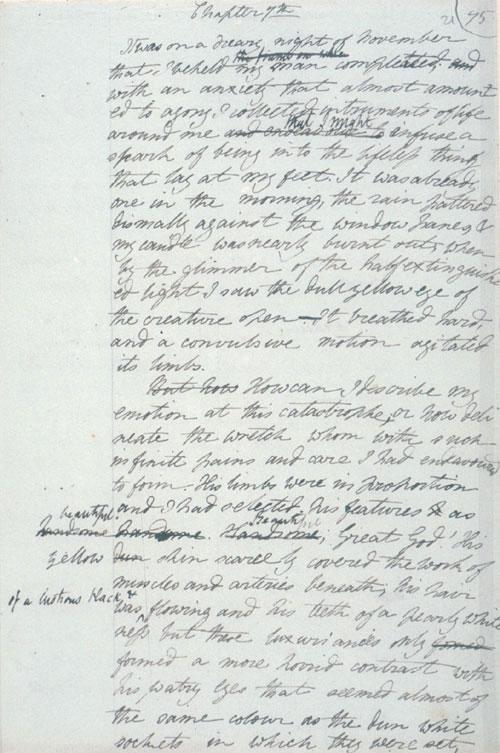
In “Frankenstein”, Mary Shelley has crafted a masterpiece. Its themes often recur in our modern-day movies and horror stories. Consider how familiar this scene sounds to anyone who has watched a horror movie:
I was answered through the stillness of night by a loud and fiendish laugh. It rung on my ears long and heavily; the mountains re-echoed it, and I felt as if all hell surrounded me with mockery and laughter. Surely in that moment I should have been possessed by frenzy, and have destroyed my miserable existence, but that my vow was heard and that I was reserved for vengeance.
I thoroughly recommend this book. Why did it take me so long to read it for the first time?