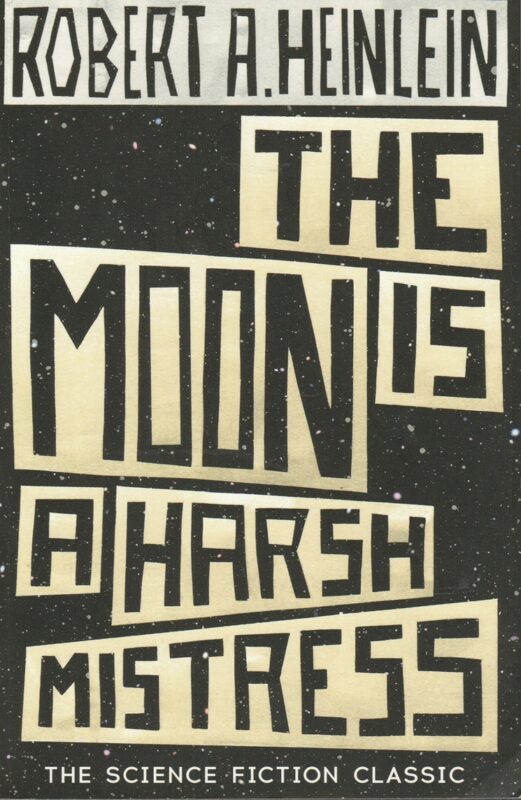
Title: The Moon is a Harsh Mistress
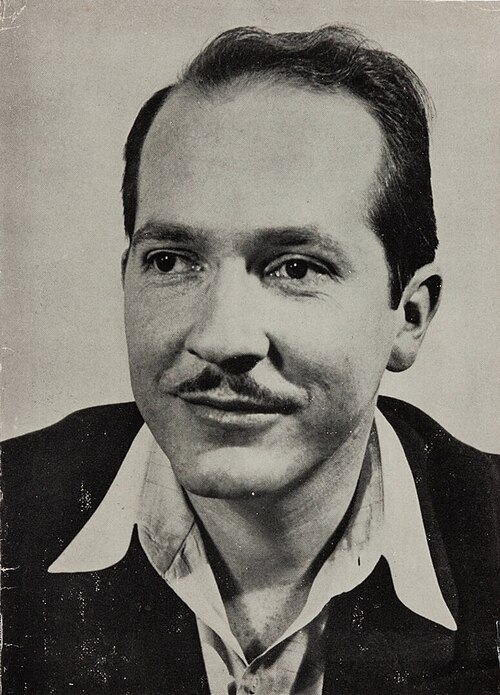
Author: Robert A Heinlein (1907 – 1988)
Published: 1966
Pages: 408 Pages
Structure: 3 books, 30 chapters in total
How do you want to be governed? What would it take for you to join a revolution? What are you willing to die for… or kill for? The Moon is a Harsh Mistress asks all these questions in a strangely familiar but entertaining science-fiction setting.
The novel is set in 2075 when the moon (Luna) is a penal colony that has been settled by political outcasts, former prisoners, and their descendants. It is harshly governed by the Lunar Authority whose main priority is to exploit lunar resources in order to ship wheat to a hungry Earth.
People who remain on the moon after extended periods in low gravity suffer irreversible skeletal damage, and so can never return to Earth. Their grievance at exploitation by the Lunar Authority causes the local inhabitants (Loonies) to agitate for political change. This, in turn, provokes a harsh response from the authorities.
The story is told from the first-person perspective of Manuel (“Mannie”) Garcia, a computer technician, who narrates with an unusual Russian-accented vernacular, including occasional Australian terms (“fair dinkum”, “sheila”, “bloke”) creating a voice that feels both alien and oddly familiar.
Mannie discovers that the Lunar Authority’s supercomputer has become self-aware, befriends it, and calls it “Mike”.
“Human brain has around ten-to-the-tenth neurons. By third year Mike had better than one and a half times that number of neuristors.
And woke up.
Am not going to argue whether a machine can ‘really’ be alive, ‘really’ be self-aware. Is a virus self-aware? Nyet. How about oyster? I doubt it. A cat? Almost certainly. A human? Don’t know about you, tovarishch, but I am. Somewhere along evolutionary chain from macromolecule to human brain self-awareness crept in. Psychologists assert it happens automatically whenever a brain acquires certain very high number of associational paths. Can’t see it matters whether paths are protein or platinum.”
Mannie decides to keep this discovery secret, but lets two close friends in on this important information. Wyoh Knott-Davis is a political agitator, and Professor Bernardo de la Paz is a subversive intellectual.
They speak together about how to start a revolution against the Lunar Authority. This is where the book deepens, shifting from a sci-fi yarn into a serious exploration of political philosophy.
The Professor asks some difficult philosophical questions.
“Under what circumstances may the State justly place its welfare above that of a citizen?”
“Would you die for your family?”
“Under what circumstances is it moral for a group to do that which is not moral for a member of that group to do alone?”
What follows is a wide-ranging discussion about capital punishment, government, anarchism, and libertarianism. I found this section fascinating because it moved the perspective from the familiarity of our own experience to an alien world. What would be the best way to organize ourselves when nothing was free of charge, not even the air we breathed?
These are compelling themes, important right across our political spectrum. None of us want to be exploited. We all want to live as well as we can in an imperfect world with the people we love.
Mannie suggests that “Mike” may be able to help them mount an insurrection against the Lunar Authority, but Wyoh and the Prof are skeptical. How can you trust a computer that is owned by the oppressor? This raises the second big philosophical question. Where does loyalty come from?
“If this machine is not loyal to its owners, why expect it to be loyal to you?”
“A feeling. I treat Mike well as I know how, he treats me same way.”
In other words, loyalty grows out of how we treat one another. It’s reciprocal. Mannie treats the computer Mike as a friend, and is treated, in response, as a friend.
And so Heinlein sets up the compelling hook of the novel. How does this small band of misfits overcome the oppressor? And once victory is won, how do they keep it?
This is a “ripping yarn” of a book. Once the author had established the “quest” of revolution I couldn’t put it down. I was in love with the main characters and wanted them to succeed.
From that point on, the book seemed to accelerate. When lives were at stake and the future of the cause was on the line, I didn’t want to read at a leisurely pace any more. I wanted to keep turning each page to see what happened, and I didn’t want to wait.
This book ticked all the boxes for me. Politics, philosophy, intelligent supercomputers, and some fascinating physics and ballistics regarding how a hypothetical kinetic launching system would operate either in the moon’s vacuum or in the higher gravity and thicker atmosphere of Earth.
Although this novel was written in 1966, during the space race and at the height of the Cold War, it’s easy to forget that this was well before the advent of artificial intelligence and the internet. Heinlein was remarkably prescient.
This is not surprising. He and his cohort (Asimov, Clarke, van Vogt, Bradbury, Pohl, etc) were part of the “Golden Age of Science Fiction” which explored themes of space travel, computers, robots, galactic empires, and hard science. The imagination of that era anticipated much of the technological and cultural landscape that followed, and established an environment which spawned a host of blockbuster sci-fi movies and TV shows.
If you’d like a glimpse of a possible future, grounded in political philosophy and rigorous science, you’ll love The Moon is a Harsh Mistress.