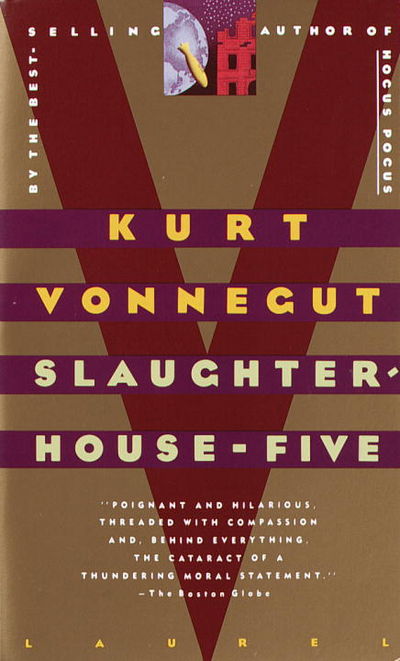
Title: Slaughterhouse-Five
Author: Kurt Vonnegut (1922 – 2007)
Published: 1969
Pages: 206 Pages
Structure: 10 chapters
“Slaughterhouse-Five, or, The Children’s Crusade: A Duty-Dance With Death” is a beautiful but strange satirical anti-war novel told from the perspective of a traumatised, time-travelling former prisoner of war.
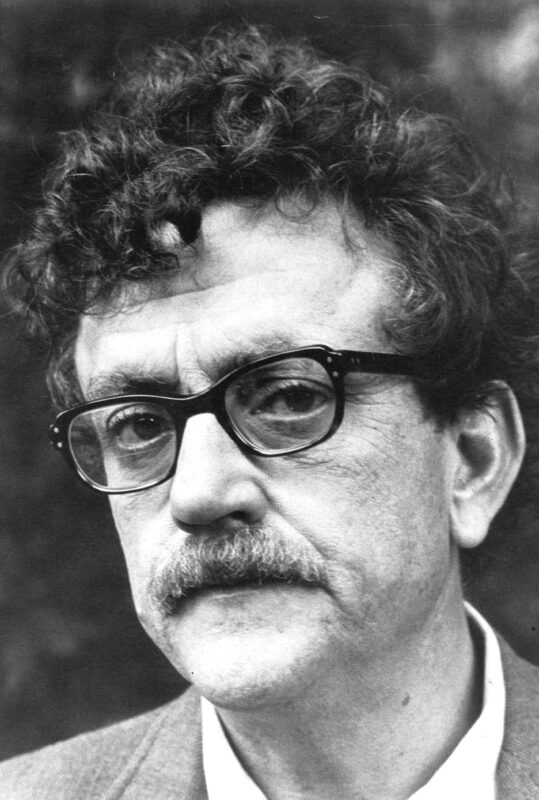
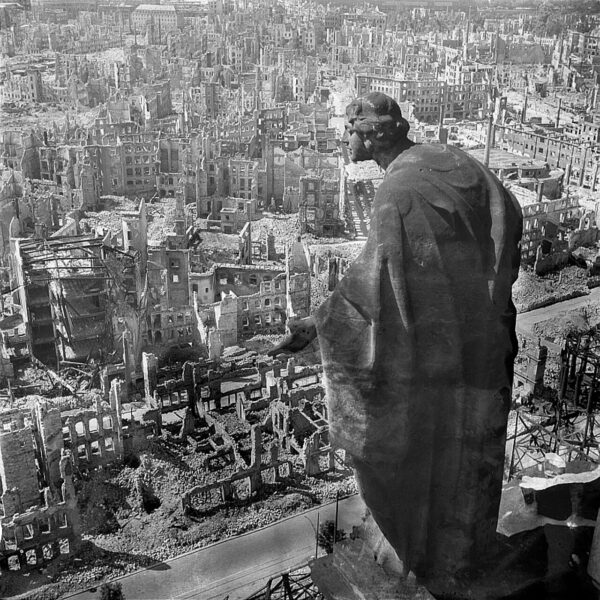
Kurt Vonnegut wrote this wonderful story in 1969. He was a prisoner-of-war (POW) in the Second World War, surviving the Firebombing of Dresden by Allied forces in 1945 in which an entire city and tens of thousands of civilians were killed.
Vonnegut gives us a snapshot of his bona-fides on the title page of the book where he describes himself as:
WHO, AS AN AMERICAN INFANTRY SCOUT HORS DE COMBAT, AS A PRISONER OF WAR, WITNESSED THE FIRE-BOMBING OF DRESDEN, GERMANY, “THE FLORENCE OF THE ELBE,” A LONG TIME AGO. AND SURVIVED TO TELL THE TALE.
THIS IS A NOVEL SOMEWHAT IN THE TELEGRAPHIC SCHIZOPHRENIC MANNER OF TALES OF THE PLANET TRALFAMADORE, WHERE THE FLYING SAUCERS COME FROM.
PEACE.
Rather than tell the story from a first-person perspective, Vonnegut narrates the novel from the point of view of Billy Pilgrim, an unimpressive American serviceman who ends up getting married after the war and starting a successful optometrist chain. But the narrator is unreliable, as you’d expect from a traumatized veteran. The opening words are iconic:
“All this happened, more or less. The war parts, anyway, are pretty much true.”
Billy is lost with several comrades behind enemy lines in Germany, with the heel missing from one of his shoes, causing him to walk with a lopsided “up / down” gait through endless snowy forests. He’s eventually captured, loaded onto a train, and slowly hauled off to a concentration camp to serve out the remainder of the war.
During this period, he “comes unstuck in time”, and finds himself moving involuntarily to different periods in his life, past and future. As a result, the timeline of the novel is disjointed: sometimes we’re in 1945 Germany, sometimes in the USA in the 1950s, sometimes in the 1960s and 70s when Billy owns a successful optometrist chain.
And during this period, we meet friendly aliens from the planet Tralfamadore, who abduct Billy, and take him to a zoo on their planet where they attempt to breed him with a former porn star.
The Tralfamadorians experience reality in four dimensions as opposed to our three, so they see a life in its entirety from beginning to end. Billy writes in a letter to a newspaper:
“The most important thing I learned on Tralfamadore was that when a person dies he only appears to die. He is still very much alive in the past, so it is very silly for people to cry at his funeral. All moments, past, present, and future, always have existed, always will exist. The Tralfamadorians can look at all the different moments just the way we can look at a stretch of the Rocky Mountains, for instance. They can see how permanent all the moments are, and they can look at any moment that interests them. It is just an illusion we have here on Earth that one moment follows another one, like beads on a string, and that once a moment is gone it is gone forever.”
Vonnegut uses the aliens to introduce us to his idea of fatalism and determinism. Everything, past and future, has already happened. In response to this, whenever anything tragic happens in the story, Vonnegut uses the line “So it goes.”
As a result, Billy appears to have very little agency. Things happen to him, rather than him making choices. In a lot of ways he reminds me of “Forrest Gump” – an innocent bystander who just happens to get caught up in huge events. One benefit of this attitude is the peace Billy experiences from his resignation to fate. He knows when he is going to die, and he’s not worried about it.
Despite the book’s lighthearted style, Vonnegut is very clear about how terrible war is, and how transformative the experience is.
The nicest veterans in Schenectady, I thought, the kindest and funniest ones, the ones who hated war the ones who’d really fought…
…I have told my sons that they are not under any circumstances to take part in massacres, and that the news of massacres of enemies is not to fill them with satisfaction or glee. I have also told them not to work for companies which make massacre machinery, and to express contempt for people who think we need machinery like that.
He’s also damning about American culture and politics:
“America is the wealthiest nation on Earth, but its people are mainly poor, and poor Americans are urged to hate themselves…
…Americans, like human beings everywhere, believe many things that are obviously untrue, the monograph went on. Their most destructive untruth is that it is very easy for any American to make money. They will not acknowledge how in fact hard money is to come by, and, therefore, those who have no money blame and blame and blame themselves.”
What I love about this book is the simple way it is told. It is woven with irony, tragedy, comedy and fantasy. As a result, instead of turning away in horror, the reader laughs with Vonnegut while witnessing what it must have been like to be a POW.
It’s also beautifully written – even the gruesome scenes. Snow the colour of “raspberry sherbet” after his friends are shot, bare feet the colour of “blue and ivory” after walking in the snow, the sound of a dog barking like a “bronze gong”, stars appearing to the four-dimensional Tralfamadorians as “rarefied luminous spaghetti”
But despite the gruesomeness and pain, Vonnegut gives us a beautiful hope:
If what Billy Pilgrim learned from the Tralfamadorians is true, that we will all live forever, no matter how dead we may sometimes seem to be, I am not overjoyed. Still— if I am going to spend eternity visiting this moment and that, I’m grateful that so many of those moments are nice.
This is a great book. It’s short, easy to read, and quietly devastating in its message. It’s well worth your time.