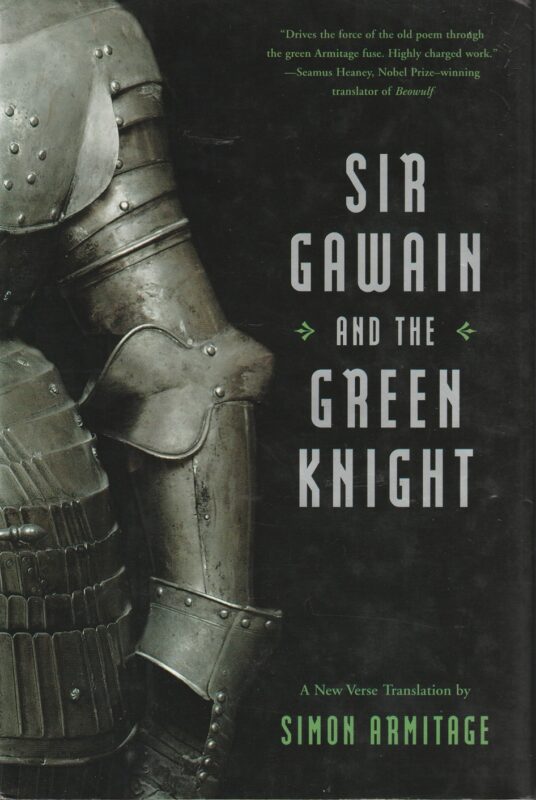
Title: Sir Gawain and the Green Knight
Author: Anonymous (circa 1370)
Translator: Simon Armitage (2007)
Pages: 198
Structure: 4 “Fitts”, 101 Stanzas, 2,530 lines
Sir Gawain and the Green Knight is a delightful fourteenth-century epic poem set in the time of King Arthur’s court and tells of the quest undertaken by a young knight in response to a challenge from a mysterious Green Knight.
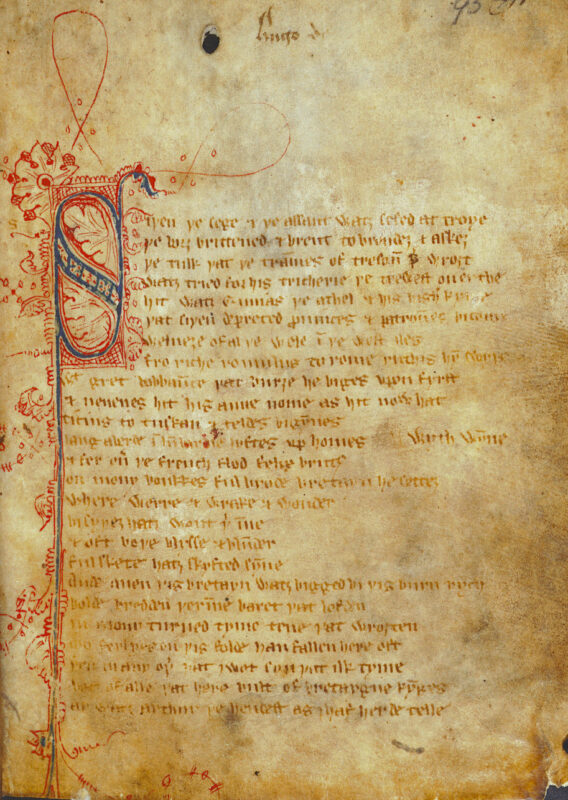
The story was written in Middle English – the same language used by Chaucer in The Canterbury Tales and was written around the same time. Unlike Chaucer’s work, this poem was written in alliterative verse rather than rhyming verse. It is not in fixed meter. In style, it’s more like Beowulf.
The author deviates from this style with a small rhyming quatrain at the end of each stanza, called the Bob and Wheel.
My copy was a facing page translation, so I could (try to) read the original text on one page, while reading Simon Armitage’s excellent translation on the other. Middle English is tantalizing. It felt like I could partially understand it – like it was hidden behind a translucent veil, but if I spoke it out aloud I could almost hear what the poet was trying to say.
Here’s a sample from the opening pages of the story:
Middle English:
Bot of alle that here bult of Bretaygne kynges
Ay was Arthur the hendest, as I haf herde telle.
Forthi an aunter in erde I attle to schawe,
That a selly in sight summe men hit holden,
And an outtrage awenture of Arthures wonderes.
If ye wyl lysten this laye bot on littel quile,
I schal telle hit astit, as I in toun herde,with tonge;
As hit is stad and stoken
In stori stif and stronge,
With lel letteres loken,
In londe so has ben longe.Translation:
But most regal of rulers in the royal line
was Arthur, who I heard is honored above all,
and the inspiring story I intend to spin
has moved the hearts and minds of many-
an awesome episode in the legends of Arthur.
So listen a little while to my tale if you will
and I’ll tell it as it’s told in the town where it trips fromthe tongue;
and as it has been inked
in stories bold and strong,
through letters which, once linked,
have lasted loud and long.
I highlighted the alliterative sounds that the poet used. Isn’t it amazing?
The story starts at a banquet in Arthur’s castle in Camelot on New Year’s Eve. The famished knights and fair ladies are gathered for a feast (see what I did there?), but are interrupted by the entry of a magical green knight:
…a mountain of a man, immeasurably high,
a hulk of a human form from head to hips,
so long and thick in his loins and his limbs
I should genuinely judge him to be a half giant,
or a most massive man, the mightiest of mortals.
The giant is green from head to foot, rides a green horse, and carries a massive green axe. He says that he has heard of the fame of Arthur’s court and has come to challenge one of them to a game of courage. Although Arthur is reluctant, he eventually agrees to the challenge but is interrupted by Gawain who tells Arthur that it’s not right for the King to accept the challenge. Gawain is the youngest and “least” of all the knights, so is the most expendable. Arthur should let Gawain face the challenge instead.
I am weakest of your warriors and feeblest of wit;
loss of my life would be grieved the least.
Were I not your nephew my life would mean nothing;
to be born of your blood is my body’s only claim.
Such a foolish affair is unfitting for a king,
so, being first to come forward, it should fall to me.
Gawain is not acting out of bravado, but from a genuine belief that this is his duty. He is trying to do the right thing.
The challenge is simple. Gawain is allowed to take one strike at the Green Knight with an axe. In return, the Knight is then allowed to take one strike at Gawain in a year and a day. On the surface it seems one-sided. If Gawain strikes in the right place he will kill the knight, so what is there to be afraid of?
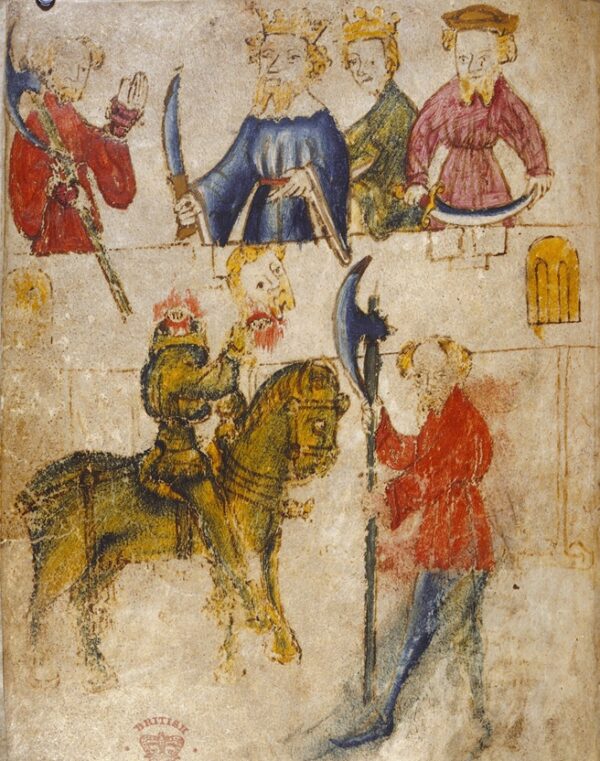
But the knight is magical. Gawain takes a swing of the axe, and lops off the knight’s head. The head rolls on the floor and the king’s men kick at it, then something strange happens:
Blood gutters brightly against his green gown,
yet the man doesn’t shudder or stagger or sink
but trudges towards them on those tree-trunk legs
and rummages around, reaches at their feet
and cops hold of his head and hoists it high,
and strides to his steed, snatches the bridle,
steps into the stirrup and swings into the saddle
still gripping his head by a handful of hair.
Then he settles himself in his seat with the ease
of a man unmarked, never mind being minushis head!
And when he wheeled about
his bloody neck still bled.
His point was proved. The court
was deadened now with dread.
What an amazing scene! Can you imagine the headless knight stooping down and picking up his grisly head from the floor by the hair, then addressing the court through the mouth of the severed head?
What becomes clear is that in his desire to do the right thing, Gawain has been drawn into a deceptive game. He has been offered what seemed like an easy challenge, but didn’t realize that decapitation would not kill the knight. And now he is faced with the certainty that in a year’s time he must face the knight in similar fashion and allow the knight one blow.
The next section of the book presents us with a beautiful description of the inevitability of death and shortness of life. The year flies by, Gawain tries to forget what lies ahead, but the seasons pass and soon the end of year approaches. True to the code of chivalry and honor, Gawain must seek out the Green Knight and face his fate.
Now, continuing in his desire to “do the right thing”, Gawain searches through the country for the knight. “He rides and rides, Sir Gawain, God’s servant, on his grim quest, passing long dark nights unloved and alone, foraging to feed, finding little to call food, with no friend but his horse through forests and hills and only our Lord in heaven to hear him.”
Gawain eventually finds refuge in a castle where he is offered hospitality, and celebrates Christmas with them. The lord and lady of the castle are kind to Gawain, but, under the chivalric code, this places an obligation on Gawain to serve and obey them while he stays with them.
The lord of the castle insists that Gawain rest up in the castle while he and his servants go on a hunt. The lady of the castle demands Gawain’s attention and tries to seduce him.
Gawain is in a difficult situation. Being a man of faith and honor, he doesn’t want to betray the trust of the lord of the castle, and is determined not to yield to the lady’s temptations. But the chivalric code demands that he must be polite to the lady and obey her as far as is morally possible.
Yet again we see Gawain trying to “do the right thing” even though it places him in a difficult situation.
Although the lady does not manage to seduce Gawain, she does tempt him to accept a magical silken belt imbued with protective powers. He accepts because he sees this as a chance to guard his life when he eventually has to face the Green Knight.
Only later do we learn that this has all been carefully arranged. The lord and lady are not who they seem, and they have been trying to deceive and trap Gawain in order to test the limits of the Arthurian code of chivalry, and reveal how difficult it is to live up to in a flawed and deceptive world.
Gawain eventually faces the Green Knight where all is revealed, and escapes with his life, and wounded pride. He is devastated when he feels that he has failed the test by “cheating” with the magical belt, and returns crestfallen to Arthur’s court.
The Green Knight is kinder in his judgement:
“…in truth it turns out
you’re by far the most faultless fellow on earth.
As a pearl is more prized than a pea which is white,
so, by God, is Gawain, amongst gallant knights.”
I love the messages hidden in this story. Sometimes we want to do the right thing, but our commitment to politeness and honor is contrary to our needs. There’s a cost to “doing the right thing”, and the game is often rigged. Not everyone plays by the same rules.
Also, time passes quickly. Our demise is inevitable:
“…for men might be merry when addled with mead
but each year, short lived, is unlike the last
and rarely resolves in the style it arrived.”
This is an easy book to read. You could easily read it in a couple of hours – but it’s more enjoyable if you take it slower. The imagery is stunning, especially the scene where the Knight lifts up his grisly head by the hair, holds open its eyes, and makes his challenge to Gawain.
It’s also a wonderful experience to see the world through the eyes of someone who lived over 700 years ago, speaking a language similar to ours, re-telling tales that still live in the periphery of our memory.
We need to read books like these.