


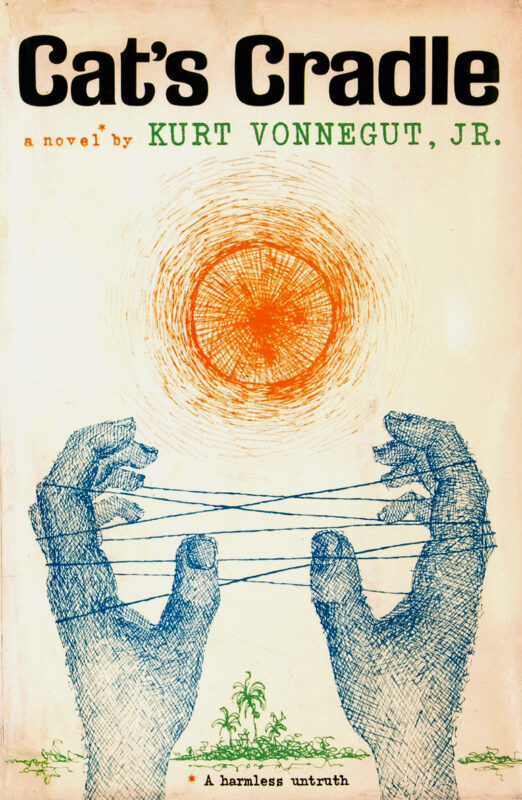
Title: Cat’s Cradle
Author: Kurt Vonnegut
Written: 1963
Pages: 306
Structure: A novel with 127 Chapters
Cat’s Cradle is a fascinating story about the end of the world, told with Kurt Vonnegut’s classic dry wit and gentle sarcasm.
The novel is written in the first person by a narrator named John, who opens his account with “Call me Jonah” – echoing Ishmael’s opening line in Moby Dick. But rather than a story of obsession about a whale, we follow John, a writer, as he tries to compile data for a book entitled “The Day the World Ended”, about the experiences of notable people on the day the U.S. dropped the Atom Bomb on Hiroshima.
The story is embellished with quotes from a fictional religion, Bokononism, based on the sayings of “Bokonon” (a.k.a Lionel Boyd Johnson), a self-styled prophet who helped establish a dictatorship on the fictional Caribbean island of San Lorenzo. When Johnson and his accomplice McCabe realized that their dictatorship would not improve the lives of the islanders, they invented a religion based on harmless lies to try and lift the spirits of their followers:
The first sentence in The Books of Bokonon is this: “All of the true things I am about to tell you are shameless lies.”
Bokononism is absurd, self-contradictory and openly fraudulent, yet it is also strangely humane. Vonnegut seems less interested in mocking faith itself than in asking whether comforting lies may sometimes be psychologically necessary.
This religion’s sacred text is the “Books of Bokonon” which include a series of “calypsos” that express the tenets of the faith:
Bokonon, I learned from Castle’s book, was born in 1891…for all his interest in the outward trappings of organized religion, he seems to have been a carouser, for he invites us to sing along with him in his “Fourteenth Calypso”:
When I was young,
I was so gay and mean,
And I drank and chased the girls
Just like young St. Augustine.
Saint Augustine,
He got to be a saint.
So, if I get to be one, also,
Please, Mama, don’t you faint.
The irony of Cat’s Cradle is that while the narrator searches for stories connected to the bombing of Hiroshima, he instead uncovers a far greater existential threat.

That threat is Ice-9 – a strangely shaped crystalline form of water which has a very high melting point, so that ice crystals are stable even at room temperature. Any liquid water which comes in contact with it immediately freezes. Like most deadly inventions, researchers invented Ice-9 at the request of the U.S. military to improve conditions for marines fighting in mud.
“Now suppose,” chortled Dr. Breed, enjoying himself, “that there were many possible ways in which water could crystallize, could freeze. Suppose that the sort of ice we skate upon and put into highballs— what we might call ice-one— is only one of several types of ice. Suppose water always froze as ice-one on Earth because it had never had a seed to teach it how to form ice-two, ice-three, ice-four …? And suppose,” he rapped on his desk with his old hand again, “that there were one form, which we will call ice-nine— a crystal as hard as this desk— with a melting point of, let us say, one-hundred degrees Fahrenheit, or, better still, a melting point of one-hundred-and-thirty degrees.”
The downside of the invention is that if it is ever released into the environment, it will freeze all liquid water on earth that it touches. It will freeze the water in the body of any animal or human that comes in contact with it.
The remainder of the book follows the mishaps of the narrator as he visits San Lorenzo, meets the ailing dictator, “Papa” Monzano, and is eventually chosen to replace “Papa” after his death.
As we follow this farcical unfolding of events, we’re forced to confront the effects that unlimited technology has on us as a species, and how powerless we are to stop it. At the same time, we are confronted with questions about our own free will. The narrator has no choice but to accept nomination as the new dictator. Despite his dreams of improving the lives of the islanders, he realizes that he is unable to do so, and therefore must continue the mirage of Bokononism to keep the people happy. And ultimately he is unable to prevent the ravages of Ice-9.
Bokononism’s idea of a “karass” reflects Vonnegut’s rather bleak view of free will and human agency. A karass is supposedly a group of people mysteriously linked together for some higher purpose, even though none of them really understand what that purpose is. Throughout the novel, characters seem to drift helplessly toward catastrophe, convincing themselves that they are making meaningful choices while actually following paths that were probably inevitable from the beginning. The narrator does not consciously seize power or shape his destiny so much as stumble accidentally into becoming dictator of San Lorenzo. In this sense, Vonnegut presents humanity as far less rational and in control than we like to imagine. Technology advances beyond our wisdom, history unfolds beyond our control, and people continue marching toward disaster while telling themselves comforting stories about being in control.
In many ways, the story is an allegory. At the time it was written in the 1960’s, the world was in the midst of the Cold War, fearing nuclear annihilation. The Cuban Missile Crisis focused the world’s attention on another small dictatorship in the Caribbean Sea. Religion offered the illusion of comfort. We felt powerless to prevent impending Armageddon.
Vonnegut shows us that comedy and farce can sometimes be the best way to approach these alarming ideas. In our amusement at the actors in “Cat’s Cradle” we laugh at ourselves, our world, and our governments.
To quote Vonnegut himself in the book:
There was a quotation from The Books of Bokonon on the page before me. Those words leapt from the page and into my mind, and they were welcomed there. The words were a paraphrase of the suggestion by Jesus: “Render therefore unto Caesar the things which are Caesar’s.” Bokonon’s paraphrase was this: “Pay no attention to Caesar. Caesar doesn’t have the slightest idea what’s really going on.”
This is an easy book to read. The novel’s 127 miniature chapters give it an unusual rhythm: sharp, fragmented, fast-moving and deceptively light, even as the story moves steadily toward catastrophe.
Despite its humour and absurdity, Cat’s Cradle leaves behind a lingering sense of unease. More than sixty years after it was written, its warnings about technology, political power and humanity’s willingness to embrace comforting illusions still feel uncomfortably relevant.
I recommend it.