


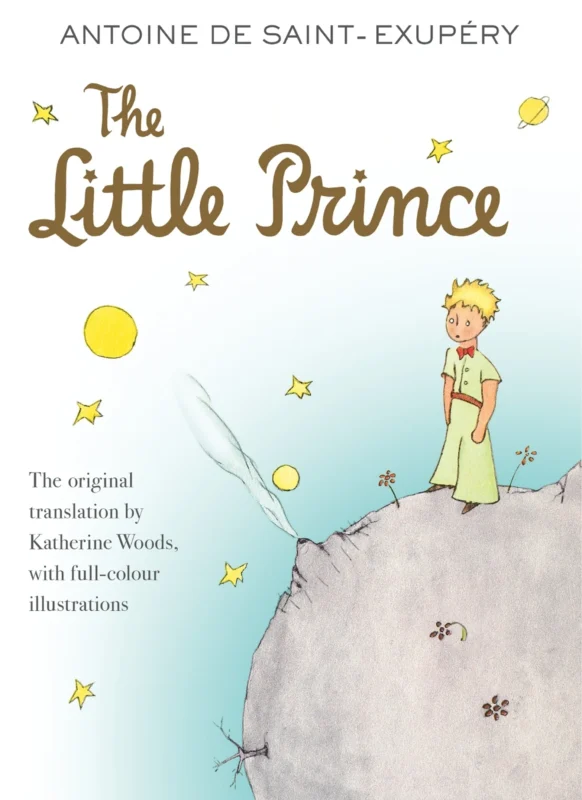
Title: The Little Prince (Le Petit Prince)
Author: Antoine de Saint-Exupéry
Written: 1943
Pages: 160
Structure: A novella with 27 Chapters
Is this a children’s book, or is it a masterfully written work of philosophy which challenges the way we observe the world? Either way you approach it, “The Little Prince” is a magical creation which has much to teach those who are either young, or young at heart.
This book was written during the Second World War while Saint-Exupéry was living in exile from occupied France, and was banned by the occupying Nazi government. It eventually went on to sell more than 140 million copies, which makes it one of the most successful literary works of all time.
Antoine de Saint-Exupéry was an aviator who fought with the Allies out of Algiers during the war. Like the protagonist of the story, the author crashed his plane in the Sahara desert. So it’s possible to view “The Little Prince” as a magical version of the author’s own experiences and thoughts.

The story begins with Saint-Exupéry describing his childhood drawings, and how adults lacked the imagination to understand them. A fanciful drawing of a boa constructor that has just swallowed an elephant (!) is misinterpreted by adults as a drawing of a hat. Adults are presented as people whose imagination and sense of wonder have become dulled.
All grown-ups were once children – although few of them remember it….
…Grown-ups never understand anything by themselves, and it is tiresome for children to be always and forever explaining things to them…
…Children should always show great forbearance toward grown-up people.
We’re then moved to the scene of an aircraft crash in the Sahara. The narrator is alone, with no passengers or mechanic, and must attempt the difficult repairs alone. For him it is a “matter of life and death”. He has only a small amount of drinking water, and is thousands of kilometres from any human habitation.
It is then that we are introduced to The Little Prince, who visits the narrator at sunrise, asking him to draw a picture of a sheep.
The narrator is not a confident artist, and so first draws a picture of a boa constrictor that has just swallowed an elephant. The Little Prince immediately recognizes the true subject of the drawing – obviously he does not suffer the same cognitive impairment as adults. After some negotiation, and several revisions of sheep-drawings, the narrator eventually draws a box with holes in it, which is recognized by the Prince as a small sheep inside his house. The picture is perfect.
Like many children, the Little Prince is voraciously curious, and persistently asks questions until he has a satisfactory answer. But he is reluctant to answer any questions about himself. The narrator learns about the the Prince’s origin only by listening carefully, and making inferences from what he has heard.
We learn that the Prince is from Asteroid B-612, which is so small that it’s possible to walk around in minutes. It has three small volcanoes, and one small, but very beautiful flower.
But… in telling us these details, the author makes an important point, reminding us of the limited way in which we view the world:
If I have told you these details about the asteroid, and made a note of its number for you, it is on account of the grown-ups and their ways. When you tell them that you have made a new friend,
they never ask you any questions about essential matters. They never say to you, “What does his voice sound like? What games does he love best? Does he collect butterflies?” Instead, they demand: “How old is he? How many brothers has he? How much does he weigh? How much money does his father make?” Only from these figures do they think they have learned anything about him……Just so, you might say to them: “The proof that the little prince existed is that he was charming, that he laughed, and that he was looking for a sheep. If anybody wants a sheep, that is a proof that
he exists.” And what good would it do to tell them that? They would shrug their shoulders, and treat you like a child. But if you said to them: “The planet he came from is Asteroid B-612,” then they would be convinced, and leave you in peace from their questions……for us who understand life, figures are a matter of indifference.
It is then that Saint-Exupéry presents us with an important point: “I do not want anyone to read my book carelessly. I have suffered too much grief in setting down these memories.”
After reading this, I was forced to stop and think. Was this merely a kid’s story, or was it something deeper? Or was it both?
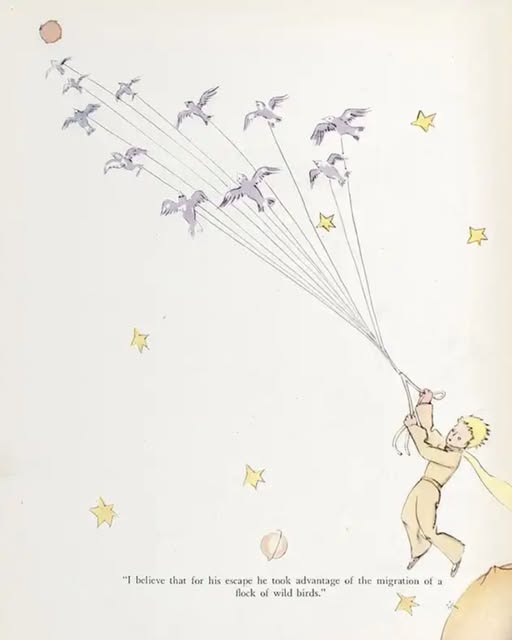
Eventually the story transforms from a first-person account of the narrator’s interaction with the Prince, into a description of the Little Prince’s life and experiences.
We hear about the small flower that grows on the Prince’s planet, and how much he loves it. We then learn about how he left his planet for an adventure, being carried away by “the migration of a flock of wild birds”.
He visits a series of asteroids. Each asteroid contains an adult trapped within a narrow and self-important way of seeing the world. A haughty king with no subjects, a conceited man who thinks that everyone admires him, a drunkard who is ashamed of his habit, a businessman who is obsessed with counting the stars, and so forth.
Each of the grown-ups has a similar attitude to life: “I am very busy with matters of consequence”.
At the end of each encounter, the Prince concludes “Grown-ups are very strange”.
Eventually the Prince visits the Earth, which we are told contains hundreds of thousands of people like the strange grown-ups that he encountered on other planets.
He meets a snake, another flower, an echo, a rosebush, and eventually a wise fox who teaches the Prince that “being tamed” is caring for someone with whom we have spent love and time. This is what makes them special.
if you tame me, then we shall need each other. To me, you will be unique in all the world. To you, I shall be unique in all the world…
“I am beginning to understand,” said the little prince. “There is a flower… I think that she has tamed me…”
“Men have forgotten this truth,” said the fox. “But you must not forget it. You become responsible, forever, for what you have tamed. You are responsible for your rose…”
In response to the author’s request that we not read the book carelessly, I was challenged to ask what he was really trying to say to me.
I think the Prince may represent the child within ourselves. We like to think of ourselves as growing “up” as though this is an improvement on childhood, but the author is saying that there are perspectives that we often lose as we age. As the author laments: “Perhaps I am a little like the grown-ups. I have had to grow old.”
We regain those perspectives by remembering our own “Little Prince” – who teaches us that the things that we tend to focus on, that we think of as “matters of consequence” are not as important as we think. We need to remember our own innocence and experiences of the magic of the world.
if I forget him, I may become like the grown-ups who are no longer interested in anything but figures
I have read many books concerned with “matters of consequence”, but I think “The Little Prince” – so short and simple, probably contains some of the most profound lessons we can learn.
This is something we should re-read many times. We are grown-ups for a long time.