


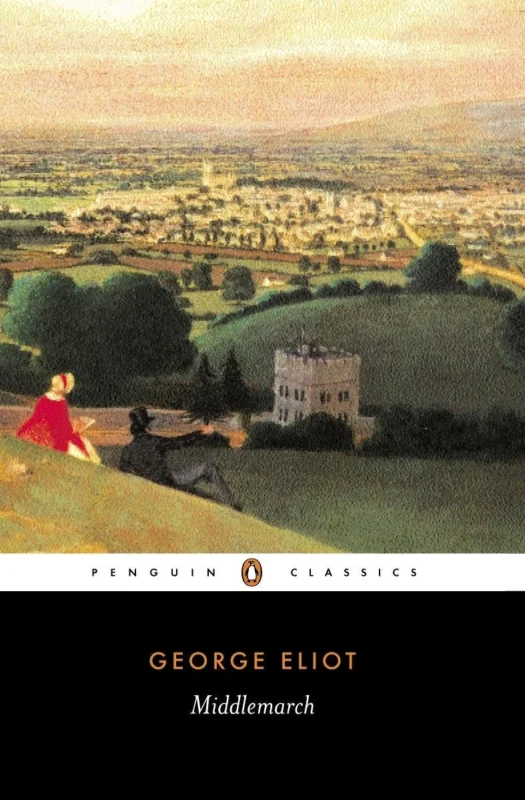
Title: Middlemarch. A Study of Provincial Life
Author: George Eliot
Written: 1872
Pages: 912
Structure: Prelude, 86 Chapters, Finale, in eight “Books”.
Middlemarch surprised me. It’s brilliantly clever: intimate, and vast at the same time. On the surface it is about life in a small provincial town in the English Midlands around 1830, but under the surface it explores the hopes, motivations and frustrations of people just like us. We can understand what drives each of the characters, even though we may disagree with them. The result feels more than a story, it is almost a detailed philosophy our own minds.
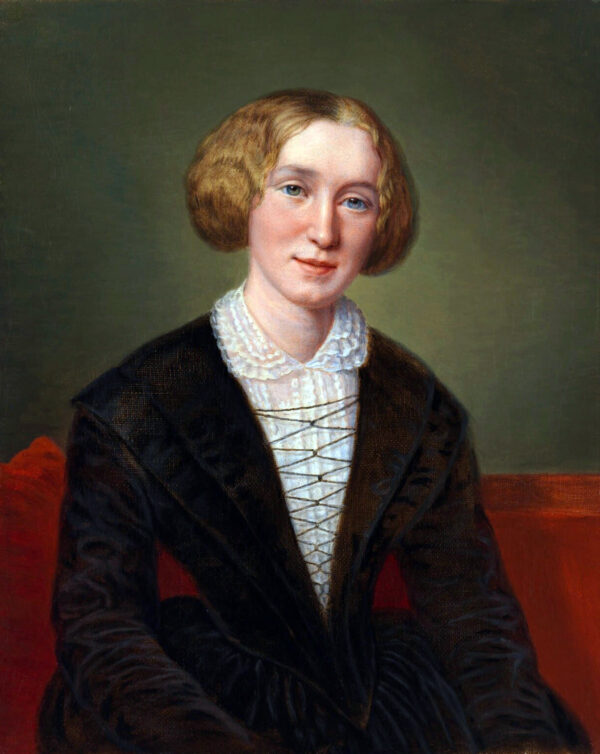
George Eliot was the pen name of Mary Anne Evans (1819 – 1880), who wrote under this pseudonym to make sure her work was judged purely on its merits. Many nineteenth century women’s novels were unjustly dismissed as “light-hearted romances”.
This is a huge, and truly great novel. There is no way this review could ever do it justice. My purpose is to suggest it is well worth the lengthy periods that you’ll need to read it.
The novel starts with a “Prelude” in which Eliot states her premise by referring to Saint Teresa of Avila – a sixteenth century hero of the Roman Catholic church who as a young child set off to “seek martyrdom in the country of the Moors”. Teresa is thwarted in her passionate pilgrimage by her uncle, and eventually ended up living as a mystic Carmelite nun and reformer. She is presented as leading “a life of mistakes… ill-matched with the meanness of opportunity; perhaps a tragic failure which found no sacred poet and sank unwept into oblivion.”
In this way, she presents the theme of the novel – well-meaning, beautiful souls, who are thwarted by the reality of life. In other times they might have been raised to greatness, but instead live good but difficult lives in relative obscurity. It is like:
a cygnet is reared uneasily among the ducklings in the brown pond, and never finds the living stream in fellowship with its own oary-footed kind. Here and there is born a Saint Theresa, foundress of nothing, whose loving heartbeats and sobs after an unattained goodness tremble off and are dispersed among hindrances, instead of centring in some long-recognizable deed.
Over the next eighty-six chapters and eight books we follow the lives of several fascinating protagonists whose lives intersect. Due to the size of the novel I will only mention a few here.
Dorothea Brooke is the main subject of the first of these eight books. She is an idealistic and sharply intelligent woman who wants to improve the world. Born into a reasonably wealthy family, and raised by an idealistic but ineffectual uncle (Arthur Brooke) she has plans to build cottages to improve the lives of the people who work in and around her estate.
In Mr. Brooke the hereditary strain of Puritan energy was clearly in abeyance; but in his niece Dorothea it glowed alike through faults and virtues, turning sometimes into impatience of her uncle’s talk or his way of “letting things be” on his estate, and making her long all the more for the time when she would be of age and have some command of money for generous schemes.
This idealism leads Dorothea into an unfortunate mismatched marriage with Rev Edward Casaubon – a dry and aging scholar whose obsession with his life’s work leaves him increasingly incapable of understanding the emotional needs of his young wife. He becomes jealous of Dorothea’s idealism and warmth to other people, especially his younger cousin. Casaubon’s dry pedantry smothers Dorothea and frustrates her ideals. In his jealousy, Casaubon adds a condition to his will which prevents Dorothea from inheriting his fortune if she pursues a relationship with his cousin Will Ladislaw.
Tertius Lydgate is a brilliant but idealistic young doctor who aspires to make advances in medicine through his research and new methods of treating his patients. He faces frustrations on many fronts. Other doctors feel that his new methods of treatment are an indirect criticism of them, so they speak against him. Townspeople become suspicious of him, and thus the income he receives from his practice is diminished. He is forced to cooperate with a wealthy self-righteous banker, Nicholas Bulstrode who is despised by the townspeople for his hypocrisy.
Lydgate believed that he should not marry for several years: not marry until he had trodden out a good clear path for himself away from the broad road which was quite ready made…
…But Lydgate was young, poor, ambitious. He had his half-century before him instead of behind him, and he had come to Middlemarch bent on doing many things that were not directly fitted to make his fortune or even secure him a good income.
Despite his plans, Lydgate falls in love and marries the beautiful Rosamond Vincy, only to discover she is vain and secretive. Lydgate ends up spending far more money than he expected to keep her happy, eventually leading to him almost becoming bankrupt. His idealism is thwarted by the realities of life.
Fred Vincy is the young entitled brother of Rosamond. He is in love the Mary Garth, and hopes to inherit a fortune from his uncle, Peter Featherstone, when he dies.
“Fred Vincy had never been a dull fellow, and perhaps there was no man in Middlemarch who had a more hopeful disposition.”
Unfortunately, Fred foolishly loses money gambling, and (since his father refuses to help) seeks financial aid from Mary’s father Caleb. Although Mary loves Fred, she refuses to marry him until he is able to make something of himself, saying “You are not a fool, Fred; but you are thoughtless and weak.”
Fred almost inherits the Featherstone fortune. Peter Featherstone has made out two wills, one of which favours Fred. Mary cares for Featherstone on his death bed. In his final hours he asks Mary to burn one of the wills, so that Fred might inherit the fortune. Mary refuses. Her integrity does not allow her to interfere with someone else’s Last Will and Testament. Thus, ironically, Fred does not inherit the fortune, and is forced to seek work on the land with Mary’s father who is a surveyor and land agent.
Eliot continually shows us how these beautiful idealistic people, like Saint Theresa in the prelude of the book, are thwarted by the realities of life. But this is not tragic. The characters have integrity, and act with goodness despite the heartache they face.
For example, when Dorothea is a widow who has just discovered the nastiness of her deceased husband’s will, she offers to speak with Lydgate’s wife Rosamond about a delicate matter:
As Lydgate rode away, he thought, “This young creature has a heart large enough for the Virgin Mary. She evidently thinks nothing of her own future, and would pledge away half her income at once, as if she wanted nothing for herself but a chair to sit in from which she can look down with those clear eyes at the poor mortals who pray to her. She seems to have what I never saw in any woman before— a fountain of friendship towards men— a man can make a friend of her.
Eliot’s greatest gift is her ability to show us the world through the eyes of people with whom we disagree. Even the novel’s hypocrites, fools and villains rarely appear monstrous. Instead, Eliot reveals the hopes, fears and self-deceptions that drive them. We understand why people make mistakes even when we wish they would act differently.
This novel is vast. It tackles important issues such as marriage, the power of money, the role of women, the effects of industrialisation. It describes a time of upheaval in British history – reforms in voting, the spread of the railways, the fear of revolution as was happening in France.
On this immense tapestry are our small protagonists who seem to be swallowed up by the machinery of an advancing civilization. Eliot demonstrates that despite this, the characters live meaningful lives, and shape the world – though not in the way they anticipate.
But we insignificant people with our daily words and acts are preparing the lives of many Dorotheas, some of which may present a far sadder sacrifice than that of the Dorothea whose story we know. Her finely touched spirit had still its fine issues, though they were not widely visible. Her full nature, like that river of which Cyrus broke the strength, spent itself in channels which had no great name on the earth. But the effect of her being on those around her was incalculably diffusive: for the growing good of the world is partly dependent on unhistoric acts; and that things are not so ill with you and me as they might have been, is half owing to the number who lived faithfully a hidden life, and rest in unvisited tombs.
I think this is profound. Yes, we are insignificant, but our actions have an effect on the world. Our kindness matters.
Eliot’s point is not that Dorothea failed. It is that greatness is not measured by fame. Dorothea never becomes a saint, reformer, or historical figure, yet her goodness changes the lives around her. The same is true of countless ordinary people whose names are forgotten. Their kindness and integrity still shape the world.
The world is better because we, and people like Dorothea were in it.