


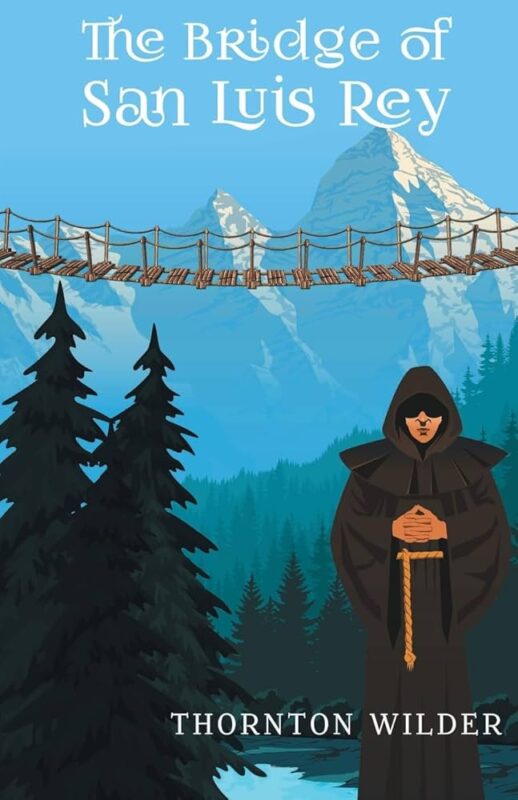
Title: The Bridge of San Luis Rey
Author: Thornton Wilder
Written: 1927
Pages: 255
Structure: Five Parts
In this beautiful novel, an Inca rope bridge collapses in Peru in 1714, killing five people. This leads the priest who witnessed the disaster to ask questions about the lives of the victims as he tries to come to terms with why God allowed these people to die.
I was personally drawn to this story because I wanted to understand how we write about people who have died. When we’re gone, what are the echoes that remain of our lives? How are we remembered? What really mattered in the end?
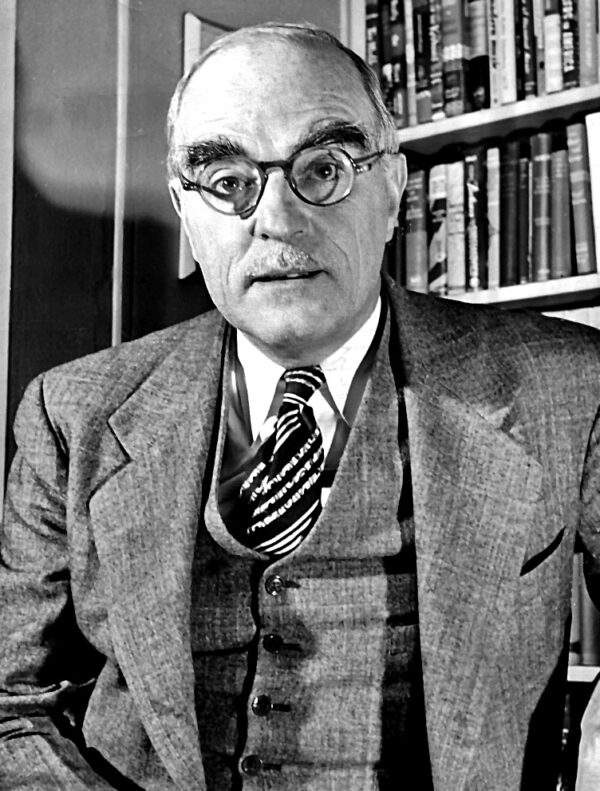
Thornton Wilder (1897 – 1975) won the 1928 Pulitzer Prize for this novel. The protagonist of his story is Brother Juniper, a Franciscan friar who in 1714 witnessed the collapse of a rope bridge which caused the death of five people. This Inca rope bridge “was a mere ladder of thin slats swung out over the gorge, with handrails of dried vine… The bridge seemed to be among the things that last forever; it was unthinkable that it should break.”
So begins this tenderly crafted story. People are shocked by the catastrophe, identify with the victims, and realise with a shudder that this could have been them:
“The moment a Peruvian heard of the accident he signed himself and made a mental calculation as to how recently he had crossed it and how soon he had intended crossing by it again. People wandered about in a trance-like state, muttering; they had the hallucination of seeing themselves falling into a gulf.”
When Brother Juniper witnesses the accident, he hears the ropes twang when they break, he sees the people fall like ants into the gorge, and he asks a simple question: “Why did this happen to those five?” If the universe had a plan, surely it could be discovered. Either everything is capricious and accidental, or there is some plan which can be discerned.
For Juniper, his religion is a science. It should be reasonable and logical. The world should be his laboratory in which he can make investigations, gather facts, and come to an eventual understanding of why the disaster happened.
Through these investigations we learn, posthumously, about the lives of the people who were killed. What were they like? What stirred their hearts? How did they feel? How did they act?
Marquesa Doña María is an ageing old rich woman who loves her daughter Clara more than anything. Clara doesn’t feel the same affection towards her mother, and moves away from Peru to Spain where she marries. Maria misses her daughter, and through the letters she writes to Clara we learn about her life and her feelings. She has a kind heart and is unaware of how her servants steal from her, or of how other people make fun of her.
She is very lonely.
…all she could ask of a god, or of immortality, was the gift of a place where daughters love their mothers.
Pepita is a young woman who, as an orphan, was raised in a convent. Because of her pleasant intelligence, the Abbess of the convent takes her under her wing and teaches her “how to manage women and how to plan contagious wards, and how to beg for money”.
In her loneliness, Maria employs her as a companion and helper. Pepita becomes acutely aware of Maria’s sad life, and the way people take advantage of her. She develops a strong loyalty and compassion for her employer.
When Maria learns that her daughter Clara is pregnant, she decides to visit a religious shrine to pray for her daughter’s safety, and takes Pepita with her.
It is during this journey that they both cross the fateful bridge when it collapses, and lose their lives.
Esteban and Manuel are twins who were brought up in the same orphanage as Pepita. The twins’ relationship is so close that they have developed their own secret language. When they grow up, they both become scribes, dictating letters for wealthy people, and copying manuscripts. Manuel dies of an infection which devastates his brother, who runs away to Cuzco in his grief.
A sea captain pursues Esteban and convinces him to return to Lima with him and become part of his crew, and sail the world.
Esteban agrees, and it is on this journey back to Lima, that he crosses the dreaded bridge and dies.
Uncle Pio is a valet and singing teacher, who loves an actress, Camila, who does not return his love. He was…
Camila Perichole’s maid. He was her singing-master, her coiffeur, her masseur, her reader, her errand-boy, her banker; rumor added – her father.
It is because of Pio’s dedication over many years that Camila is transformed from a twelve-year-old singer to the most famous performer in all of Peru. She becomes the mistress of the Viceroy of Peru, as well as having affairs with other men such as Esteban’s brother Manuel.
Through all of this, Pio remains devoted to her. But when she suffers the scars of smallpox, she rejects Pio, telling him she does not wish to see him again.
As a parting act of devotion, Pio convinces Camila to let him take her son, Don Jaime, to Lima so that Pio can teach him and give him the same opportunities that he gave Camila.
Camila agrees, and it is on the trip back to Lima that they cross the bridge and die.
Brother Juniper spends six years investigating the lives of the people who died, and writes a book in which he assigns various measures of the worthiness of each of the victims. He ultimately reaches no conclusion – the fate of each of the people who died has no correlation with their inherent “goodness”. The tragedy of Juniper’s project is that the question itself cannot be answered by statistics or logic. Human lives resist being reduced to a ledger of merits and faults.
The church deems Juniper’s work heretical, and he is burned at the stake.
The book ends with the living thinking about the dead. Maria’s many letters are bound into a volume and immortalized; the sea captain thinks about Esteban while sitting on the edge of his boat and considers how false and unreal the funeral procession is; the Abbess remembers Pepita and realizes she should have shown more affection and been less busy; Camila remembers Pio and Don Jaime, and realizes that she has no heart and that her life is meaningless. She eventually finds relief from her despair by sharing her grief with the Abbess, who is also grieving for Pepita.
Hearing about the death of her mother, Clara returns to Lima and meets with the Abbess. She is regretful of her earlier selfishness towards Maria, but the Abbess tells her:
“in love our very mistakes don’t seem to be able to last long.”
The Abbess thinks about the people who had died, “who had no one to turn to, for whom the world perhaps was more than difficult, without meaning”, and she realizes that eventually we will all be forgotten.
“But soon we shall die and all memory of those five will have left the earth, and we ourselves shall be loved for a while and forgotten. But the love will have been enough; all those impulses of love return to the love that made them. Even memory is not necessary for love. There is a land of the living and a land of the dead and the bridge is love, the only survival, the only meaning.”
For me, that final realization is the beautiful gem of the story. We have read how three centuries ago there were some people in pain who wanted to be loved, and who died. We read about someone who wanted to remember all the details of their lives and write it down as precisely as he could. But he also died. And this story itself was crafted a century ago by an author who is now also dead.
Each of them had a purpose and plan that was important to them, but those plans dissolved. All that remained was the way they ultimately touched the lives of others through their love. Brother Juniper tries to build a bridge from the living to the dead through facts and analysis. Wilder ultimately suggests that love itself is the bridge.
As I mentioned at the start, I came to this novel with a question. “What are the echoes that remain of our lives after we have gone?” I think Thornton answers my question well, from beyond the grave. I am glad I read it.