


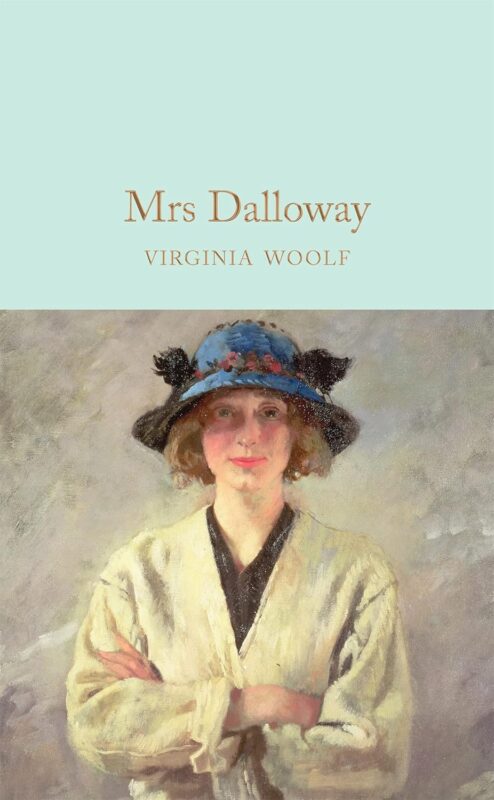
Title: Mrs Dalloway
Author: Virginia Woolf
Written: 1925
Pages: 224
Structure: No chapters.
What does it feel it like to be a middle-aged woman in 1920’s London? Or a traumatised war veteran battling insanity? Or dissatisfied playboy who never really got over being rejected by the love of his life? Mrs Dalloway answers these questions in an intimate way, allowing us to dwell in the minds of different people for one day in June 1922, flitting from mind to mind like a telepathic butterfly.
It’s one of the most unusual novels I have read, and one of the most rewarding.
I found this book challenging. It’s important to realise from the start that it is not plot driven. We’re not exploring a sequence of events, but the thoughts and feelings of different people as they all proceed through one summer day in London.
Clarissa Dalloway, wife of British Conservative MP Richard Dalloway, goes shopping in London for flowers, in preparation for a formal party that she will be hosting that evening. The beautiful day reminds her of her youth, and the people who meant a lot to her at that time. We eavesdrop on her thoughts as she sees a dignitary driving past in a chauffeured car, as she meets an old friend on the street, as she looks at books in a shop window. We hear her thoughts about her own life.
She felt very young; at the same time unspeakably aged. She sliced like a knife through everything; at the same time was outside, looking on. She had a perpetual sense, as she watched the taxi cabs, of being out, out, far out to sea and alone; she always had the feeling that it was very, very dangerous to live even one day…
…Did it matter then, she asked herself, walking towards Bond Street, did it matter that she must inevitably cease completely; all this must go on without her; did she resent it; or did it not become consoling to believe that death ended absolutely?
Despite her frustrations with her own life, Clarissa is bright and optimistic. Memories of her delightful and privileged youth at Bourton continually come back to her in flashbacks. She remembers a stolen kiss with her girlfriend Sally Seaton, times of flirting with a romantic interest Peter Walsh, and of playing in the expansive gardens at the old house.
Septimus Warren Smith is a veteran from Word War 1. He is haunted by hallucinations, and memories of his comrade Evans who was killed on the battlefield. He sees some skywriting by an airplane passing overhead, advertising some sort of product, and thinks it is a supernatural message specifically for himself:
So, thought Septimus, looking up, they are signalling to me. Not indeed in actual words; that is, he could not read the language yet; but it was plain enough, this beauty, this exquisite beauty, and tears filled his eyes as he looked at the smoke words languishing and melting in the sky and bestowing upon him in their inexhaustible charity and laughing goodness one shape after another of unimaginable beauty and signalling their intention to provide him, for nothing, for ever, for looking merely, with beauty, more beauty! Tears ran down his cheeks.
Although Clarissa and Septimus never meet, Woolf quietly binds their lives together, suggesting that strangers may share emotions and fears they never express aloud. Like Clarissa, Septimus’ memories intrude into his life. But instead of bringing him delight as they did for Clarissa, they haunt him. He is suicidal. He is fighting insanity. The sensations of busy London intrude on his mind, causing him to disengage from reality.
Our perspective shifts to his young wife, Lucrezia, who cares for Septimus. She is exasperated. She secretly wishes he would die, so that she could be free, but (as a woman in the 1920’s) it is impossible for her to share her thoughts with anyone:
For she could stand it no longer. Dr. Holmes might say there was nothing the matter. Far rather would she that he were dead! She could not sit beside him when he stared so and did not see her and made everything terrible; sky and tree, children playing, dragging carts, blowing whistles, falling down; all were terrible. And he would not kill himself; and she could tell no one. ‘Septimus has been working too hard’ — that was all she could say, to her own mother. To love makes one solitary, she thought. She could tell nobody, not even Septimus now, and looking back, she saw him sitting in his shabby overcoat alone, on the seat, hunched up, staring. And it was cowardly for a man to say he would kill himself, but Septimus had fought; he was brave; he was not Septimus now.
Peter Walsh is a childhood friend of Clarissa’s whom she rejected when he proposed to her. He moved to India, had an unhappy marriage, and is seeking to divorce his current wife. He is now having an affair with a married woman, but is still secretly is in love with Clarissa. He has an annoying habit of playing with a pen-knife while he thinks, and drops in uninvited to visit Clarissa in the afternoon, and we eavesdrop on his thoughts:
Here she is mending her dress; mending her dress as usual, he thought; here she’s been sitting all the time I’ve been in India; mending her dress; playing about; going to parties; running to the House and back and all that, he thought, growing more and more irritated, more and more agitated, for there’s nothing in the world so bad for some women as marriage, he thought; and politics; and having a Conservative husband, like the admirable Richard. So it is, so it is, he thought, shutting his knife with a snap.
And then suddenly we’re drawn into Clarissa’s thought of Peter:
Now of course, thought Clarissa, he’s enchanting! perfectly enchanting! Now I remember how impossible it was ever to make up my mind — and why did I make up my mind — not to marry him, she wondered, that awful summer?

Virginia Woolf wrote this novel in 1925 at a time of upheaval in English life. The War had ended. Some women had been given the right to vote in 1918 while others received the same right as men in 1928. The political landscape was changing rapidly, culminating in Britain’s first Labour government in 1924. Watching movies at cinemas had become a popular pastime for many people.
These changes are reflected in the novel.
Many of the scenes are cinematic. As I read the novel, in my mind’s eye I could picture a camera moving from one character to another while a car backfired in the street, or while a skywriting airplane droned overhead. Woolf treats the narrative perspective almost like a moving camera, except that it can also slip effortlessly into a character’s thoughts and memories.
We’re reminded of the passage of time continually throughout the story as we hear Big Ben marking out the hours:
Big Ben was beginning to strike, first the warning, musical; then the hour, irrevocable…The leaden circles dissolved in the air.
We’re also reminded of the impotence of the establishment to address some of the major problems facing society. His doctors prove incapable of preventing Septimus from committing suicide by jumping from a balcony. The people at Clarissa’s party mention the suicide, and Clarissa thinks of him while watching an old lady across the street through her window:
The clock began striking. The young man had killed himself; but she did not pity him; with the clock striking the hour, one, two, three, she did not pity him, with all this going on. There! the old lady had put out her light! the whole house was dark now with this going on, she repeated, and the words came to her, Fear no more the heat of the sun. She must go back to them. But what an extraordinary night! She felt somehow very like him — the young man who had killed himself. She felt glad that he had done it; thrown it away while they went on living. The clock was striking. The leaden circles dissolved in the air. But she must go back. She must assemble.
What is Woolf trying to show us with this novel? My impression was that ordinary moments are not interruptions between the important events of our lives. They are our lives. We don’t experience our own lives as a story with a central plot, climax and resolution. Mundane events such as crossing the road, or walking in the park are things worthy of our attention.
Similarly I think Mrs Dalloway shows us that one event, such as the striking of a clock bell, or an airplane flying overhead, has vastly different meanings for different people. A skywriter can be a delightful curiosity for one person, and a horrifying reminder of past trauma for another.
But perhaps the most striking thing for me was the experience of seeing the world through someone else’s eyes, and feeling emotions and responses that I would not otherwise have felt. Each person is their own universe of feelings and memories – it’s good to remember that when we interact.
It’s a challenging book. It took me two attempts to finish it, but Mrs Dalloway was worth the time. I feel like it has changed the way I look at other people. I recommend it.