


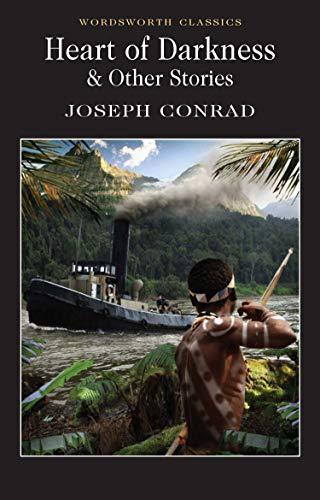
Title: Heart of Darkness
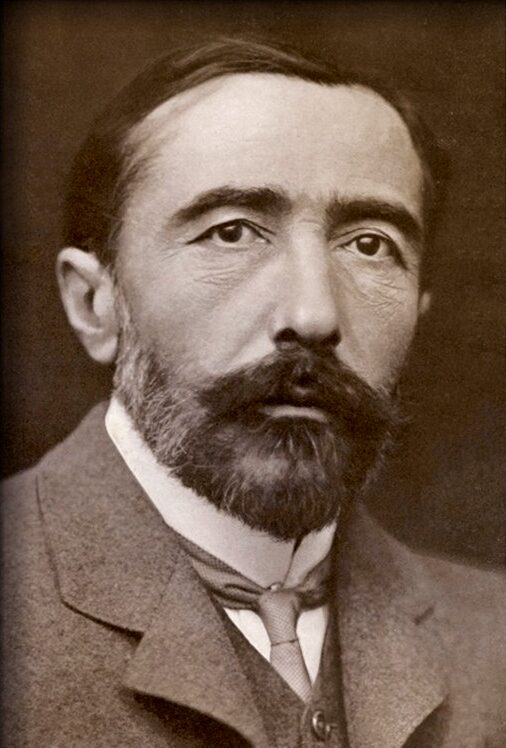
Author: Joseph Conrad
Written: 1899
Pages: 188 pages
Structure: Three Chapters.
Heart of Darkness is a chilling story set in the Nineteenth Century about corruption and colonialism on the Congo River, told by Charles Marlow, the captain of a river steamboat. By the end of it, I wondered whether the darkness that Conrad spoke about throughout the novella was in our own hearts rather than in the dark jungles of the Congo.
The story starts on the sailing ship “Nellie” at anchor on the sea-reach of the Thames in London. Charlie Marlow is sharing a rambling story with his friends. At first he remembers the people in history who have sailed on this river “from Sir Francis Drake to Sir John Franklin … the great knights-errant of the sea”. He recalls their adventures and conquests:
Hunters for gold or pursuers of fame, they had all gone out on that stream, bearing the sword, and often the torch, messengers of the might within the land, bearers of a spark from the sacred fire.
He then shifts perspective, remembering that Roman soldiers once landed on these same shores, and that at one time England had “been one of the dark places of the earth”, and that at one time there might have been a young citizen in a toga who landed in an English swamp and marched through the savage woods to collect taxes for the Romans.
We then get a hint of Marlow’s attitude towards conquest and colonialism – both the Romans and, by implication, the English as well:
They were conquerors, and for that you want only brute force – nothing to boast of, when you have it, since your strength is just an accident arising from the weakness of others. They grabbed what they could get for the sake of what was to be got….
…The conquest of the earth, which mostly means the taking it away from those who have a different complexion or slightly flatter noses than ourselves, is not a pretty thing when you look into it too much.
What struck me about this story was the way Conrad powerfully describes scenes and ideas.
Conrad rarely lectures the reader directly. Instead, he builds his argument through images and symbols. Brussels becomes a “whited sepulchre”, outwardly clean but inwardly corrupt. The women knitting black wool resemble the Fates of Greek mythology, quietly measuring out human destinies. Throughout the novella, ordinary scenes acquire an unsettling symbolic weight.
Often far away there I thought of these two, guarding the door of Darkness, knitting black wool as for a warm pall, one introducing, introducing continuously to the unknown, the other scrutinizing the cheery and foolish faces with unconcerned old eyes.
When he receives his commission to captain a steamboat up the Congo, Marlow recalls how the Company and others considered him “something like an emissary of light”, as though he were helping to civilise Africa rather than serving a business built on exploitation.
Sailing down the West African Coast, Marlow describes a French ship shelling a native village with its six inch guns. He describes the absurdity:
There was a touch of insanity in the proceeding, a sense of lugubrious drollery in the sight; and it was not dissipated by somebody on board assuring me earnestly there was a camp of natives—he called them enemies!—hidden out of sight somewhere.
This absurdity is repeated when he arrives at the Company station on the Congo. Marlow is horrified to discover local people chained together with iron collars around their necks. This time they’re not described as “enemies” but as “criminals”. The Company uses this as an excuse to force them into slavery.
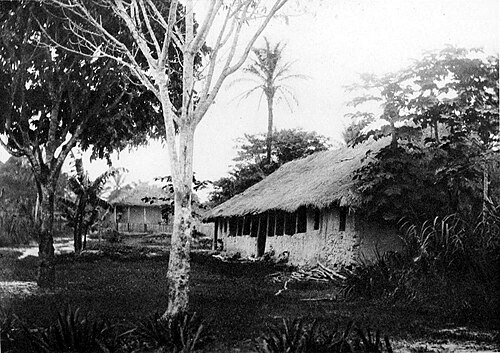
Other workers are critically ill from working on the railroad, waiting to die. In the midst of this squalor he meets a well-dressed and impeccably groomed Company Accountant who gives him his instructions. The Chief Accountant is one of Conrad’s cleverest creations. Instead of being vicious, he is impeccably dressed, efficient, and proud of his bookkeeping while dying workers lie only yards away. Conrad suggests that evil often wears respectable clothes and performs ordinary office work.
Marlow is eventually sent to retrieve the Company’s most successful agent, Mr Kurtz, who is trading deep within the Congo. Before he can begin the journey, however, he spends months waiting for simple repairs because the Company cannot even supply the rivets needed to repair his steamboat. There are warehouses full of worthless trade goods, but nothing genuinely useful. Conrad portrays imperialism not as efficient civilisation but as chaotic incompetence driven by greed.
On this upriver journey Conrad gives us some of his most evocative prose.
“Going up that river was like travelling back to the earliest beginnings of the world, when vegetation rioted on the earth and the big trees were kings. An empty stream, a great silence, an impenetrable forest…
…The dawns were heralded by the descent of a chill stillness; the wood-cutters slept, their fires burned low; the snapping of a twig would make you start. We were wandering on prehistoric earth, on an earth that wore the aspect of an unknown planet.
He describes being dwarfed by giant trees that towered over his little steamboat as though it was a sluggish beetle crawling on the floor of a high portico. It is at this point that Conrad first uses the title of his story as part of the narrative:
We penetrated deeper and deeper into the heart of darkness. It was very quiet there. At night sometimes the roll of drums behind the curtain of trees would run up the river and remain sustained faintly, as if hovering in the air high over our heads, till the first break of day.
As they approach Kurtz’s station, the steamboat is attacked from the forest, a final reminder that European conquest has drawn everyone around it into fear, violence and retaliation.
When they arrive at their destination, Marlow describes a row of wooden posts in the ground, each topped with the severed head of a native. It is in this harrowing environment that he meets Kurtz. This is the man who had once written in a report that white men appear to the “savages in the nature of supernatural beings” – like gods who can “exert a power for good practically unbounded”. On the back of that report he had written “exterminate the brutes”.
He had the power to charm or frighten rudimentary souls into an aggravated witch-dance in his honour; he could also fill the small souls of the pilgrims with bitter misgivings.
Marlow eventually persuades the gravely ill Kurtz to return downriver. Removed from the power he had accumulated, Kurtz finally confronts the life he has lived. His dying words, “The horror! The horror!”, become the moral climax of the novella.
“Anything approaching the change that came over his features I have never seen before, and hope never to see again. Oh, I wasn’t touched. I was fascinated. It was as though a veil had been rent. I saw on that ivory face the expression of sombre pride, of ruthless power, of craven terror—of an intense and hopeless despair. Did he live his life again in every detail of desire, temptation, and surrender during that supreme moment of complete knowledge? He cried in a whisper at some image, at some vision—he cried out twice, a cry that was no more than a breath— “ ‘The horror! The horror!’
Back in Europe, Marlow visits Kurtz’s fiancée. Unable to destroy her comforting illusion of the man she loved, he lies about Kurtz’s final words. Even after everything he has witnessed, truth proves more difficult than deception.
The final section of the story returns to the “Nellie” still at anchor on the Thames. Marlow’s tale is over, the tide of the river has turned, and the “Nellie” needs to depart. The narrator looks up river which he realizes also flows into “the heart of an immense darkness”.
The story cleverly uses two different rivers, the Thames and the Congo to consider the idea of “darkness”. We see the Thames first as the ancient home of the English, invaded and exploited by Romans. We then see the Congo treated similarly by European colonials, we then return to the Thames and are forced to consider the question – where is the darkness really? Is it in the conquered tribes? The conquerors? Or is it in us all? When we face our final breath, will we be like Kurtz and contemplate the horror of it all?
Conrad never gives a simple answer. Kurtz becomes monstrous, but he is still human. Marlow returns home morally shaken. Even the Thames, cradle of the British Empire, is finally seen leading into “the heart of an immense darkness”. Conrad’s suggestion seems to be that civilisation does not remove our capacity for evil. It merely changes its appearance.
More than a century after it was written, Heart of Darkness still provokes uncomfortable questions. Conrad condemns colonial brutality, but he is equally interested in the darkness that ambition, greed and absolute power awaken within ordinary people. It is a disturbing novella, filled with unforgettable imagery, and one that lingers long after the final page. I recommend it.