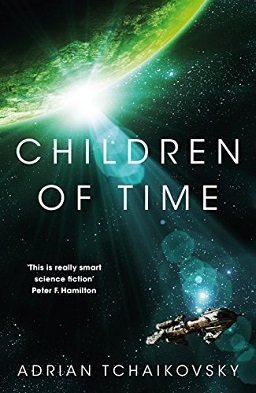
Title: Children of Time
Author: Adrian Tchaikovsky
Published: 2015
Pages: 600
Structure: 65 chapters in 8 parts
What happens when civilisations collide, and the remnants of a dying people find a perfect world that is already inhabited? Who deserves the spoils, and how could there possibly be a middle way?
Children of Time is a gripping tale of humanity’s desperate attempt to survive after centuries of conflict render Earth a wasteland. It’s also the grand story of the birth of a new civilisation as it evolves from simplicity to elegant and intelligent complexity.
We are all familiar with the conflicts caused by ideology and resources, and the inevitable clash between fear and greed. Most of us hope the villains lose, and the forces of good prevail for the benefit of everyone as a whole.
I think I bring an underlying hope to many of the stories I read: that somehow we will improve over time, that our lives will get better, and that humanity will grow into something better than it is today. Surely all those millions of years of evolution, all those millennia of strife, struggle and heartache ought to count for something in the end? If not, then why bother?
In this novel, Adrian Tchaikovsky presents something more sobering. The world as we know it is coming to an end. War, environmental collapse and the remnants of old conflicts have all but destroyed Earth.
Such outbursts represented the last throes of humanity’s underevolvers.
The ark ship Gilgamesh, carrying the remnants of humanity in cold storage, drifts through the void searching for one of the terraformed worlds left behind by the old human civilisation.
The humans we meet are going backwards. They possess the remnants of extraordinary technology, but selfishness, ideology and conflict are steadily eating away at their civilisation.
At the same time, an ancient human experiment has gone spectacularly wrong. Kern’s World was successfully terraformed, but sabotage destroyed the primates that were meant to inherit it. The engineered nanovirus intended to accelerate their evolution survived.
The remaining survivor of the project, Avrana Kern, slowly grows insane, merges herself with her onboard computers, and sees herself as the god of the evolving species on the planet.
This accident causes a small species of jumping spider, Portia labiata, to evolve in strange new ways, acquiring intelligence, technology, government and religion.
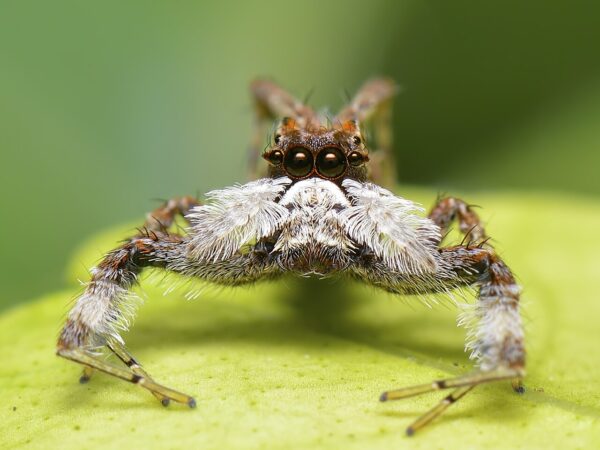
What delighted me most was that Tchaikovsky doesn’t simply turn the spiders into little eight-legged humans. They remain spiders. Their webs, eyesight, mating behaviour and physical abilities shape the civilisation they build. Even their technology develops along paths that would never occur to us. And yet, somehow, I grew to care about them.
We watch the humans, after centuries of drifting through space, gaze on a new world:
We’re a civilization in transport, waiting to happen somewhere else. Maybe here. We’re the last cutting of old Earth.
We watch the spiders learn how to build computers from colonies of ants, and eventually to reach for the stars. They’re aware of a satellite orbiting their world, sending them messages. At first they treat it as a deity and worship it:
seeking the reassurance of the numinous, the certainty that there is something more to the world than their senses can readily grasp; that there is a greater Understanding. That, even when all is lost, all need not be lost.
But as they develop, and as their science improves, they learn to communicate with Avrana Kern and understand that the satellite is technology from a dying Earth.
The story leads us to the inevitable clash between humans who desperately need a new planet and newly evolved intelligent arachnids who love their home world.
In the end, Tchaikovsky had me firmly on the side of the intelligent, religious spiders. The humans were the bad guys.
What manner of propaganda is this? How does a story persuade a humanist like me to turn against my own species?
This story suggests that the key thing is empathy. Lack of it is the fatal flaw in the version of humanity that we see in the story.
If there had been some tiny bead present in the brain of all humans, that had told each other, They are like you; that had drawn some thin silk thread of empathy, person to person, in a planet-wide net – what might then have happened? Would there have been the same wars, massacres, persecutions and crusades?
And it is empathy that ultimately gives the spiders another way:
Life is not perfect, individuals will always be flawed, but empathy – the sheer inability to see those around them as anything other than people too – conquers all, in the end.
I found this book compelling. I had surprisingly visceral responses to its conflicts. Perhaps I shouldn’t have been surprised. Survival, fear, tribalism and empathy are deeply human concerns, even when the characters exploring them happen to have eight legs.
It’s good for the soul to read something like this and come away with renewed faith in the importance of working together.
It has also given me a new love for spiders 🙂