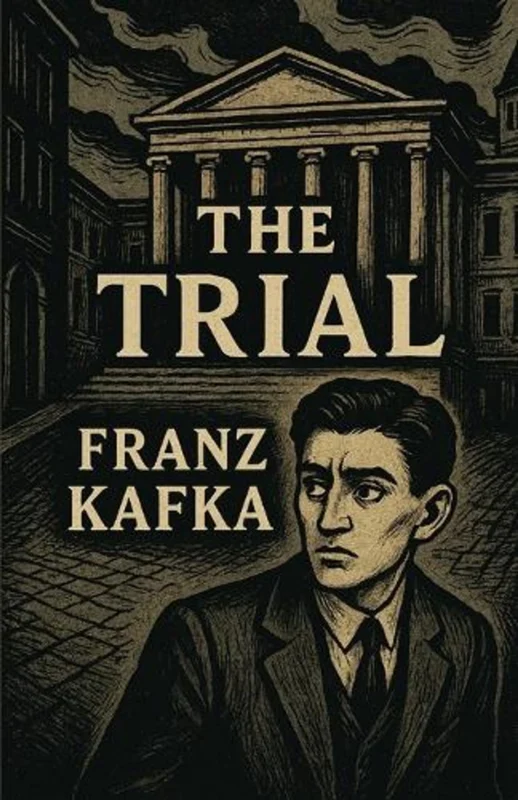
Title: The Trial
Author: Franz Kafka
Published: 1925 (Posthumously)
Pages: 233
Structure: 10 chapters
Although I hated reading this book, I think it is great. It reminds me that it is not always the job of literature to entertain us, but also to challenge and confront us. I finished it shaking my head, asking myself “what have I just read?” and feeling angry about the abuse of power. So, on that metric, this is a powerful novel that is worthy of our attention.
Before we explore the strange plot, it’s worth mentioning the unusual style in which Kafka constructed the novel. In the edition I read, the prose often appears in huge paragraphs that stretch for pages. It’s repetitive. The scenes are dark, damp, almost claustrophobic. I felt stifled as I read it, like I was struggling through a dense cityscape of despair. For me, this made the reading experience oppressive. And in hindsight, I think this is the feeling that the author wanted.
There is another reason the novel feels strange and disjointed. Kafka never finished it. He abandoned the manuscript in 1915, leaving the chapters unnumbered, and after his death his friend Max Brod arranged them and published the novel in 1925. So the book we read was never given its final form by Kafka himself.
The premise of the story is simple. Josef K., a senior bank employee, is arrested for an unnamed crime by two agents of a mysterious Court. He is not informed of the nature of his crime, he knows almost nothing about the authority that has arrested him, and he is not even told the location of the courtroom. He must find it himself, and somehow mount a legal defence.
At first, Josef thinks that there has been a mistake, and assumes the agents are stupid.
It’s only because of their stupidity that they’re able to be so sure of themselves. I just need few words with someone of the same social standing as myself and everything will be incomparably clearer, much clearer than a long conversation with these two can make it.
I smiled at Josef’s confidence here. He assumes that the problem is merely that he is dealing with idiots. Surely, once he reaches someone intelligent and important enough, reason will prevail.
It never does.
But beneath his confidence lies a strange misgiving. Josef begins to wonder whether, if only he had behaved a little differently or been better prepared, the whole thing might somehow have been avoided. Although he suspects the agents are stupid and mistaken, part of him has already begun to accept that perhaps he has done something wrong.
He speaks with Leni, the nurse and attendant of a lawyer involved with the Court, who tells him that resistance is futile:
there’s nothing you can do to defend yourself from this court, you have to confess. So confess to them as soon as you get the chance. It’s only then that they give you the chance to get away, not till then.
Josef gradually becomes obsessed with his case. His work suffers. He becomes antagonistic towards the people in his life. The mere fact that proceedings have been brought against him begins to consume him. He tries to plan a defence in which he explains why he is a good citizen, and considers giving an account of all his actions, despite not knowing why he is on trial. He realises that “defense is not really allowed under the law, it’s only tolerated”.
He finds it nearly impossible to plan his defence because he “does not know what the charge was or even what consequences it might bring”.
As I read this, I wanted Josef to fight against the injustice he faced. I felt that a legal system that was not open to scrutiny had no legitimacy.
At his first appearance before a chaotic courtroom, Josef angrily attacks the way he has been treated and denounces the corruption of the proceedings. But he never takes the final step that I desperately wanted him to take. He never simply rejects the Court’s authority over him.
Instead, he keeps returning, trying to understand its rules and work within them.
He discovers a maze-like arrangement of court offices in the dirty attics of buildings. He finds the air so stifling that it makes him ill. He finds it almost impossible to deal with the court system.
And horribly, he slowly becomes complicit in it.
He submits to it in the same way everyone else does.
Towards the end of the novel, Josef speaks with a priest who tells him a parable about a man from the country who comes seeking access to the Law. A doorkeeper tells him that he cannot enter at present. The man waits there for the rest of his life, hoping that permission will eventually be granted.
As he is dying, the doorkeeper tells him:
‘Nobody else could have got in this way, as this entrance was meant only for you. Now I’ll go and close it.'”
I read this as a warning that the corridors of power and privilege can remain permanently closed to us. The inhabitants of those corridors have power over us, but are not answerable to us.
Worse, we can become complicit in our own oppression simply by accepting their authority.
I spent my entire time reading the novel hoping that Josef would rebel against this tyranny. That he would at least call it out for what it was. But he never really does.
In the end, he submits to the power of the Court. He does not fight his executioners, and ends up dying “like a dog”.
I found no satisfaction in reading this story. It left me angry, and wanting to tear down the forces of oppression. It made me want to rage against injustice.
I spoke with Liz about how stupid and horrible I thought this book was, and how it made me feel, and she gently asked, “don’t you think that is exactly what the author wanted you to feel?”
Damn it. She’s right.
I still hate this book. But reluctantly, I have to concede that it is a great one.
If you want to feel good, or entertained, or to “enjoy a good read”, then please don’t read this book. But if you want a fresh perspective on the power structures in our own world, and how we unwittingly submit to them, if you want to feel righteous indignation, then this is the book for you.