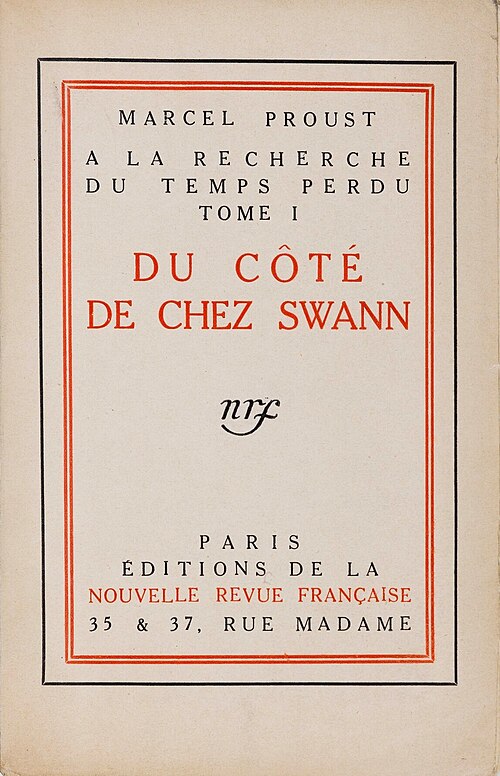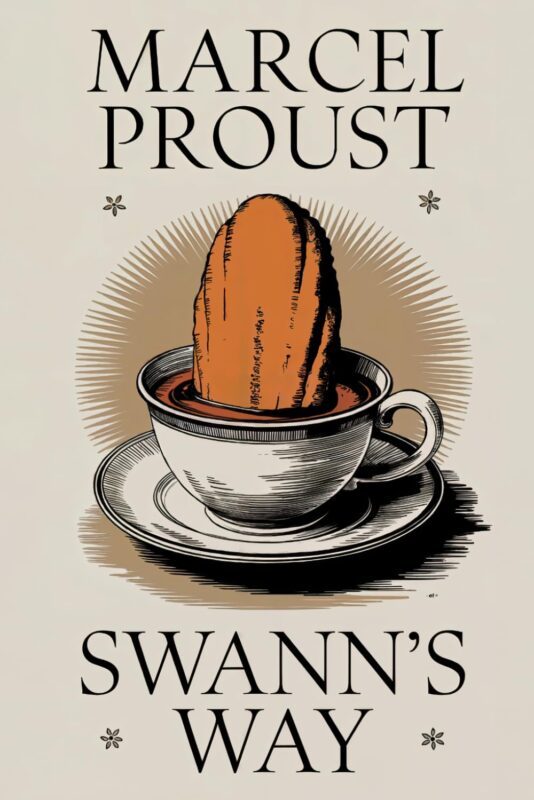
Title: In Search of Lost Time, Volume 1: Swann’s Way
Author: Marcel Proust
Published: 1913
Pages: 379
Structure: 3 parts
Swann’s Way is the most challenging book that I have read, and the most descriptive. It is, however, merely the first of seven volumes in a work recognised by Guinness World Records as the world’s longest novel. There is very little plot, sections of it are incredibly dense, with complex sentences that continue for more than a page, and it took me two attempts in six months to finish just the first volume. So why read it?
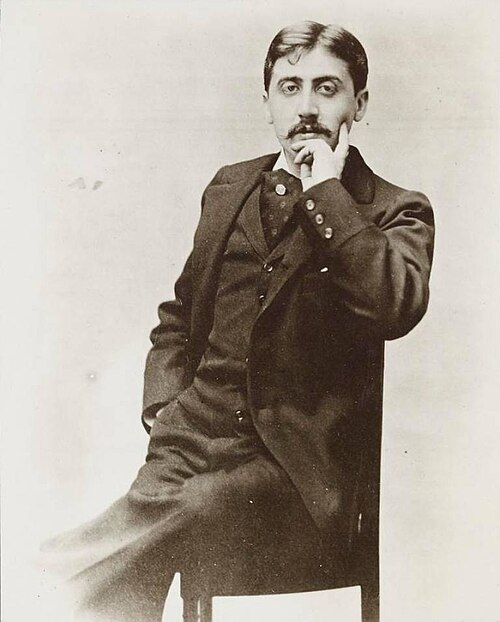
In writing this novel, Proust attempted something extraordinarily ambitious: to describe what is, for most of us, almost impossible to describe, our most intimate memories and sensations. When I first tried to read it, I got lost in the words. Apart from a few brilliantly crafted passages, I couldn’t see what he was describing.
But, a few months later, when I came back to it, I let his words build vivid mental imagery for me, and by some dark art I do not understand, Proust’s words began to affect me. When I tried to describe this sensation to Liz, the best I could come up with was that it was like an ASMR experience, but on the page.
The book starts with the narrator lying awake in bed, remembering his childhood in the fictional French town of Combray. He drifts off to sleep, sometimes waking and hearing noises, sometimes just thinking.
I pressed my cheeks tenderly against the beautiful cheeks of the pillow, which, full and fresh, are like the cheeks of our childhood.
He describes his wandering, sleepy thoughts and sensations that move our minds across decades, and how we hold in a circle around us “the thread of the hours, the order of years and of worlds”, and how by shifting his thoughts he “passed in a second over centuries of civilization”.
As the title suggests, the theme of the book is memory. What do our memories feel like? How do they change us? His descriptions include pleasant sensations such as what it is like to taste a madeleine that has been dipped in a cup of tea, or what it feels like to read a book. But they also descend into more powerful experiences such as what it feels like to fall in love, to become obsessed, and to descend into the insanity of jealousy.
One powerful idea that Proust explores is how certain things such as tastes, smells, and sounds can evoke involuntary memories in us. For instance, the narrator tastes a madeleine dipped in a cup of tea that reminds him of the same taste he experienced as a child. This experience causes him to recall his village and neighbours. As he tastes it, he remembers the gardens of his childhood. All these memories seem to come forth from his cup of tea.
He revisits this idea later when Charles Swann falls in love. Swann hears again a sublime phrase from Vinteuil’s sonata, which gradually becomes associated with Odette and the emotional world of their love. Later, even when jealousy has poisoned the relationship, hearing the melody can resurrect the feelings he experienced when their love was new.
The narrator, in his childhood, was an avid reader. He meticulously describes what it feels like to spend an afternoon reading a book, and how that time felt filled with more dramatic events than he might experience in a whole life. He describes how in life it is difficult to see into someone’s soul, but not when reading about a character in a book. He shows us how it takes us a lifetime to watch someone slowly grow and change, but we can see that clearly over an hour or two as we read about it. In dreams we have fleeting images of fancy that we often forget, but the images we see when reading are “in the manner of a dream, but of a dream clearer than those we have while sleeping”.
He says of the novelist in general:
…here he unleashes in us for an hour all the possible happiness and misfortunes of which we could take years in life to know some, and of which the most intense would never be revealed to us because of the slowness with which they occur takes away from us the perception of them…
In the second part, “Swann in Love”, Proust then demonstrates the intensity that reading can evoke.
Charles Swann is a wealthy man of society who falls in love with Odette. We read about Swann’s initial indifference to Odette, his curiosity, and then attraction. Proust describes their first kiss, how Swann pauses beforehand, looking at her and thinking that this was the last time he would see this version of her that he had not yet kissed:
He had wanted to leave time for his thought to catch up, to recognize the dream that it had so long cherished and to witness its realization, like a relative that one calls to take part in the success of a child she has loved very much. Perhaps also Swann was fixing on this face of Odette not yet possessed, not even yet kissed by him, that he was seeing for the last time, this gaze with which, on a day of departure, one would want to carry away a landscape one is going to leave forever.
For me, the most compelling part of this story was the way the ambitious and meddling Verdurins try to sabotage Odette’s relationship with Swann because he refuses to submit to their social control. Proust describes the pretentiousness of the Verdurins in a way that made my skin crawl. They have gathered around them a sycophantic group who are terrified of contradicting them:
To be admitted to the ‘little nucleus,’ the ‘little group,’ the ‘little clan’ of the Verdurins, one condition was sufficient, but it was necessary: one had to adhere tacitly to a Creed…
Mme Verdurin is relentlessly theatrical. Even the way she laughs becomes a performance:
she would utter a shrill cry, shut tight her little bird-like eyes … and quickly … burying her face in her hands … appeared to be trying to suppress, to extinguish a laugh… she had abandoned the effort involved in wholehearted laughter, and had substituted a kind of symbolical dumb-show which signified … that she was ‘splitting her sides.’
When Swann asks the Verdurin circle what makes the sonata beautiful, their confident admiration collapses. They “seemed never to have asked themselves these questions because they were incapable of answering them.” The Cottards, in particular, hear little more than a seemingly random succession of notes.
When Mme Verdurin realises that Swann is an independent thinker who won’t be manipulated, she criticises him in front of everyone else, ironically pointing out the way he laughs:
Did you notice the way Swann laughed, such an idiotic laugh, when we spoke about Mme. La Trémoïlle?
Odette is drawn further into the Verdurins’ machinations, and we witness Swann descend into a hell of jealousy and despair. We see how it disrupts his entire life as he grows more obsessed with what Odette might be doing while they are apart.
Like an evil deity, his jealousy was inspiring Swann, was thrusting him on towards destruction.
Proust stretches Swann’s downward spiral over a large portion of the book. It is painted in meticulous detail, so that as I read it, I felt his anguish as well. Despite the pages being dense with descriptive prose that demanded my total attention, I couldn’t put the book down. I hated the Verdurins. I wanted Odette to gain some moral courage, and for Swann to “get a grip”.
Later in the book, Proust returns to the gulf between outward appearance and inner experience. An observer who sees things only from outside, he says, “sees nothing”. Much of Proust’s achievement lies in attempting to show us precisely what such an observer cannot see.
But why read Proust? There are plenty of easier novels from the same period. Countless novels explore childhood, falling in love, or jealousy. I think the experience of reading this book is unique. For me, reading “In Search of Lost time” was like looking at an Impressionist painting by Monet or Renoir, except that the image was being assembled in my mind from words.
I could see the balconies of houses, shining like gold in the sun after rain on the Champs-Élysées. I could re-imagine the iridescent bodies of pigeons flying away like “lilacs of the bird kingdom”. I saw asparagus “dipped in ultramarine and rose” with their dawning colours of aurora.
Proust has the rare ability to notice things that other writers pass over. He sees the world differently, noticing things that matter precisely because they are so easily overlooked. I want to see more of these things. Reading this book has helped me to see the world differently.
This is a very difficult book. But so is climbing a mountain. If seeing magnificent views is important to us, we improve our fitness in order to complete the journey. As it is with the views from high summits, so it is with reading Proust.