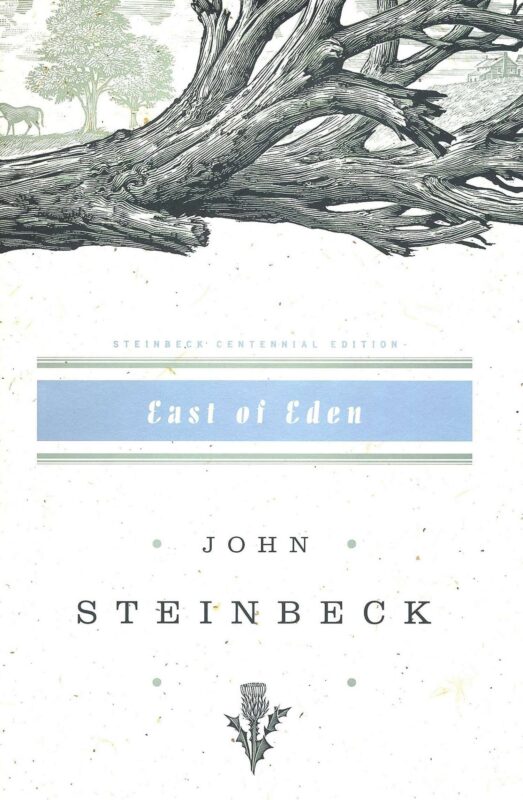
Title: East of Eden
Author: John Steinbeck
Written: 1952
Pages: 640 pages
Structure: 55 chapters, split into four parts
Are we condemned to the life that fate allots us through our parents, our upbringing and the circumstances into which we are born, or do we have a choice over who we become?
East of Eden is a vast family saga that explores this question over several generations. It’s a huge book, but I didn’t want it to end. I turned the final page feeling a mixture of hope and despair about human nature, and about our capacity both to damage one another and to choose something better.
One of the things I enjoy about a long family saga is how well we get to know the people in it. We see them as children, learn about their parents, and follow the disappointments and mistakes of their lives. We have some understanding of what drives them, even when we disagree with what they do.
Adam and Charles Trask grow up with a domineering father, Cyrus, who loves Adam more than Charles. Charles desperately wants to please him. For his father’s birthday he spends his savings on an expensive knife, which Cyrus barely acknowledges. Adam gives him a puppy, and Cyrus is delighted.
We understand why Charles is hurt. He loves his father and has put considerable effort into buying a gift, but his father prefers Adam. He can do nothing about it, and resents his brother. Consumed with jealousy, he nearly kills him.
Cathy Ames is totally different. She has grown up in a loving home, but she lies and manipulates people, and doesn’t care about the harm she causes. She murders her parents. There seems to be very little humanity in her. She’s horrible. When she meets the brothers, Charles distrusts her immediately. Adam falls hopelessly in love. Having already seen what Cathy is capable of, we can see how badly he has misjudged her. His love makes it almost impossible for him to recognise the danger she poses.
Samuel Hamilton is a much more loveable character. He struggles to make a living from his poor farm, and his inventions earn him very little. Despite this, he is happy. He enjoys a conversation, takes an interest in people and is generous with what he has. There is so much that he likes about being alive.
I also liked Lee, Adam’s Chinese servant. He is intelligent and compassionate, and understands much of what the people around him struggle to explain about themselves. He is patient with Adam and helps care for his sons. I liked his willingness to keep caring about people even when he knows their faults.
In their conversations, Samuel and Lee discuss the story of Cain and Abel, and the jealousy that leads Cain to kill his brother after God favours Abel’s offering. We have already seen something of this in Charles’s resentment of Adam. Years later, Adam repeats his father’s favouritism with his own sons.
Aron is handsome, idealistic and apparently good. Cal is jealous of the affection his father gives Aron, and troubled by his own capacity for cruelty. When he discovers that Cathy is his mother, he worries that he has inherited it from her. Is he destined to become like her?
What most appealed to me about Cal is that he wants to be good. Occasionally he silently expresses that wish. He knows how much he resents Aron and tries to resist the urge to hurt him. I found myself hoping he could overcome his jealousy, and wishing Adam could see how hard his son was trying.
Most of all, he wants his father’s love, but Adam loves Aron more. The pattern of Charles and Adam begins again. After Adam loses a large amount of money, Cal earns $15,000 and proudly offers it to his father. It is Cal’s version of Charles’s expensive birthday knife, and Adam rejects it. He tells Cal that he would rather he lived a good life like Aron.
Even though Adam does not mean to be cruel, his response devastates Cal: he has tried to do something good for his father. He has tried to repair his father’s loss and show him how much he cares. Once again Aron receives love simply by being Aron.
Cal responds by doing something terrible. He takes Aron to meet their mother. Aron has grown up believing that Cathy is dead. Like Adam, Aron has an idealised view of people, particularly of goodness and purity. He is shocked when he discovers the truth about his mother.
Aron enlists in the army and is killed. Cal blames himself for his brother’s death. Even though he has tried to be good, he has deliberately hurt someone he loves, with consequences he can never undo. It is painful to see him become so convinced that he is as bad as he feared.
Abra is more understanding. She knows how difficult it is to live up to Aron’s expectations. She can admit her own faults and accept that Cal has them too. Earlier, when she tells Lee how she never felt good enough for Aron, he says:
“And now that you don’t have to be perfect, you can be good.”
Cal will have to live with what he has done, but he can still become the good man he wants to be. He still has the choice.
Earlier, Samuel and Lee discuss the story of Cain and Abel and become fascinated by the Hebrew word timshel. Different translations of Genesis suggest different meanings, but Lee’s study leads him to this:
Thou mayest.
You may overcome sin, or you may not. The choice is yours.
When Samuel and Lee first discuss this it is an interesting theological question. By the end of the novel, it is about Cal. Cal has failed. He has hurt someone he loves. He cannot undo what he has done. But neither is he condemned forever by it.
At the end of the novel, with Adam dying and Cal crushed by guilt over Aron’s death, Adam’s final word to him is:
Timshel.
Thou mayest. Instead of excusing Cal’s actions, it tells him that what he does next is still his choice.
Despite all the cruelty and suffering in this book, there’s hope.
We are shaped by our parents, by whether we are loved, by the injuries done to us and by circumstances we did not choose. But what happens to us when we are young does not have to determine the rest of our lives.
We will sometimes fail and hurt other people. But we can recognise what we have done, and choose what we do next.
Timshel.