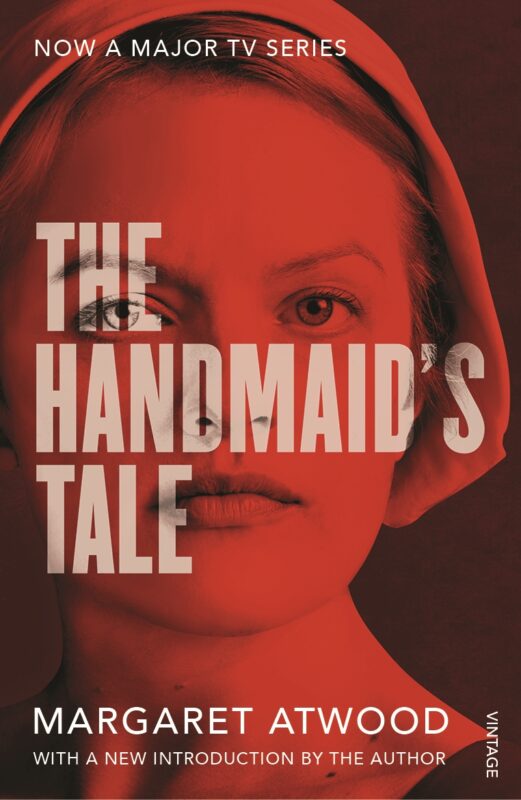
Title: The Handmaid’s Tale
Author: Margaret Atwood
Published: 1985
Pages: 311
Structure: 46 chapters in 15 sections, plus “Historical Notes on The Handmaid’s Tale”
The Handmaid’s Tale is a dystopian novel about a woman’s experience in what was once the north-eastern United States after a coup has imposed a Christian fundamentalist theocracy. I found it both frightening and compelling, and could not put it down.
I have never watched the TV series, but this story haunts me because, in a way, I have visited Gilead. I have been in church meetings where preachers advocated a theocracy to “establish God’s kingdom on earth”, and total submission to religious leaders. I have sat in classes which advocated the “Seven Mountains Mandate”, in which true believers must seek to dominate the “pillars” of Government, Education, Business, Media, Arts, Family and Religion in order to “win the country for the Lord”. I was brainwashed and willing to give up everything for the cause.
This book is real for me.
The oppressive, corrupt and destructive world of The Handmaid’s Tale is not only possible in our time; there are people among us who want to bring about something disturbingly like it, often without understanding where it leads. That scares the shit out of me. In the introduction to this edition, Atwood explains that she included no event, law, technology or atrocity that had not already existed somewhere in human history. “God is in the details,” she says. “So is the devil.”
The story is set in the near future as Atwood imagined it in 1985, where Christian fundamentalists have seized control of what is now “The Republic of Gilead” after assassinating the US president and machine-gunning Congress.
It was after the catastrophe, when they shot the President and machine-gunned the Congress and the army declared a state of emergency. They blamed it on the Islamic fanatics, at the time. Keep calm, they said on television. Everything is under control. I was stunned. Everyone was, I know that. It was hard to believe. The entire government, gone like that. How did they get in, how did it happen?
What shocked me as I read this was how easy it seemed, and how recognisable. It is easy for those in power to blame minorities such as Muslims, and easy to placate the masses in times of disaster by telling them, “Everything is under control”. We observe these things happening all the time. For me, this story did not seem to be a fanciful invention; it was merely a slight variation on the familiar.
In Gilead, women are not allowed to own property or control money. Second marriages are declared adulterous and invalid. Fertile women from those marriages are forced into sexual slavery as Handmaids, while their children are taken and placed with privileged families. Other women work in Commanders’ households as Marthas, while lower-ranking men serve as Guardians. Women are forbidden to read, and books and written information are controlled by the male elite.
In this nightmare we meet Offred, a Handmaid who has been assigned to a Commander and his Wife. Her function is to bear them a child through a monthly ritualised rape known as the Ceremony, because disease and environmental damage have caused fertility to collapse. Her name means “Of Fred”: it marks her as the property of a Commander whose first name is presumably Fred. If she fails to bear a child during her two-year posting, she will be assigned to another Commander and given another name. After three unsuccessful postings, she can be declared an Unwoman and sent to the Colonies.
We hear Offred’s tale in the first person. She speaks to us about her life, her feelings, and her memories of life before the Christian revolution, where “normal” slowly changed:
We lived, as usual, by ignoring. Ignoring isn’t the same as ignorance, you have to work at it. Nothing changes instantaneously: in a gradually heating bathtub you’d be boiled to death before you knew it… The newspaper stories were like dreams to us, bad dreams dreamt by others. How awful, we would say, and they were, but they were awful without being believable. They were too melodramatic, they had a dimension that was not the dimension of our lives. We were the people who were not in the papers. We lived in the blank white spaces at the edges of print. It gave us more freedom.
This was one of the things I found most compelling about the novel. Offred is not a conventional heroic rebel; she is an ordinary woman trying to survive.
This system of government, like any other, has its own forms of corruption, giving the powerful and wealthy special access to privileges not available to the masses. Alcohol, books, magazines and information are readily available to Commanders, but forbidden to most of the population. In one of his secret meetings with Offred, the Commander asks her what she would like in return for spending time with him.
Her response is simple: “I would like to know … what’s going on.”
Many of us have witnessed how power structures manage the flow of information. Whether it is in religious groups, businesses or governments, we are all familiar with the concept of “need-to-know” and demands for confidentiality “for the greater good”. I have personally heard preachers advising adherents, especially women, to avoid higher education and “seek the kingdom of God” instead. A population denied education and information is much easier to control.
Educating yourself is therefore subversive.
In the final section of the book, the narrative suddenly moves to the year 2195. We hear an academic paper given by Professor James Darcy Pieixoto at the Twelfth Symposium on Gileadean Studies. We learn that Offred’s account survived on cassette tapes discovered in Maine and was reconstructed by historians. Gilead has passed into history, but Pieixoto treats Offred’s suffering as an academic puzzle. He makes jokes about her story and appears more interested in identifying her Commander than in discovering who she was.
For me, this portrayed both hope and despair. Gilead has disappeared, and Offred’s voice has somehow survived. Yet even in 2195, something remains of the attitude that made Gilead possible. Even when oppressive regimes fall, it can take decades, or even centuries, to repair the damage done by self-serving powers. I look at the faint glimmer of hope at the end of the novel and wonder about the cost imposed on millions of people by those who seek to “claim the world for their god”.
This is a cautionary tale. You should read it. If you’re a person of faith, read it and think about the dangers of trying to impose your beliefs on an entire nation. If you’re a non-believer, read it and think about how easy it is to lose a country to fanatics. If, like me, you’re a lover of books, read it and consider what a privilege it is to be literate and have access to such powerful stories.