Title: Jane Eyre
Author: Charlotte Brontë
Published: 1847
Pages: 624 (Penguin Classic Edition)
Structure: 38 chapters, originally published in three volumes
“Jane Eyre” is how I think the story of “Cinderella” should have been told. Through her own inner strength, an orphaned girl overcomes an abusive childhood and a tempestuous young adulthood, eventually finding peace, but on her own terms. She’s not rescued by a “hero”. She is the hero.
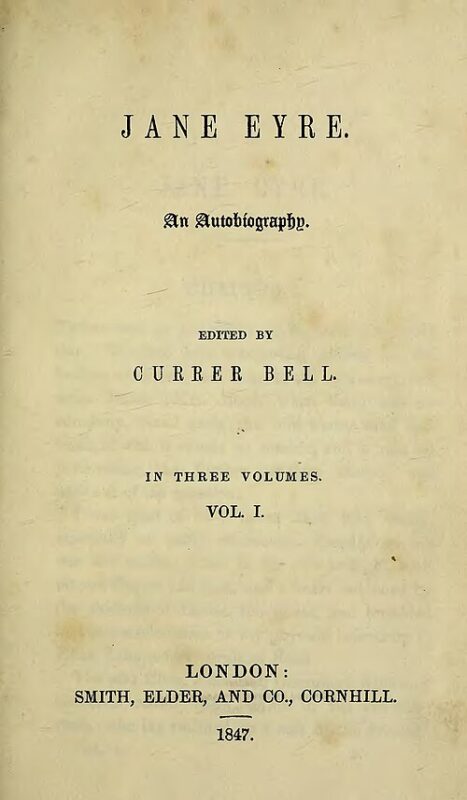
Charlotte Brontë presents this novel as the autobiography of a young woman, but published it under the masculine-sounding pseudonym “Currer Bell”, who is identified as the editor of Jane’s story. Brontë and her sisters adopted masculine pen-names partly because women writers faced considerable prejudice from the reading public. George Eliot would later do the same.
This is a compelling story told from the first-person perspective of Jane, orphaned as a small child and brought up by her spiteful aunt, Mrs Reed, while enduring endless torments from her cousins. As I entered the world of this vulnerable girl and experienced her injustices through her own remembered voice, I was hooked. There’s something irresistible about seeing the world through the eyes of a child.
But Jane isn’t pathetic. She has a fire in her heart that I found adorable. Jane is chastised by a hypocritical preacher named Brocklehurst, who threatens her with the fires of hell because she is “wicked”. Hoping for a pious answer, Brocklehurst asks her what she thinks she must do to avoid burning in hell. I laughed when Jane replied, “I must keep in good health and not die”.
On the eve of her departure to a strict boarding school, Jane confronts Mrs Reed:
“How dare I, Mrs. Reed? How dare I? Because it is the truth. You think I have no feelings, and that I can live without one bit of love or kindness; but I cannot live so… People think you a good woman; but you are bad, hard-hearted. You are deceitful!”
What a fiery young woman! I did a fist-pump when I read this. Why is it so satisfying to see such a seemingly powerless child defy the forces arrayed against her? I think when we watch Jane’s life, we see our own childhood, and remember similar times when we felt overwhelmed.
This pattern repeats several times throughout her story as Jane matures. At Lowood School, Brocklehurst humiliates Jane in front of the entire assembly. He forces her to stand on a stool and publicly denounces her as a liar because of what Mrs Reed has told him. Jane is horrified, but as she stands there disgraced, her friend Helen Burns passes her and gives her a smile. Jane finds strength in that small gesture:
“I mastered the rising hysteria, lifted up my head, and took a firm stand on the stool…
…What a smile! I remember it now, and I know that it was the effluence of fine intellect, of true courage… It was as if a martyr, a hero, had passed a slave or victim, and imparted strength in the transit.”
Helen becomes Jane’s first real friend, and offers a striking contrast to her. Where Jane rebels against injustice, Helen endures it with an almost otherworldly patience. Jane never entirely adopts Helen’s philosophy, but her friendship teaches her that strength can consist of something more than resistance. Helen’s death in Jane’s arms is one of the most tender and painful moments in the novel.
Jane remains at Lowood for eight years, six as a student and two as a teacher. Eventually she seeks a new life and applies for employment as a governess at Thornfield Hall, where she is engaged to teach a young French girl, Adèle Varens.
Here Brontë upends the familiar trope of “girl meets boy and falls in love”. Jane meets Rochester for the first time while he is riding his horse along a narrow lane. The horse slips on ice, Rochester is injured, and needs Jane’s assistance. Although he proudly dismisses her, she refuses to leave, helps him to his feet, lets him lean on her, and helps him mount his horse.
Rochester is an imposing figure. Later, as he gets to know her, he questions Jane abruptly about her beliefs and her art. Although the questions are confrontational, Jane refuses to be intimidated by him. Finally, he asks her, “Do you think me handsome?”
She immediately replies, “No, sir.”
Rather than flatter him, she tells the truth, which impresses him and earns his respect. Much of their attraction develops through these conversations. Rochester challenges Jane, but she continually meets him as an intellectual equal despite their enormous differences in wealth, age and social position.
Rochester allows Jane to believe that he intends to marry Blanche Ingram. When he then speaks of Jane leaving Thornfield to take a position in Ireland, her emotions finally break through. She insists that their differences in wealth and social position do not make them unequal as human beings:
“I am no bird; and no net ensnares me; I am a free human being, with an independent will.”
Rochester falls in love with the very quality other people have spent Jane’s childhood trying to suppress.
Jane and Rochester decide to marry, but the wedding is stopped at the last moment when Jane discovers that Rochester is already married. His mentally ill wife, Bertha Mason, has been kept confined at Thornfield for years.
Rochester pleads with Jane to remain with him as his mistress, but she refuses. Jane’s principles are no longer being tested by people she despises. Now they are being tested by the man she loves:
“Laws and principles are not for the times when there is no temptation: they are for such moments as this.”
This is the moment when I most admired Jane. She chooses to leave Rochester even though she faces devastation. She loves him, has nowhere to go, and has little prospect of supporting herself. Yet she will not surrender her principles simply because the alternative is painful. The fiery child who once told Mrs Reed “because it is the truth” is still there. She has simply grown into a woman capable of paying a much greater price for that truth.
Jane travels as far away as she can and eventually ends up penniless and homeless. An extraordinary coincidence brings her to the home of two sisters, Diana and Mary Rivers. Their brother, St John Rivers, helps her gain employment as a teacher at a local school. Jane later discovers that all three are her cousins.
St John is a parson who aspires to become a missionary, and sees in Jane an ideal companion for his religious vocation. He asks Jane to marry him, not because he loves her, but because he believes that she is suited to the work he believes God has called him to do.
St John is persuasive, offering Jane respectability, purpose, religion and marriage, but no real love. His attempt to control her is more subtle than Rochester’s, but Jane again refuses to let another person decide what her life ought to be.
Jane eventually inherits a fortune of £20,000 from an uncle. Rather than keep it all, she divides it equally with Diana, Mary and St John. The orphaned child who has longed for family suddenly has both a family and financial independence.
Then something strange happens. While Jane is thinking about Rochester, she imagines she can hear his voice calling her name, even though he is many miles away. She decides she must go back to Thornfield.
When she arrives, she discovers that Thornfield has burned down. Bertha died in the fire, and Rochester was terribly injured trying to save the people in the house. He has lost a hand and is blind.
Jane finds him living quietly at Ferndean. He is no longer the powerful master, and Jane is no longer his poor governess. She now has money of her own, a family, and complete freedom to choose what she wants to do. And she chooses Rochester.
That is why I thought of Cinderella while reading Jane Eyre. Both stories begin with an orphaned girl, mistreated by the family charged with caring for her, and both eventually lead towards love and happiness. But Jane does not wait patiently for somebody to rescue her. She continually chooses, resists, leaves, survives and begins again. When she finally returns to Rochester, she does so because that is what she wants.
“Reader, I married him.”
Exactly. She married him.