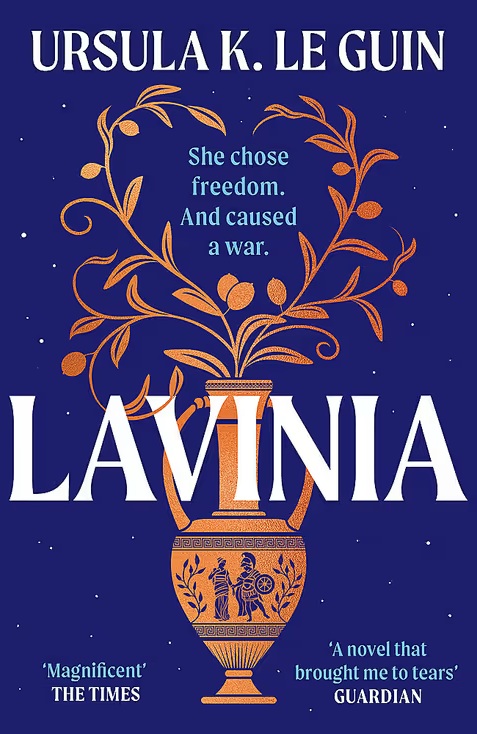
Title: Lavinia
Author: Ursula K. Le Guin
Published: 2008
Pages: 288
Imagine discovering that you were a character in a story, and that you could converse with the poet who “wrote” you. How would that change you?
“Lavinia” by Ursula Le Guin is a delightful retelling of the latter half of Virgil’s Aeneid from the perspective of the Latin princess over whose marriage a war is fought, but with the added twist that Lavinia knows that she’s in a story.
Lavinia is the only surviving child of the King of the Latins. Her role in the Aeneid is pivotal because she is fated to marry a foreigner and stands at the beginning of the lineage that will eventually lead to Rome. But despite her importance to the plot, Virgil gives her a minor role in his story: she says nothing, and has very few actions.
Le Guin’s story turns that on its head in a beautiful way. Lavinia is aware she is part of Virgil’s story, and she speaks directly to us from the page:
How is it that you understand me, who lived twenty-five or thirty centuries ago? Do you know Latin?
I found this wonderfully unsettling. It transformed my experience from being a mere reader to someone who was speaking with Lavinia. How many books do you know of that do this?
But why can Lavinia continue speaking to us when Aeneas, Turnus, and the other “heroes” of the story cannot? Le Guin’s explanation is ingenious. Because the poet gave her such a quiet role in the story, she is not bound to an ending in the same way as the “major” characters:
The poet made him (Aeneas) live, live greatly, so he must die. I, whom the poet gave so little life to, I can go on. I can live to see the cloud above the sea at the end of the world.
Thus Lavinia describes her experience, and in doing so, brings the ancient myth to life for us.
In the original story we see conflict caused by the jealous goddess Juno, who commands the Fury Alecto to stir up fear, hatred and xenophobia among the Latins towards Aeneas and his people. Foremost in this divinely inspired hostility is Amata, mother of Lavinia. Indeed, throughout Virgil’s poem the gods actively meddle in human affairs.
Le Guin presents Amata in more human terms as a grief-stricken mother, driven insane by the death of her infant sons and by her infatuation with her nephew Turnus, whom she hopes will eventually marry Lavinia and reunite the Latins with her own people, the Rutulians. In general, the gods in Lavinia’s world are less intrusive. What matters more in her world is how we respond to our beliefs in those gods, and to the disasters which befall us.
Nowhere is this more clearly shown than in the wondrous shield of Aeneas, its divinely crafted artwork portraying the unfolding of history. Virgil spends pages describing its intricate and prophetic detail. When Lavinia sees it, she perceives something different:
There are a few women here and there in the pictures, but mostly it is men, men fighting, endless battle scenes, men torn apart, men disembowelled, bridges torn down, walls torn down, slaughter…
…‘What is yet to come is mostly war, then,’ I say, looking among them for some that aren’t battles, for an unhelmeted face. I see a mass rape, women screaming and fighting as they are dragged off by warriors. I see great, beautiful ships with banks of oars, but the ships are all at war, some are burning. Fire and smoke rise up over the water.
And Lavinia sees further than Aeneas. The history on the shield does not end with the glory of Rome, but continues through wars that Virgil himself could never have known, towards that terrible cloud above the sea at the end of the world.
But despite these differences in perception between the traditional view of history and what a mother, wife, or daughter might see, Le Guin does not simply reject Virgil’s heroic world. She remains faithful to the importance of heroic virtue.
Virgil’s story shows us a pious man, committed to the task that fate has assigned him despite his own personal cost. He endures terrible tragedy because he can see his part in a bigger picture.
Likewise, Lavinia is pious, which she describes as being “open to awe”. She respects her family’s gods, and accepts the prophecy spoken about her that she must not marry a local Latin man, but instead must marry a foreigner. She is faithful to this commitment even when she observes its consequences: war among her people, the death of loved ones, and destruction.
Like Spartan Helen, I caused a war. She caused hers by letting men who wanted her take her. I caused mine because I wouldn’t be given, wouldn’t be taken, but chose my man and my fate.
And then Le Guin does something Virgil never did. The Aeneid ends with the death of Turnus, but Lavinia’s story continues. She becomes Aeneas’s wife, the mother of his son, and then his widow. She must continue living after the heroes have left the stage. In that sense her earlier words, “I can go on”, become much more than a clever literary conceit.
For me, the power of Le Guin’s story, and Virgil’s original, is that they remind me of the importance of the myths we tell ourselves. They shape the lives of twenty-first-century humans just as powerfully as they shaped the ancient Romans and Greeks. Our stories echo our values back to us, they show us the consequences of our choices, they tell us who we are.
This novel shows me that the age of heroes is not over. We still wrestle with our ideas of fate and national identity. We still weigh up the cost of political decisions that will affect countless lives for future years. Each of us is a Lavinia or Aeneas, trying to make sense of the world and deciding what to do.
The magic of this story is that the heroine has an opportunity to question the one who wrote her fate. We see it from both perspectives. Virgil has to answer to a character he has created: “why have you written me like this?” Writing a story is a consequential thing. Authors should rightly converse with their characters.
But Lavinia gets to hear her story told by the poet who created her: “what would you think of a man who learned piety the hard way?” The conversation runs both ways.
And it makes me think: if I were writing a story, what would my characters say to me? What would I tell them? If I were a character in an epic poem, what would I ask of the poet who wrote me?
“Lavinia” changed the way I looked at stories. It made them real for me, and I think that is a wonderful thing. It is a good thing to be affected by a great book.
One final thing. Lavinia asks us from the page, “Do you know Latin?” I do not, but I’d like to. So in response to her question I’m going to try to learn some Latin, so that the next time I read those words I can reply to her, “Latine loquor.”
I hope you read it. And I hope it changes the way you look at the world.