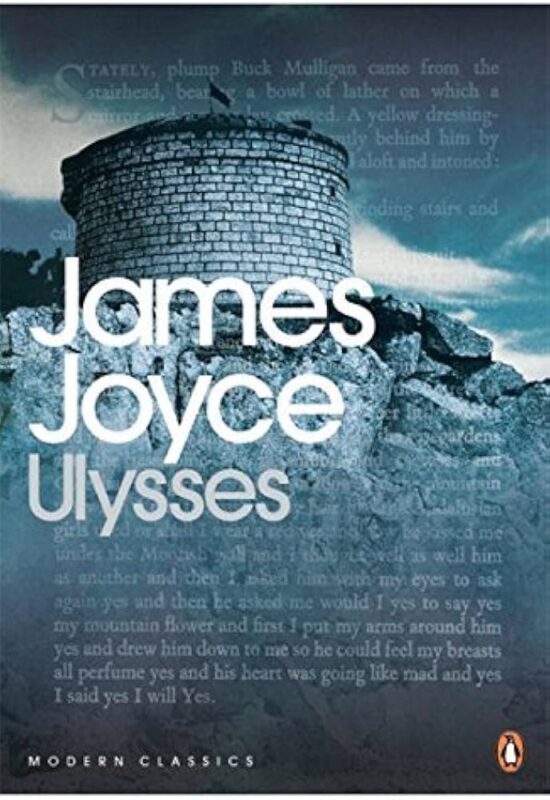
Title: Ulysses
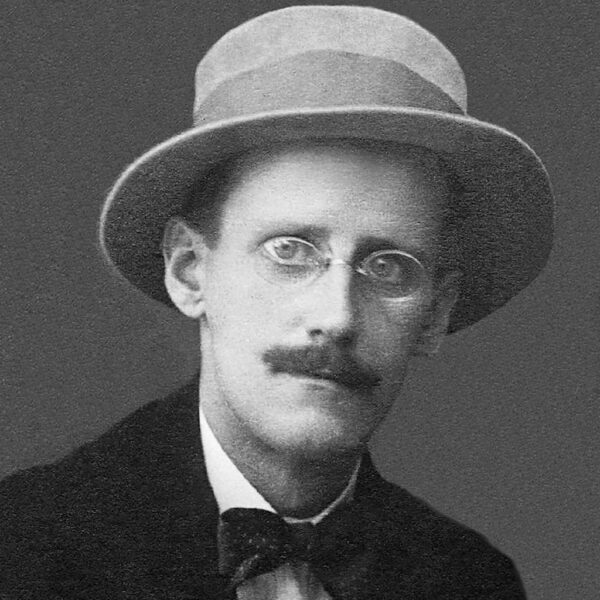
Author: James Joyce
Published: 1922
Pages: 1,040 pages (Penguin Classics Hardback)
Structure: Eighteen Episodes in three parts
What a strangely wonderful book!
I have never read anything like Ulysses by James Joyce before. I have no idea how to describe it in one sentence. Vast, intimidating, funny, life-affirming – it is all of these things, but crafted in such an ingenious way.
Ulysses is an epic after the style of The Odyssey by Homer. But whereas Homer writes about an arduous journey of a crafty soldier trying to find his way home after a decade-long war, Joyce writes about average people on a single day in Dublin.
This immediately confronts us with big questions: Who is a suitable subject for an epic? Is it just the heroes of history whose story deserves to be told? What is a hero anyway? What makes a story worth telling?
Ulysses focuses on a single day: 16 June 1904 in Dublin. The story focuses in detail on the experiences of three people on that day. It is written in a way that allows us to inhabit the thoughts and feelings of Stephen Dedalus, Leopold Bloom, and Molly Bloom, his wife. To me, it appeared that Joyce was showing that the lives of these three average people were worth writing about. They were worthy of an epic.
Stephen is presented as a type of “Telemachus” – the son of Odysseus who has been supplanted by suitors in his own house, in the same way that Stephen has been supplanted by two unwelcome guests – Mulligan and Haines.
Bloom is portrayed as a version of “Odysseus” – estranged from his wife and facing challenges throughout the day in the same way that Odysseus must fight with supernatural forces.
Molly is portrayed in the same way as “Penelope”, wife of Odysseus, pursued by numerous men.
The structure of the story, in 18 Episodes, which loosely reflect the themes of Homer’s Odyssey (24 “books”). Both stories cover similar themes, but in different ways. For example, there are episodes about The Cyclops, The Sirens, The Lotus Eaters, Hades, etc.
For example, in “Cyclops” (Episode 12), the story is told by an unnamed, abrasive Dublin narrator whose conversational voice is full of insults, exaggerations and comic turns of phrase. He opens by complaining that a chimney sweep nearly poked him in the eye:
I was just passing the time of day with old Troy of the D. M. P. at the corner of Arbour hill there and be damned but a bloody sweep came along and he near drove his gear into my eye.
The Citizen appears later, dominating the conversation in Barney Kiernan’s pub with his intense Irish nationalism. He is Joyce’s modern version of the Cyclops – although it’s not clear if he has only one eye, he is “one-eyed” in the sense that he sees everything through one narrow ideological perspective. Bloom, an Irishman of Jewish ancestry, does not fit the Citizen’s exclusive definition of Irishness.
Bloom eventually argues with him about nationalism, persecution and Jewish identity. As Bloom departs in a carriage, he calls back:
Your God was a jew. Christ was a jew like me.
The enraged Citizen throws a biscuit tin after him, echoing Polyphemus hurling a boulder at Odysseus’s departing ship. The weapon, like the Citizen himself, is both threatening and ridiculous. Joyce turns Homeric violence into a Dublin pub altercation without entirely removing its ugliness.
The book is full of Irish conversational banter that is wonderful to listen to. I think much of this book is intended to be read out loud. It sounds much more realistic to the ear than it can sometimes appear on the page.
Each episode has its own governing style or technique. “Aeolus” is repeatedly interrupted by newspaper headlines. “Wandering Rocks” moves through nineteen interlocking scenes across Dublin. “Sirens” tries to make prose behave like music. “Oxen of the Sun” follows the historical development of English prose while a woman undergoes a long labour. “Circe” becomes a hallucinatory play script. “Eumaeus” is written in a deliberately tired, verbose and clichéd style. “Ithaca” takes the form of an extraordinarily precise question-and-answer catechism, before “Penelope” abandons conventional punctuation for Molly’s flowing interior monologue.
“Circe” (Episode 15) is written as a play script with stage directions. It describes the experience of Bloom and Stephen as they wander through Dublin’s red light district, spending time in a brothel. It is full of hallucinations, and ends with Stephen assaulted by an English soldier and being rescued by Bloom.
The play script is strange in that even animals and inanimate objects have lines to say:
BLOOM
…Run. Quick. Better cross here.(He darts to cross the road. Urchins shout.)
THE URCHINS
Mind out, mister!(Two cyclists, with lighted paper lanterns aswing, swim by him, grazing him, their bells rattling.)
THE BELLS
Haltyaltyaltyall.BLOOM
(Halts erect, stung by a spasm.) Ow!(He looks round, darts forward suddenly. Through rising fog a dragon sandstrewer, travelling at caution, slews heavily down upon him, its huge red headlight winking, its trolley hissing on the wire. The motorman bangs his footgong.)
THE GONG
Bang Bang Bla Bak Blud Bugg Bloo.(The brake cracks violently. Bloom, raising a policeman’s whitegloved hand, blunders stifflegged out of the track. The motorman, thrown forward, pugnosed, on the guidewheel, yells as he slides past over chains and keys.)
THE MOTORMAN
Hey, shitbreeches, are you doing the hat trick?BLOOM
(Bloom trickleaps to the curbstone and halts again. He brushes a mudflake from his cheek with a parcelled hand.)
This Episode includes a hallucinatory court scene in which Bloom is tried for his sexual fantasies and alleged offences, before undergoing a series of visions involving domination, humiliation and gender reversal.
Despite the wildness, the Episode reveals emotional depth when Stephen hallucinates about his dead mother, and Bloom sees a vision of his son Rudy who died as an infant.
In my edition, this one Episode is over 150 pages long. I found it difficult – several hours of hallucinatory narrative is hard work, but I thought it was worth persevering to see how Bloom and Stephen are drawn into something like a father-and-son friendship, Stephen replacing Bloom’s son Rudy who never got to grow up.
For me, the most enjoyable Episode in the book was “Penelope” (Episode 18) in which we hear Molly’s stream of thoughts as she lies awake at night. This is one Episode that is better experienced aurally than read on the page. Molly’s Irish accent and turns of phrase are magically lyrical as they come through the text.
It is a monologue, and consists only of eight sentences that stretch for more than sixty pages. Molly reminisces about her past, and the men in her life. Her thoughts eventually come back to her husband, Leopold Bloom, and she cherishes the memory of accepting his marriage proposal. For me, this was some of the most beautiful prose in the book. (Notice how many times Molly says “yes” in this section. I think she’s saying “Yes” to life with Leopold,)
…the sun shines for you he said the day we were lying among the rhododendrons on Howth head in the grey tweed suit and his straw hat the day I got him to propose to me yes first I gave him the bit of seedcake out of my mouth and it was leapyear like now yes 16 years ago my God after that long kiss I near lost my breath yes he said I was a flower of the mountain yes so we are flowers all a womans body yes that was one true thing he said in his life and the sun shines for you today yes that was why I liked him because I saw he understood or felt what a woman is and I knew I could always get round him and I gave him all the pleasure I could leading him on till he asked me to say yes and I wouldnt answer first only looked out over the sea and the sky I was thinking of so many things he didnt know…
She recalls of dozens of memories of different men, and then she comes to her beautiful conclusion:
…yes and how he kissed me under the Moorish wall and I thought well as well him as another and then I asked him with my eyes to ask again yes and then he asked me would I yes to say yes my mountain flower and first I put my arms around him yes and drew him down to me so he could feel my breasts all perfume yes and his heart was going like mad and yes I said yes I will Yes.
This book is challenging. I understood about two-thirds of what I read – some of it went over my head. Some of the references were difficult to understand, and there are copious sections in foreign languages – French, Italian, Latin, German.
I am happy with this partial comprehension. Joyce said he believed academics would be dissecting this book for centuries. I don’t mind if I need to read it through a few times to understand it more. I feel like this is a book that becomes more enjoyable each time you return to it.
I used three editions of Ulysses to read it.
- The Joyce Project provides a free, heavily annotated online text. Its extensive notes explain historical references, foreign phrases, Dublin geography and the Homeric parallels. I mostly read this version of the book on my Kindle and dug down into the footnotes when I needed more information
- Audio-books such as the narration by Donal Donnelly and Miriam Healy-Louie are a delight to listen to. The Irish accents bring it to life.
- The Penguin Classic Hardcover edition of Ulysses has a great introduction, but no footnotes. Sometimes it’s enjoyable to flip through a physical book rather than tap a Kindle
After spending many hours over the last two weeks reading Ulysses, what does it mean to me?
Joyce has shown me that ordinary lives can be heroic. We do not have to be soldiers, kings or “great” leaders to encounter grief, temptation, humiliation, love and difficult choices. We all face challenges each day, and there is rarely a happy, clear-cut conclusion. Life remains ambiguous.
He has also shown me how powerful language can be in the hands of an imaginative writer. It allows us to enter the experiences of people who lived a century ago, and even to recognise ourselves in stories first told several millennia ago.
I did not understand everything in Ulysses, but I do not think I needed to. I finished it feeling that another reading would reveal an entirely different book.
Most of all, Joyce makes me want to become a better writer.
What a strangely wonderful book.