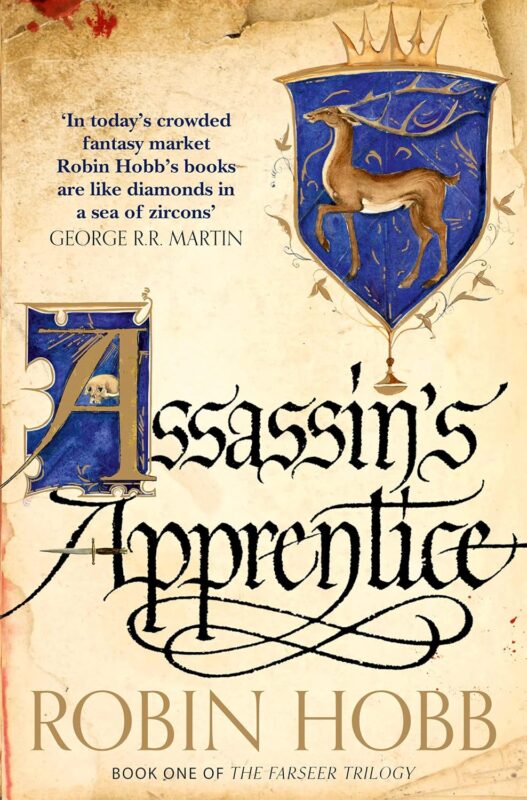
Title: Assassin’s Apprentice
Author: Robin Hobb
Published: 1995
Pages: 390
Structure: 24 chapters plus Epilogue
Assassin’s Apprentice is the story of a young boy, the illegitimate son of the heir to the throne and grandson of King Shrewd, and how he grows and finds his place in the world. It is the first of sixteen fantasy novels in the epic Realm of the Elderlings series.
This review contains some plot spoilers.
I am surprised at how much I enjoyed this book.
Apart from the works of Tolkien, fantasy is not a genre that I often read. But this book’s undeniable appeal forces me to ask “why?” What is it about the supernatural and magic that appeals to us mortals?
FitzChivalry is the bastard son of Prince Chivalry, the heir to the throne. We meet him as a six-year-old, brought by his maternal grandfather to the royal outpost at Moonseye, where his grandfather insists that the royal family take responsibility for the growing boy.
This vulnerable child has strange abilities. His telepathic powers, known as the Wit, allow him to communicate and form bonds with animals. If a human threatens him, he can repel them with his thoughts. Eventually, through the Skill, he learns how to communicate with, and aid, other people over vast distances.
He also has unusual friends and enemies. The ageing King Shrewd is drawn to him. The youngest prince, Regal, hates him. The Skillmaster, Galen, who teaches Fitz how to use the Skill, has a murderous loathing for him.
Fitz tells the story himself, as an older man looking back on his childhood. That helps. We see events through a child’s eyes, but with occasional hints that the adult Fitz still carries the wounds.
The book is compelling because it is easy to identify with the vulnerable child in a bildungsroman such as this. It’s the same appeal we find in Jane Eyre, Great Expectations, or Northanger Abbey. A child faces the hostile world and survives it, but is changed by it.
But when you add the secret spice of magic, things get interesting. The conflict is no longer merely about who is strongest, but who is best able to understand and use the secret powers available to them. Perhaps this is part of the appeal of religion? The possibility that unseen powers might help us in a world where ordinary strength is not enough?
There are also people quietly helping Fitz on his journey. The King’s Fool, a mysterious figure at court, offers him advice. His father’s widow, Lady Patience, takes an interest in him and tries to give him some of the care he has missed. Burrich, the gruff stablemaster who has become his guardian, physically defends him when he is unfairly treated.
He is placed in impossible situations that test both his loyalty and his intelligence. He overcomes these challenges, but they wound and alter him, in the same way that our real-life challenges affect us.
But the novel’s appeal lies in more than just having a relatable protagonist. It asks him, and us, to answer an important question: what is loyalty? How far does it stretch? Are there times when we can or should reconsider our pledges of loyalty?
Fitz is forced to answer this question early in the story when his tutor, Chade, tells him to steal something from King Shrewd as part of his training. He refuses outright.
‘It’s not the punishment. It’s that if I were caught … the King and I … we made a bargain …’
Despite harsh rebukes from his tutor, Fitz refuses to do what he thinks is an act of disloyalty to the king. Only later do we discover that this was actually a test, ordered by the king, and that Fitz passed it.
“Don’t do what you can’t undo, until you’ve considered what you can’t do once you’ve done it.”
His loyalty is stretched even further when the king sends him to the Mountain Kingdom with orders to assassinate Prince Rurisk. Shortly before carrying out the assassination, Fitz discovers that the information behind the order is false, and he has to decide whether loyalty means obeying his orders or preventing the king from making a disastrous mistake. He displays impressive intelligence in the way he solves this problem.
Another part of the novel’s allure is the chance to visit a new world. This is the first of sixteen novels spread across five connected series, and we gain only a glimpse of that world in the first novel. We discover that there is an entire world for us to experience if we want to. It’s like visiting a new country and realising that, if we wanted, we could return many times for new adventures.
If, like me, you haven’t experienced much good-quality fantasy fiction, then I recommend Assassin’s Apprentice. Like a rollercoaster, it accelerates as it progresses. Towards the end I found it difficult to stop turning the pages.
I am glad I read it.