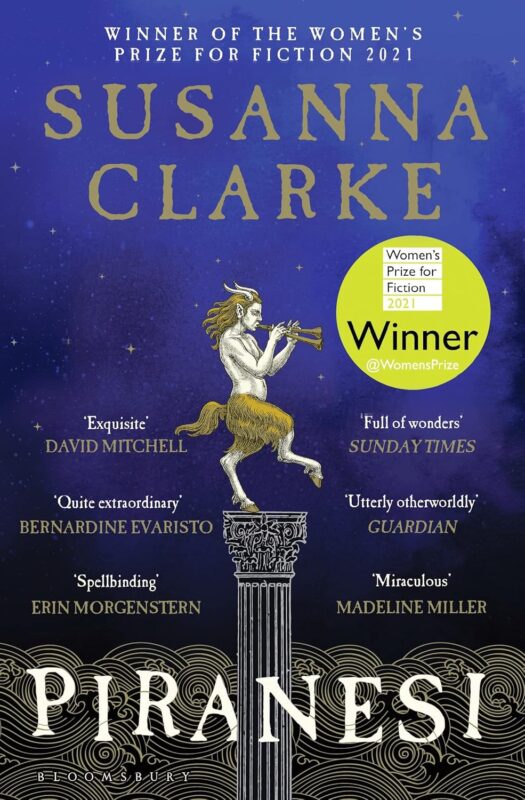
Title: Piranesi
Author: Susanna Clarke
Published: 2020
Pages: 272
Structure: Journal entries in seven parts
Imagine a world which consists of one seemingly infinite house, endless halls filled with statues, an ocean whose tides flood the lower floors, clouds in the upper halls, only two living people, and thirteen sets of human remains. We encounter this world through the journals of Piranesi, an intelligent man who remembers nothing of any life outside the House.
This review contains some spoilers.
The opening pages of this book disorient the reader.
Because it’s written as a journal, we experience the House as Piranesi describes it to us. There’s no outside narrator patiently explaining things. We have to think hard in order to get our bearings.
ENTRY FOR THE FIRST DAY OF THE FIFTH MONTH IN THE YEAR THE ALBATROSS CAME TO THE SOUTH-WESTERN HALLS
When the Moon rose in the Third Northern Hall I went to the Ninth Vestibule to witness the joining of three Tides. This is something that happens only once every eight years.
Some readers might put the book down at this point, shake their heads, and look for something simpler. But that would be a mistake. The beauty of this story is the way it unfolds before our eyes. We read Piranesi’s thoughts, see this strange world through his eyes, and understand him a little better.
I believe this is why reading fiction helps us grow into better humans. It teaches us to see the world from someone else’s point of view. Things that might not normally make sense to us take on new meaning when we experience them from another person’s perspective.
Our immediate reaction might be to pity this poor prisoner in his strange world, but he tells us, “The Beauty of the House is immeasurable; its Kindness infinite”. He loves this place, he’s curious about it, and he tells us, “I am determined to explore as much of the World as I can in my lifetime”. I admired Piranesi’s earnest sincerity.
And there’s much to admire in the way he lives. He carefully observes the tides, the birds, the fish and the thousands of statues that fill the House. He records his discoveries, makes plans for further exploration, and finds pleasure in the smallest things. His world is incredibly restricted, yet he seems to find it endlessly fascinating.
Piranesi calls the second major character “The Other”, whom he treats with respect and deference. The Other seems to know things that he is not willing to disclose. He has enlisted Piranesi’s help to find a “Great and Secret Knowledge” in the House that will grant enormous power to the one who discovers it. But in his innocence, Piranesi has no idea why anyone would need such power in his world.
There are thirteen people who have died. Piranesi tends their skeletal remains and has named them affectionately: “Biscuit-Box Man”, “Concealed Person”, and “People of the Alcove”. He brings them offerings of food, water and flowers, and takes care to protect their remains. Although they are dead, he feels responsible for them. He therefore confidently asserts that there are fifteen people in the whole world, counting himself and the Other, and wonders if more people exist.
There’s a delightful section where he is in a room full of statues and has an overwhelming thought:
I almost forgot to breathe. For a moment I had an inkling of what it might be like if instead of two people in the World there were thousands.
And so he wonders: might there be a sixteenth person?
He discusses this hypothetical person, whom they call “16”, with the Other, who warns him that 16 is dangerous, malicious, and might cause Piranesi to become insane if he contacts them. The Other suggests that he might have to kill Piranesi if he becomes insane, supposedly for his own good. At this point, we are able to see what Piranesi can’t: the Other is malicious and self-serving. Unlike the hypothetical “16”, he is a real danger.
At this point, the author does something magical. Just as we have learned about Piranesi by reading his journals, so he learns about himself by reading his older journal entries. He discovers strange entries that refer to unintelligible (for him) dates such as 2011, places such as Battersea Park, and people such as Valentine Ketterley, Matthew Rose Sorensen, and Laurence Arne-Sayles.
At first, he fears he has gone insane as the Other warned, but eventually realises that there are many things he has forgotten, and that the Other has not been telling him the truth.
This conflict forced me to ask: am I in a similar situation? Do I get my view of the world from sources I trust, but which may not have my best interests at heart? If so, how do I, like Piranesi, discover the truth?
But it also raises a deeper issue. The reader discovers that Piranesi was originally deceived into entering the House and then trapped there, although he does not remember it. Our impulse is to view him as a prisoner who needs to be freed. But he loves the House. When he is ultimately given the choice, he is unsure whether he really wants to leave.
And we can understand why. Although his presence in the House is the result of another person’s deception, his love for it is genuine. He has discovered beauty, purpose and contentment there. His experience in the House has changed who Piranesi is and what he values. Even when he returns to the outside world, he is no longer quite the person he was before.
There’s another contrast here that I found interesting. The Other wants to discover the secrets of the House in order to acquire power. Piranesi simply wants to understand it and appreciate its beauty. He has no ambition to dominate it. I wonder how much of the beauty in our own world we miss because we are too occupied with trying to possess or control it.
And this has implications for our own experience.
We also are shaped by our experiences, including the injustices and deceptions that are imposed upon us by an indifferent society. From another perspective, someone might argue that we are imprisoned by our circumstances and that we face difficulties we never chose. And yet we love our world and appreciate its beauty.
Piranesi has been deceived, exploited and deprived of his former life. Yet he remains curious, kind and grateful for the beauty around him. His kindness extends even to those who have wronged him.
When we’re looking at Piranesi trying to make sense of the world, we see ourselves.
Perhaps that’s why he is such a compelling character, and why we care about what happens to him.
This is a short book. Plunge in enthusiastically. Embrace the strangeness; it is worth the reward.
I’m glad I read it.