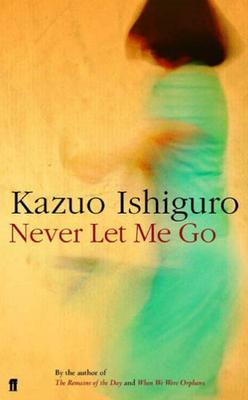
Title: Never Let Me Go
Author: Kazuo Ishiguro
Published: 2005
Pages: 288
Structure: 23 chapters in three parts
*Never Let Me Go* is an intimate but striking novel about children growing up in a dystopian alternative reality. I loved the way it forced me to think about why we tolerate being exploited, and why we often turn a blind eye to the suffering of others.
This review contains some spoilers.
The story is narrated by “Kathy H”, who recalls her childhood at *Hailsham*, a secluded English boarding school. Kathy’s soft-spoken style has a compelling sweetness to it. She’s warm and caring without being naive. But she doesn’t do us any favours: there’s very little explanation of her world or the terms she uses in strange ways, such as “donors”, “guardians”, and “completing”. We have to figure it out as we go along, which sets us up for some surprises later on.
I don’t know how it was where you were, but at Hailsham we had to have some form of medical almost every week—usually up in Room 18 at the very top of the house—with stern Nurse Trisha, or Crow Face, as we called her.
Although it seems strange to us, the children enjoy their “privileged” but secluded lifestyle, and are grateful for it. They believe unusual things about the school, without question. For example, there’s a frightening story about a boy who ventured beyond the school boundaries and was later found “tied to a tree with the hands and feet chopped off”. They believe that the best examples of the artwork they create might be taken to a mysterious “Gallery”, although they don’t know why. And they know that none of them “could have babies”.
We certainly knew—though not in any deep sense—that we were different from our guardians, and also from the normal people outside; we perhaps even knew that a long way down the line there were donations waiting for us.
Much of Kathy’s story concerns her childhood friendships, particularly with Ruth and Tommy. Ruth is a strong-willed girl who can be possessive and sometimes cruel. Tommy is a sensitive boy who is bullied by the other children because of his temper and his lack of artistic talent. Kathy notices his suffering and tries to understand him. The relationships between these three children are complicated. They hurt one another, they quarrel, and they make up. But they also care deeply about one another.
Throughout the novel, Ishiguro slowly builds a feeling of uneasiness in the reader until we are worried for the safety of the children. As I read it, I found myself thinking, “When are they going to run? How will they escape?” This is how we often see dystopian stories: the protagonist is in a terrible situation, they fight the system, and they either succeed or fail. And in some small way, our sense of justice is preserved because at least someone did something about “the system”.
But this doesn’t happen. The power of this story isn’t in how people overcome a terrible situation, but why they remain in it. It shocks us because we identify with the children, and we think, “If I was in that situation, I’d resist”. And Ishiguro is quietly asking us, “But what if you couldn’t see it? What if the status quo was all you had ever known? What if you weren’t aware of the boundaries that society had placed around you?”
The children know something about their fate, but they don’t fully understand it. And by the time they do, they have already accepted it as a normal part of life.
And the shocking thing is that when we ask this about ourselves, we’re forced to admit we’d probably do the same thing. What harmful things do we accept every day without question?
But there are beneficiaries of this system whose lives are enriched at the cost of others. And the other disturbing question the novel forces us to face is whether we are reaping benefits from someone else’s suffering. And of course we are. Our lives depend on myriad things whose origins we rarely question: for example, the minerals in our phone batteries or clothing produced in factories where workers are exploited. It’s almost impossible for us to avoid these situations. And, like the beneficiaries in the novel, we often turn a blind eye.
In some ways, the message of this story is very similar to The Trial, by Franz Kafka, where the protagonist suffers under an unjust system, struggles to understand it, but ultimately submits to its authority.
But this story shines in a way that *The Trial* does not. It demonstrates that even a short and oppressed life can be beautiful.
As Kathy, Ruth and Tommy grow older, their relationships become even more moving. Ruth comes to recognise that her jealousy has caused pain to the people she loves, and tries to make amends. Kathy becomes a carer for both Ruth and Tommy as they approach the end of their lives. Despite their troubled history, there is tenderness and forgiveness between them. They cannot escape their fate, but they can still love one another, and find some happiness in the time they have left.
Our world is full of outrage at injustice, and this is a good thing. But Ishiguro reminds us that even in an oppressive world, kindness can make life beautiful. These children have so little control over their lives, yet they still have something precious to give one another.
And that gives me hope.
*Never Let Me Go* is easy to read, reasonably short, and well worth your time. I am glad I read it.